

There's a surprising number of teams thattreat brand reputation management like fire insurance. You set up Google Alerts, claim your G2 profile, and wait for something to go wrong.
That worked when reputation lived in three places: Google's first page, a handful of review sites, and the occasional press mention. In 2026, it also lives in ChatGPT's response to "is [your company] any good," in LinkedIn comments under your founder's last post, and in AI Overviews distilling your G2 reviews into a single sentence before a buyer ever clicks through.
According to brand reputation data from PwC's 2025 CEO survey, 84% of global CEOs now rank reputation risk as their top external threat, ahead of cyber and regulatory risk for the first time. Only 17% of companies have a formal program to manage it.
That gap is the problem this article addresses.
TL;DR:
- 84% of CEOs rank reputation as their top external threat; only 17% have a formal program to manage it
- 95% of buyers read reviews before purchasing, making reputation a direct conversion variable
- Strong reputation can drive up to a 25% valuation premium (World Economic Forum)
- Personal LinkedIn profiles now generate 561% more reach than company pages, which means brand reputation increasingly lives in your team's profiles
- The 2026 playbook: monitor across AI surfaces, activate your team's profiles, respond within 7 days, measure with revenue-linked KPIs
What Brand Reputation Management Is in 2026
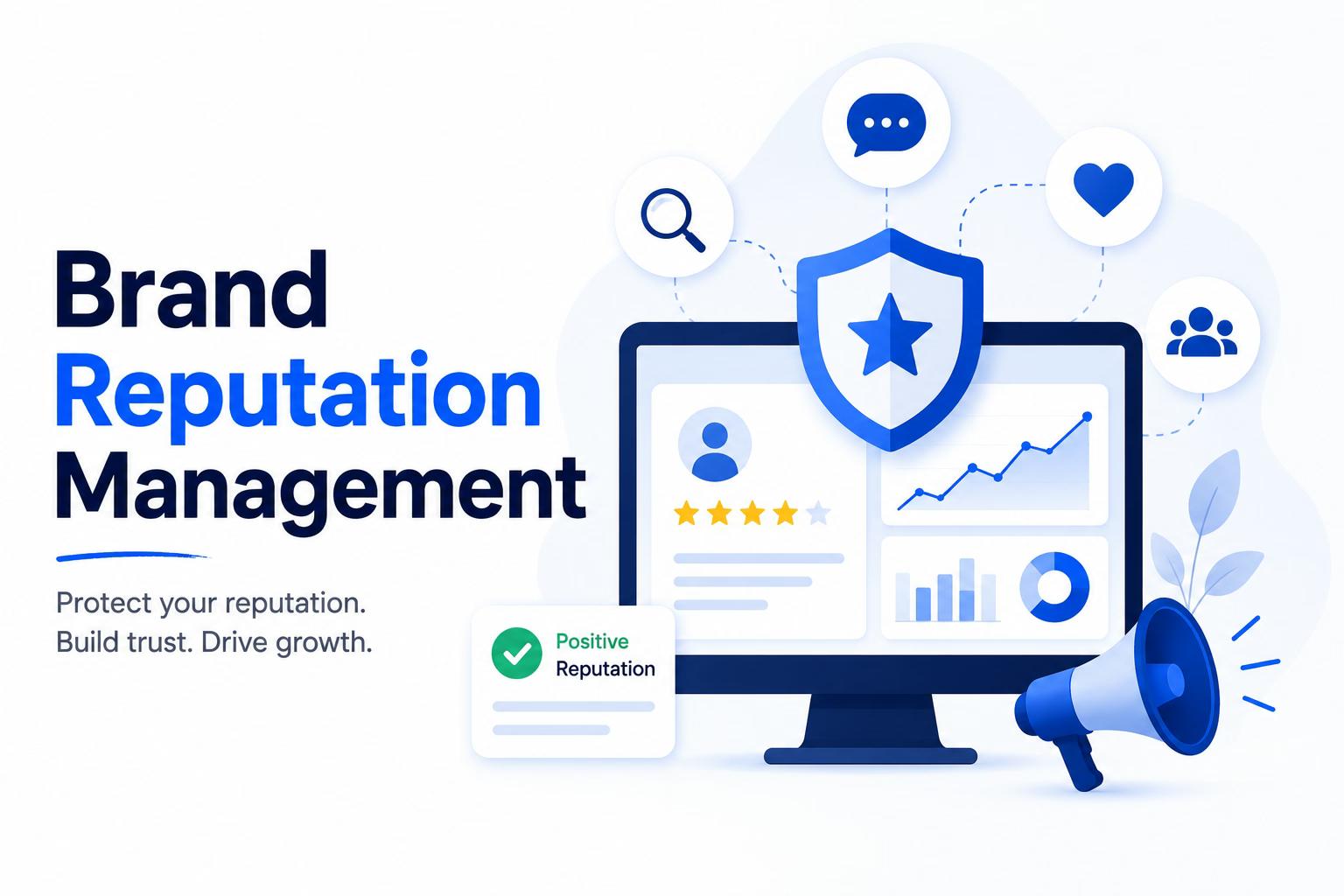
Brand reputation management is the continuous practice of monitoring, building, and protecting how your company is perceived across search engines, social platforms, review sites, and AI tools like ChatGPT and Perplexity. It's a measurable marketing function, not a PR or legal one, and in 2026 it spans three distinct layers: search reputation, social reputation, and AI surface reputation.
The search layer is what most teams already know: Google rankings, G2 profiles, press coverage.
The social layer is messier: LinkedIn comments, Reddit threads, Discord servers where buyers talk candidly about your category.
The AI layer is new and largely unmanaged: when someone asks ChatGPT whether your product is worth buying, the answer gets assembled from your G2 reviews, your LinkedIn content, and whatever your competitors have published about your space.
Organizationally, this sits in marketing. Not legal, not comms, not a PR agency on retainer.
Those functions play supporting roles in a crisis, but day-to-day reputation is a content and distribution problem, which means it's also a tooling problem. Legacy social schedulers like Buffer, Hootsuite, and Sprout were built in an Instagram-centric, push-only world. They weren't designed for the collaboration workflows, exec approvals, and AI-native distribution that serious B2B reputation work requires in 2026.
Bottom line: If your team isn't actively shaping what ends up in AI summaries and LinkedIn feeds, someone else is doing it for you.
Why it matters: the business case for reputation
Brand reputation management matters because it directly affects revenue, valuation, and talent acquisition — not just perception. According to digital reputation research from InMoment (2025), nearly 95% of consumers read online reviews before making a purchase. For B2B SaaS, that means a buyer has already formed an opinion before your SDR sends the first email.
The valuation angle is just as compelling, especially for founders and heads of marketing justifying budget to a board. Companies with strong reputations can command up to a 25% higher valuation than peers because investors explicitly price in public perception (World Economic Forum, via brand reputation data, 2025). Weak reputation shows up as higher CAC, slower deal cycles, and harder recruiting — all of which compound over time.
The 4 pillars of modern brand reputation management
1. Monitor: where your brand lives now
Traditional monitoring covered Google Alerts and occasional G2 checks. That's still necessary, but no longer sufficient. Social surfaces (LinkedIn comments, X threads, Reddit posts in your category subreddit) are where buyers form unfiltered opinions. And AI surfaces are where those opinions get synthesized and served back at scale.
Track mentions weekly at minimum.
For AI surfaces specifically, run manual queries in ChatGPT, Perplexity, and Google AI Overviews every month. Search for "[your brand] vs [competitor]," "is [your brand] worth it," and your primary category keywords. What you find is your current AI reputation. It's often different from what your marketing team thinks it is.
The teams pulling ahead here are wiring their own social data into AI assistants directly. With an MCP-connected social platform, Claude or ChatGPT can pull your historical post performance, your team's top-engaging content, and competitor mention patterns into a single query, turning monthly manual checks into a continuous monitoring layer.
2. Build: proactive reputation creation
The most durable reputation asset in 2026 is founder-led and exec-led LinkedIn content. Personal profiles now generate more reach than company pages (see the full breakdown on company page reach), which means your brand reputation increasingly lives in your team's profiles, not your company account. Only 1% of LinkedIn users post weekly, yet that group generates 9 billion impressions per week (the bar to stand out is still surprisingly low).
Employee advocacy is the systematic version of this.
When your team shares content, adds commentary, and engages publicly with your category, they create a distributed reputation layer that no competitor can easily replicate. See how teams are building this at scale in our guide to employee advocacy platforms. Clay grew their LinkedIn following from 8,000 to 120,000 in a year by activating a 25-person advocacy program read how Clay scaled that engine).
Zapier takes a different angle on the same problem: their team uses MCP-connected AI to draft exec posts in each leader's specific tone of voice, pulling from past top-performing content, and ties the resulting reach back to attributed pipeline through a custom dashboard built on top of their social platform's data.
Two reputation levers most teams under-use:
a. Auto-engagement on your own posts. When a founder publishes a launch post, the first ten minutes of engagement signal the algorithm and shape who sees it next. Coordinating that manually across a 20-person team in Slack rarely happens reliably.
Productizing it is the difference between a post that lands and a post that doesn't.
b. Approval workflows for exec accounts. Exec voices are some of your highest-leverage reputation assets, which means they're also the highest-risk. Blocking approvals, inline comments, and version history aren't nice-to-haves — they're what makes it safe for a CEO to publish weekly.
Owned media like case studies, blog posts, original research matter because AI models cite it.
A well-structured case study with specific outcomes is far more likely to appear in an AI-generated summary than a generic product page. Our personal branding guide covers how B2B founders can build that citable content layer systematically. And for why LinkedIn content now feeds Google rankings directly, see our guide to LinkedIn SEO impact.
3. Respond: the 7-day rule
According to reputation management statistics from ReviewTrackers, 53% of customers expect a review response within one week, and 63% say a business has never responded to their review at all. That gap is both a reputational risk and an easy win. A thoughtful response to a negative G2 review, visible to every future buyer who reads it, does more reputation work than a press release.
Set a 7-day SLA for review responses. For social mentions, prioritize anything with meaningful reach or a direct product complaint. When you do respond, be specific about what you're fixing (vague apologies erode trust faster than silence).
The operational unlock for hitting that SLA consistently is consolidating notifications. If your team is chasing G2 emails, LinkedIn notifications, X mentions, and Reddit alerts across five tabs, things get missed.
A unified Slack channel that pings the right person the moment a mention or response is needed turns SLA compliance from a discipline problem into a routing problem.
4. Measure: KPIs that matter
Vanity metrics (total mentions, follower count) tell you almost nothing about reputation health. Worth tracking: share of voice versus named competitors, sentiment trend over rolling 90-day windows, review response rate with a 7-day target, and AI citation rate. That last one means manually tracking how often AI tools mention your brand for category-relevant queries and whether the framing is positive, neutral, or negative.
One metric most teams ignore: earned media value (EMV) on organic social. Calculating what it would have cost in LinkedIn ads to drive the same impressions your team's organic posts generated gives you a defensible number for board decks, and a way to attribute reputation work back to revenue.
For a complete LinkedIn measurement framework, see our guide on how to track LinkedIn metrics that connect to revenue.
Final Thoughts
The 84%/17% gap in this article is the real opportunity. Most of your competitors know reputation matters. Almost none of them have built a system to manage it.
Three things worth doing this week: run your brand name through ChatGPT and Perplexity and read what comes back, pick three team members to activate on LinkedIn using the guidance in our track LinkedIn metrics framework, and set a 7-day SLA for review responses before the next one goes unanswered for a month.
If your team needs a faster path to consistent LinkedIn presence — the engine that feeds both social reputation and AI citation — LinkedIn content management with Ordinal handles scheduling, advocacy coordination, auto-engagement, and analytics in one place, with an open MCP and API so your AI tools can read and write into the same system your social team works in.
Reputation compounds. Start the program before you need it.
Frequently Asked Questions
What is brand reputation management?
Brand reputation management is the continuous practice of monitoring, building, and protecting how your company is perceived across search engines, review sites, social platforms, and AI tools like ChatGPT and Perplexity. It's a measurable marketing function, not a PR or legal one. Modern programs cover both proactive reputation building (content, advocacy, reviews) and reactive response (crisis comms, review replies).
Why is brand reputation management important in 2026?
According to PwC's 2025 CEO Survey, 84% of global CEOs now rank reputation risk as their top external threat, and 95% of buyers read reviews before purchasing (InMoment, 2025). Strong reputation can drive up to a 25% valuation premium, per WEF research. The additional pressure in 2026 is AI search: a single AI-generated summary can shape buyer perception before anyone visits your site.
What's the difference between brand reputation and corporate reputation?
Brand reputation focuses on how customers and prospects perceive your product and company. Corporate reputation is broader, covering investor sentiment, regulatory standing, and employee perception. For B2B SaaS companies, the two overlap heavily because buyers, investors, and recruits often come from the same talent pool and read the same sources.
How much does brand reputation management cost?
Early-stage startups can run a basic program with free tools like Google Alerts and native social analytics. Growth-stage companies typically spend $2,000–$10,000 per month on monitoring tools, content production, and employee advocacy infrastructure. Enterprise programs with dedicated headcount and crisis retainers range from $100,000 to $500,000+ annually.
How do you measure brand reputation management?
Track share of voice against competitors, sentiment trend over time, review response rate (target: under 7 days), AI citation rate, earned media value on organic social, and conversion lift from branded organic search. Total mention volume without sentiment context is a vanity metric. For LinkedIn specifically, engagement rate and share of voice among your ICP are the metrics worth tracking.
See our guide on how to track LinkedIn metrics that connect to revenue.
How long does it take to build a strong brand reputation?
Crisis response can show measurable results in days. Proactive reputation building through content, advocacy, and review programs typically takes 6–12 months to produce meaningful share-of-voice and sentiment shifts. Founder-led and exec-led LinkedIn content compounds fastest: personal profiles drive 561% more reach than company pages, so consistent posting moves the needle faster than most other tactics.
How do you handle a brand reputation crisis?
Within the first 24 hours: assess the scope, align internally on facts and tone, and issue a holding statement if needed. In the first week, respond on the channels where the conversation is happening (not just where it started), correct misinformation publicly, and document what you're changing. After 30 days, measure sentiment recovery and update your crisis playbook with what you learned.
Related Posts
Looking to learn more? The below posts may be helpful for you to learn more about social media and content marketing.