

If your LinkedIn company page reach has tanked over the past two years, you're seeing the same pattern everyone else is. The brands winning on LinkedIn in 2026 aren't waiting for the algorithm to change back. They're using strategies that work right now, and that's exactly what we're covering in this guide. Whether you're leading a marketing team, building your personal brand as a consultant, or positioning yourself as an industry expert, these insights apply to anyone trying to reach their audience on LinkedIn.
TLDR:
- LinkedIn company page reach dropped 60-66% since 2024, while personal profiles now get 561% more reach
- The first 60 minutes after posting determines your reach - coordinate team engagement immediately
- Employee advocacy generates 30% of total company engagement despite only 3% of employees sharing
- Ordinal automates employee advocacy with auto-reposts, Slack alerts, and approval workflows at scale
Company Page Reach Has Dropped 60% Since 2024
If your LinkedIn company page feels like it's shouting into a void, you're not imagining things. Organic reach for company pages plummeted between 60% and 66% from 2024 to early 2026, according to recent platform analysis data.
This isn't a temporary dip or seasonal fluctuation. LinkedIn has fundamentally restructured how it distributes company content in user feeds. The same post that reached 10,000 people in 2024 now struggles to hit 4,000 impressions, even with an identical follower count.
For teams who spent years building company page audiences, this shift feels like a gut punch. But here's a different way to look at it: LinkedIn is forcing us to evolve beyond broadcast-style company posts.
The brands winning on LinkedIn in 2026 aren't mourning their company page metrics. They're redirecting energy toward strategies that actually work under the new algorithm.
Why Personal Profiles Now Reach 561% More People Than Company Pages
The gap between personal and company page performance isn't just wide. It's a chasm. Personal profiles generate 561% more reach than company pages when sharing the same content. That's not a typo.
When you break down the numbers further, the story becomes even clearer:
- Personal LinkedIn profiles drive 2.75x more impressions and 5x more engagement compared to company profiles posting identical content
- Employee networks are 10× larger in aggregate than company follower lists
- Posts by employees are 2× more likely to be engaged with than those by brand pages
- Even founder profiles with 98% fewer followers than a company page can match or exceed its engagement
A Refine Labs study found that employee posts generated 2.75× more impressions and 5× more engagement than the company page, despite 46% fewer followers. These differences aren't marginal—they're structural and compounding.
Why the massive gap?
LinkedIn makes money when users spend time on the network. People engage more with posts from other people than with content from faceless company accounts. Individual profiles spark conversations, debates, and genuine interactions. Company pages tend to broadcast announcements that users scroll past.
LinkedIn's algorithm reflects this reality. When a personal profile shares a post, it appears higher in connections' feeds, gets tested with a larger initial audience, and receives more algorithmic amplification if engagement picks up quickly. Company page posts start with a smaller test audience and face higher thresholds to break out of that initial group.
Trust translates to business outcomes
Decision-makers prefer content from real people. According to Edelman and LinkedIn studies, thought leadership shared by individuals is viewed as significantly more credible than official brand communication. Trust in personal content is 3× higher than in brand-published material.
This credibility advantage drives measurable pipeline impact:
- IBM found that leads sourced via employee content convert 7× more often than those from paid channels
- Engagement with a team member's content often serves as a "dark social" pre-touch before conversion
In SaaS, where trust is critical and cycles are long, this advantage is both qualitative and quantifiable.
The strategic imperative: Your company's LinkedIn presence needs to flow through your employees' personal profiles, not just your company page. The brands maintaining visibility on LinkedIn in 2026 have embraced employee advocacy as their primary distribution channel, using company pages as a secondary amplification tool rather than the main event.
For individual professionals, consultants, and freelancers, this shift works in your favor - your personal profile already has the algorithmic advantage that companies are now scrambling to access through their teams.
The First 60 Minutes Determines Whether Your Company Posts Live or Die
LinkedIn's algorithm operates on a brutal testing model. When you publish a company page post, it initially shows that content to just 2-5% of your followers. This first hour acts as a trial run where the algorithm measures engagement velocity: likes per minute, comments per impression, and how quickly you respond to interactions.
If your post gains momentum during this window, LinkedIn expands distribution to a larger audience segment. If engagement stalls, your post gets buried in feeds and never recovers. There's no second chance.
The math is unforgiving. A company page with 10,000 followers might see its post shown to only 200-500 people initially. You need engagement from that tiny group to unlock reach beyond that test audience.
Here's what actually works: publish when your core audience is active on LinkedIn, typically Tuesday through Thursday between 8-10 AM in your primary timezone. Coordinate with your team through Slack channels the moment a post goes live, sending alerts so teammates can engage immediately.
Most critically, respond to every comment within 15 minutes. When the original poster replies quickly, LinkedIn interprets this as valuable conversation worth amplifying. That signal matters more than comment volume alone.
These tactical optimizations help, but they're fighting against a fundamental shift in LinkedIn's feed architecture.
Company Pages Now Represent Just 1-2% of User Feeds
Company pages now account for just 1-2% of content appearing in typical user feeds, while personal profiles dominate 65% of what people actually see and consume. This isn't accidental. LinkedIn deliberately restructured its feed architecture to prioritize human-to-human connections over corporate broadcasting.
The rationale makes sense from LinkedIn's perspective. Users open the app to learn from peers, discover job opportunities, and build professional relationships. Corporate announcements don't drive the daily engagement that keeps people returning to the network.
Does this mean you should abandon your company page? No. But it does mean rethinking how you allocate team time and creative resources.
Company pages still deliver value for specific use cases. They establish legitimacy when prospects research your brand. They serve as a content repository for recruiting efforts. They provide a place to showcase major announcements, awards, and milestone content that employees can then reshare from their personal profiles.
The key shift is treating your company page as infrastructure rather than your primary distribution channel. Build it properly, maintain it consistently, but invest your best content creation energy into employee profiles that actually reach your target audience.
One common misconception holds teams back from maximizing even the limited company page reach they still have.
Do External Links Hurt LinkedIn Company Page Reach in 2026?
For years, marketers have warned that adding external links to LinkedIn posts can hurt reach. Some early reports even claimed LinkedIn’s algorithm treats outbound links like kryptonite - resulting in fewer likes, comments, and shares.
That belief has persisted, but it’s not entirely accurate anymore.
According to LinkedIn’s Senior Director of Product Management,Rishi Jobanputra, LinkedIn does not intentionally limit the reach of posts simply because they include external links. The algorithm isn’t designed to “punish” links by default.
However, context matters.
If a post leads with value for the reader - insights, education, or a strong point of view - then including an external link is perfectly fine. On the other hand, posts that exist primarily to drive traffic off LinkedIn (with little standalone value) may see weaker performance.
In short:
- Links aren’t the problem.
- Low-value, click-first posts are.
If you want a deeper breakdown of how LinkedIn’s algorithm evaluates content in 2026 - and how to share links without sacrificing reach - check out our full blog post.
With company pages representing such a small fraction of user feeds, the real distribution power lies elsewhere: your employees' networks.
Employee Advocacy Drives 30% of Total Company Engagement
Employees amplify company content more effectively than any paid promotion strategy. While only 3% of employees share content about their company, those shares generate roughly 30% of total engagement on company posts.
The multiplier effect explains why. When an employee shares your company page post, it reaches their personal network with the credibility of a peer recommendation rather than a corporate advertisement. Their connections engage at higher rates because the content comes from a trusted individual, not a brand account.
But most employee advocacy programs fail because they feel forced. Employees ignore Slack messages asking them to share the latest product announcement. They skip past company content in their feed because resharing feels like unpaid marketing work. The solution isn't better reminders or more pressure - it's removing friction entirely.
Building Employee Advocacy Programs That Actually Scale
Identify natural advocates:
- Start with employees who already engage with industry content organically
- Look for team members across sales, customer success, and product who regularly post about their work or industry trends
- Natural sharers make better advocates than executives who feel obligated to participate
Create content that serves personal brands first:
- Content should make employees look smart to their network: actionable insights, contrarian takes, behind-the-scenes strategy breakdowns
- If you're building your own personal brand, share insights that add value, not just self-promotional content
- Most advocacy programs fail because they ask employees to reshare generic company announcements
- If a post helps someone's professional reputation, they'll share it willingly
Make participation effortless and optional:
- Automatically reshare company content from executive profiles
- Coordinate early engagement from team accounts without manual effort
- Alert employees when content goes live with one-click access to engage if the topic resonates with them personally
- Use approval workflows so employees can review and edit company-drafted posts before they go live from their profiles
- Give them autonomy to opt in or out of specific content based on what resonates with their audience
- Track how many sales conversations start from employee post engagement, not just impression counts
- Export the list of people who interact with employee content and route qualified prospects to your sales team
- That connection between social activity and pipeline proves advocacy's business value beyond reach metrics
How Ordinal Turns Every Team Member Into a Content Amplifier
Ordinal was built to solve exactly this coordination problem. The reality is that employee advocacy only works when it's automated enough to be sustainable.
Our approach removes the manual overhead that kills most advocacy programs. When your company page publishes content, our system, with its LinkedIn-first features, handles the orchestration: Slack channels get instant alerts with one-click engagement access, executive profiles automatically reshare posts at optimal times through Auto Repost, and Auto Likes coordinate early engagement signals without requiring anyone to remember.
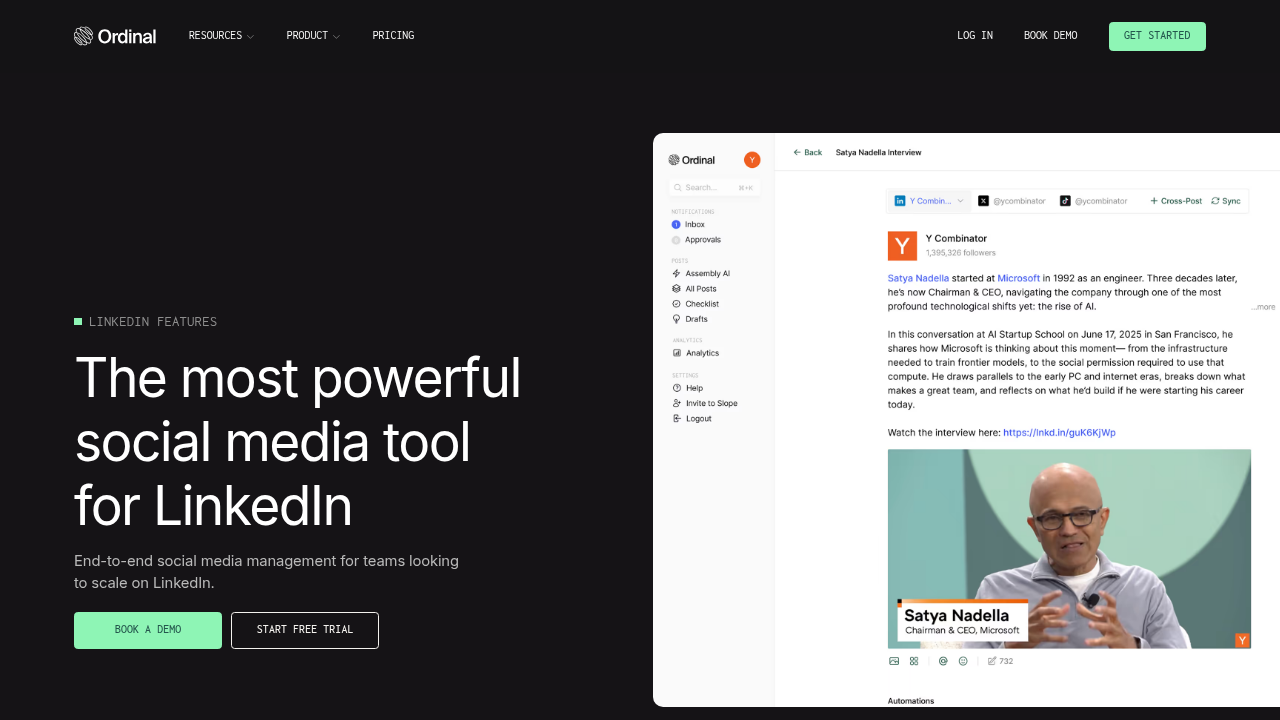
The approval workflows ensure brand safety while distributing content creation across your team. Draft posts get routed to the right reviewers, changes happen inline with comments, and nothing goes live until it's approved.
This systematic amplification is how teams maintain LinkedIn visibility in 2026. You're essentially multiplying every company post by the combined reach of employee profiles, all coordinated through one calendar and content editor.
Key features:
- Content calendar for employee posts – Coordinate posting schedules across your entire team from one visual calendar. Maintain consistent presence without overwhelming individual feeds or creating scheduling conflicts between team members.
- Cross-posting efficiency – Adapt a single piece of content for multiple employee accounts with one-click distribution. Ordinal automatically adjusts formatting while preserving each person's authentic voice.
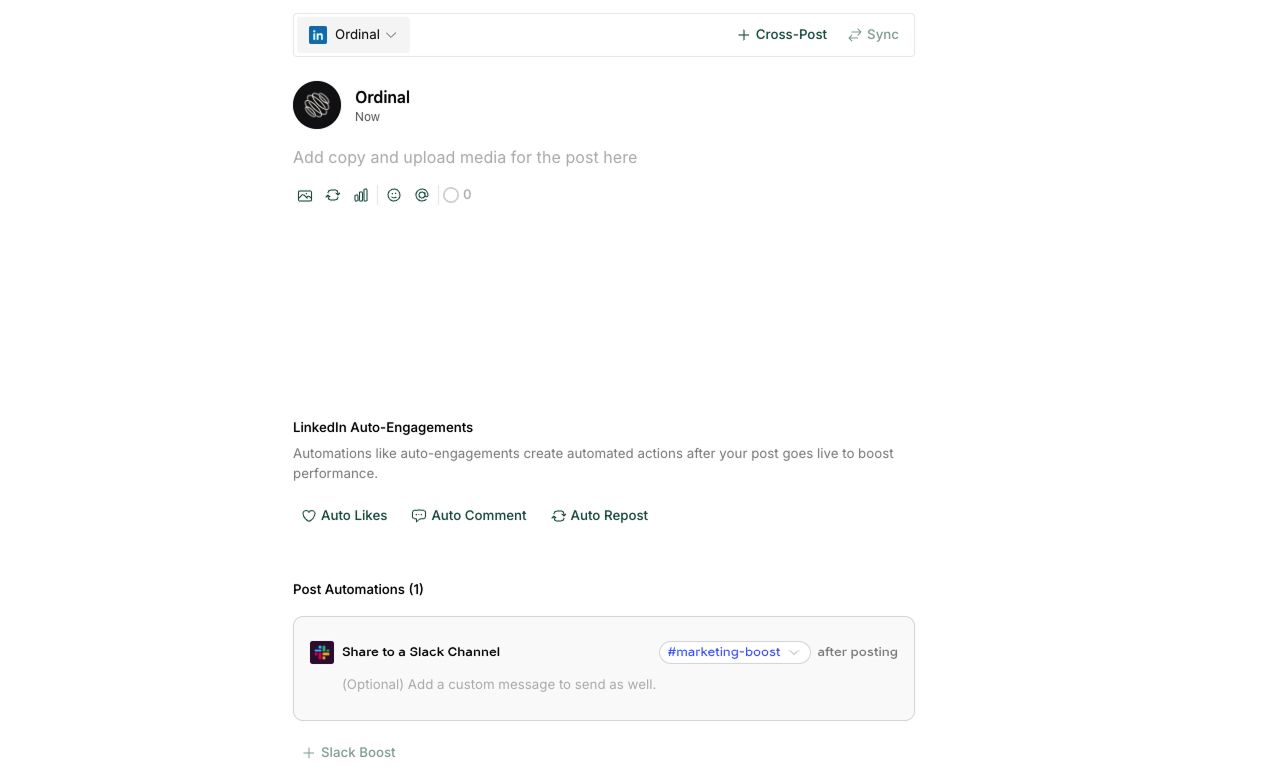
- Realistic post previews – See exactly how each post will appear on LinkedIn before it goes live. Sales leaders and product managers can review the exact in-feed appearance across different employee profiles.
- Approval workflows – Route content through approvers via Slack notifications and schedule posts across dozens of employee accounts from one dashboard. Maintain brand consistency without creating bottlenecks.
- Auto-engagement features – Coordinate early engagement signals automatically. Trigger likes from leadership accounts, post pre-written first comments, and auto-repost from executive profiles to signal content quality to the algorithm.
- Multi-account management at scale – Connect and manage unlimited employee LinkedIn profiles, company pages, and personal accounts from one dashboard. No switching logins or juggling multiple tools.
- Slack boost notifications – Alert your team in Slack the moment employee posts go live. Prompt immediate engagement from colleagues to trigger algorithmic momentum during the critical first hour.
Final Thoughts on Maintaining LinkedIn Visibility
The declining LinkedIn reach for company pages forces a strategic shift toward employee advocacy as your primary distribution channel. Company pages become a supporting infrastructure while personal profiles carry your message to actual audiences. Coordination at scale requires automation, which is exactly what Ordinal handles. Your content gets amplified across employee networks without the manual overhead that kills most advocacy programs. The brands that maintain visibility on LinkedIn in 2026 won't be the ones with the biggest company page followings - they'll be the ones who turned their employees into a coordinated content distribution network.
FAQ
Why did my LinkedIn company page reach drop so dramatically in 2025?
LinkedIn restructured its algorithm to prioritize personal profiles over company pages, resulting in a 60-66% drop in organic reach for company content between 2024 and 2026. The platform now shows company page posts to only 2-5% of followers initially, while personal profiles receive significantly better distribution because they drive more user engagement and time spent on the network.
How much more reach do personal profiles get compared to company pages?
Personal LinkedIn profiles generate 561% more reach than company pages when sharing identical content. They also drive 2.75x more impressions and 5x more engagement, even when the personal profile has fewer followers than the company page.
What should I do in the first 60 minutes after publishing a company page post?
Respond to every comment within 15 minutes and coordinate immediate engagement from your team through Slack alerts. LinkedIn's algorithm tests your post with just 2-5% of followers during this window, and strong engagement velocity (likes per minute, quick comment responses) determines whether your post gets expanded distribution or dies in the feed.
Should I stop posting external links on LinkedIn to improve reach?
No. LinkedIn's Senior Director of Product Management confirmed the platform doesn't intentionally limit reach for posts with external links. The key is providing standalone value in your post first—insights, education, or a strong perspective—rather than creating posts that exist solely to drive clicks off-platform.
How can I get employees to share company content without it feeling forced?
Create content that serves their personal brand first and your company second—actionable insights, contrarian takes, or strategy breakdowns that make them look smart to their network. Make participation optional and effortless through automated resharing, one-click engagement alerts, and approval workflows that let employees review and edit posts before they go live from their profiles.
Related Posts
Looking to learn more? The below posts may be helpful for you to learn more about social media and content marketing.