


Long gone are the days of relying solely on corporate social accounts with limited reach. Employee advocacy platforms help B2B teams multiply their social presence by turning employees into content distributors on their personal networks. The difference between tools comes down to workflow sophistication. Basic platforms give you a content library where people reshare posts. Advanced solutions let you draft thought leadership for executives and coordinate team engagement to boost algorithmic reach. Here, we take a look at the best employee advocacy platforms for B2B companies in 2025. Let's dive in!
TLDR:
- Employee advocacy turns your team into brand ambassadors, extending reach beyond corporate accounts
- Auto-engagement features like coordinated likes and scheduled comments boost algorithmic visibility
- Posts shared by employees receive 8x more engagement than company account content
- Ordinal combines content creation, approval workflows, and engagement analytics in one platform
What is Employee Advocacy Software?
Employee advocacy software helps B2B companies extend their social media reach by enabling employees to share company content on their personal social networks. Instead of relying solely on corporate accounts with limited followers, these tools empower your workforce to become brand ambassadors who amplify your message to their own professional audiences.
The core value proposition: your employees' combined networks are exponentially larger than your company's official channels. When a sales rep shares a product update on LinkedIn or a marketer posts about a new case study, that content reaches audiences who might never see your corporate page.
These solutions typically provide a content library where marketing teams curate shareable posts, making it easy for employees to distribute pre-approved messages with a single click. Most include scheduling capabilities, performance analytics, and gamification features to encourage participation across teams.
For B2B organizations, employee advocacy matters because professional networks like LinkedIn prioritize personal profiles over company pages in their algorithms. Teams managing multiple accounts benefit from social media management tools that coordinate content across employee networks.
When your team shares content, it appears more authentic and generates better results than traditional corporate marketing.
For teams evaluating LinkedIn ads vs organic content, employee advocacy through personal profiles often delivers better engagement than paid campaigns.
How We Ranked Employee Advocacy Solutions
We assessed each solution based on criteria that matter for B2B teams running employee advocacy programs.
- Social content scheduling capabilities – Especially for LinkedIn, where B2B engagement lives. The ability to draft, preview, and schedule posts for multiple team members from one interface matters for scale.
- Team collaboration features – Includes approval workflows, inline commenting, and notifications that keep distributed teams coordinated between marketing, sales, and leadership.
- Auto-engagement capabilities – Features like auto-likes, auto-comments, and coordinated boosting help posts gain algorithmic momentum, which directly impacts reach.
Each of these factors determines whether a platform simply distributes content or actually drives measurable business results.
Best Overall Employee Advocacy Software: Ordinal
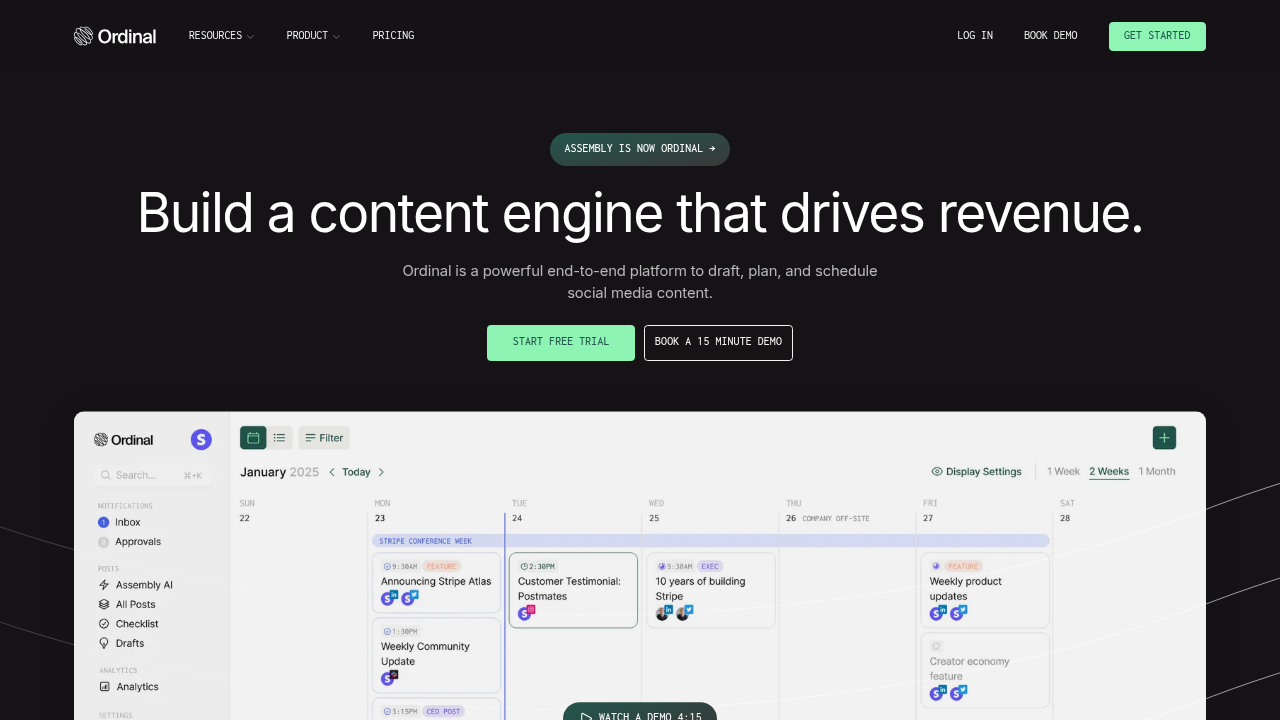
Ordinal gives B2B teams a content creation and coordination system that goes beyond content libraries, where employees reshare pre-written posts.
Key Features
- Content calendar for employee posts - Visualize and coordinate posting schedules across your entire team to maintain consistent presence without overwhelming individual feeds or creating posting conflicts.
- Cross-posting efficiency - Adapt a single piece of content for multiple employee accounts with one-click distribution, automatically adjusting formatting for each person's voice and network.
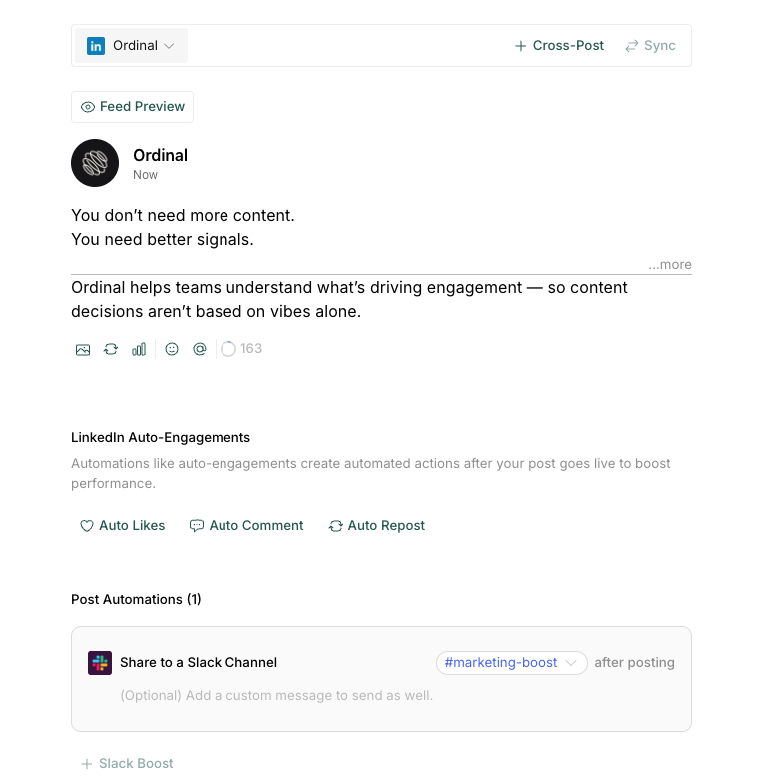
- Realistic post previews – Draft social posts for multiple team members and see exactly how each will appear on LinkedIn and other social media platforms, so sales leaders and product managers know the exact in-feed appearance.
- Approval workflows – Maintain brand consistency without bottlenecks by routing content through approvers via Slack notifications and scheduling posts across dozens of employee accounts from one dashboard.
- Auto-engagement features – Trigger likes from leadership accounts, post pre-written first comments, and auto-repost from your company page to signal to the algorithm that content deserves wider distribution.
- Multi-account management at scale - Connect and manage unlimited employee LinkedIn profiles, company pages, and personal accounts from one dashboard without switching logins or juggling multiple tools.
- Slack boost notifications - Automatically alert your team in Slack when employee posts go live, prompting immediate engagement from colleagues to trigger algorithmic momentum in the critical first hours.
Ordinal stands out as the best overall employee advocacy software because it transforms employee advocacy from a manual content-sharing task into a scalable, coordinated system that maximizes reach across your team's networks.
Sprout Social
Sprout Social is a social media management tool that spans multiple networks with built-in listening capabilities and a basic employee advocacy add-on.
Pros
- Social scheduling and publishing across major networks
- Social listening and monitoring tools to track brand mentions, competitor activity, and audience sentiment
- Basic employee advocacy module with content library where team members can find and share pre-approved posts
- Reporting dashboard for social metrics
Cons
- Prohibitive pricing and contract lock-in
- Employee advocacy treated as a separate add-on rather than a core workflow
- No LinkedIn-specific features like coordinated engagement or auto-comments that help content gain algorithmic traction
- Analytics don't identify which individual prospects engaged with posts
- Limited value for B2B teams focused on thought leadership and prospect engagement
Sprout Social works for teams handling customer service and brand reputation management across multiple social channels who need listening capabilities alongside basic advocacy features.
Hootsuite
Hootsuite is a social media management tool that includes team collaboration and employee advocacy capabilities through its Amplify add-on.
Pros
- Multi-network scheduling dashboard that covers major social channels
- Hootsuite Amplify functions as a content library where employees can access pre-approved posts to share on their personal accounts
- Team assignment workflows with approval processes for content review
- Engagement stream monitoring across connected social accounts
Cons
- Interface shows its age compared to newer social tools built for modern workflows
- No auto-engagement features like coordinated likes or scheduled comments that boost post visibility in critical first hours after publishing
- Analytics lack granular LinkedIn engagement data that identifies which prospects are showing buying signals
- Limited sales intelligence capabilities—can't route engaged prospects to the right reps or export data to CRM
For basic social scheduling and content distribution, Hootsuite works. But B2B teams focused on social selling will find gaps in collaboration features and engagement automation.
Oktopost
Oktopost serves enterprise B2B marketing teams that need social publishing combined with CRM tracking. The tool includes employee advocacy through content libraries where teams access pre-approved posts to share.
Pros
- Social publishing and scheduling for B2B marketing teams
- Content libraries for employee sharing
- CRM integrations for lead attribution
- Social analytics tied to marketing metrics
Cons
- Lacks auto-engagement features like scheduled comments or coordinated auto-likes that help B2B content gain algorithmic traction
- Collaboration experience feels less intuitive than tools built for team-based workflows
- Employee advocacy functionality remains basic compared to solutions purpose-built for content coordination
- Enterprise pricing and complexity may be overkill for smaller B2B teams
Oktopost is for enterprise-focused tool for larger B2B marketing teams with sophisticated attribution requirements. The employee advocacy capabilities exist but remain secondary to the broader social marketing suite.
CoSchedule
CoSchedule is a marketing calendar tool with social scheduling capabilities built around content planning workflows.
Pros
- Calendar view for coordinating campaigns across channels
- Plan and track content schedules
- Assign tasks and ownership
- View all marketing work in one dashboard
Cons
- Editor lacks collaborative features needed for drafting thought leadership content with team input
- No auto-engagement capabilities to help posts gain algorithmic traction after publishing
- Analytics remain surface-level without prospect identification features that connect social engagement to sales conversations
- Limited LinkedIn-specific functionality for B2B social selling workflows
CoSchedule fits marketing teams that need campaign calendar visualization with basic social scheduling.
Buffer
Buffer is an entry-level social media scheduling tool focused on simplicity. The interface uses queue-based publishing where you load content into a schedule and Buffer distributes posts at pre-set times across connected accounts.
Pros
- Basic post scheduling across major social networks with a queue system for automated posting
- Mobile app for scheduling content remotely
- Simple analytics dashboard tracking likes, shares, and engagement metrics
Cons
- No approval workflows for content review or team collaboration features
- No auto-engagement features like coordinated likes or scheduled comments to boost algorithmic reach
- Analytics stay surface-level—can't identify which prospects engaged with posts or export engagement data to CRM
- Limited multi-account management capabilities for teams running employee advocacy programs at scale
Buffer works for individual content creators or very small teams with minimal budgets who need straightforward scheduling.
Feature Comparison Table of Employee Advocacy Tools
The feature gaps become especially clear around auto-engagement and sales intelligence, where most legacy tools simply weren't built for B2B social selling workflows.
Why Ordinal is the Best Employee Advocacy Software
Posts shared by employees receive 8x more engagement than content from company accounts, making employee advocacy one of the most effective ways to expand your B2B brand's reach.
Ordinal coordinates the workflow from drafting thought leadership content to triggering engagement that drives algorithmic reach. When your sales team publishes on LinkedIn, Slack boost notifications alert teammates to engage immediately, while auto-likes from leadership accounts create social proof.
For B2B teams that need measurable results from employee advocacy, Ordinal provides the automation and coordination features to maximize reach and engagement.
Final Thoughts on Employee Advocacy Software for B2B
The best employee advocacy programs don't just distribute content - they coordinate teams, amplify reach through strategic engagement, and streamline the content creation process.
Your executives and sales reps need more than a content library. They need realistic post previews before publishing, approval workflows that don't create bottlenecks, auto-engagement that triggers algorithmic momentum, and analytics that measure content performance across your team.
For teams serious about scalable employee advocacy, Ordinal delivers the workflow automation and coordination features that legacy tools can't match.
FAQ
How do I choose the right employee advocacy platform for my B2B team?
Start by identifying your primary goal: if you need basic content sharing, simpler tools work fine. For B2B teams focused on LinkedIn thought leadership and coordinated engagement, prioritize platforms with auto-engagement features, team collaboration workflows, and analytics that show how your content performs across employee networks.
Which employee advocacy software works best for small teams versus enterprises?
Small teams benefit from tools with intuitive interfaces and quick setup, while enterprises need robust approval workflows and multi-account management. Buffer suits individual creators, while solutions like Ordinal and Oktopost handle complex team coordination, with Ordinal offering stronger LinkedIn-specific features for B2B social selling workflows.
What are auto-engagement features and why do they matter for LinkedIn?
Auto-engagement includes scheduled first comments, coordinated likes from team accounts, and automatic reposts that help content gain algorithmic momentum in the critical first hours after publishing. These features signal to LinkedIn that your post deserves wider distribution, directly impacting reach and visibility.
When should I upgrade from basic social scheduling to a full employee advocacy solution?
Consider upgrading when you need to coordinate content across multiple employee accounts or track which prospects engage with your posts. If your team spends significant time manually coordinating engagement or lacks visibility into sales opportunities from social, a purpose-built solution makes sense.
Related Posts
Looking to learn more? The below posts may be helpful for you to learn more about social media and content marketing.