

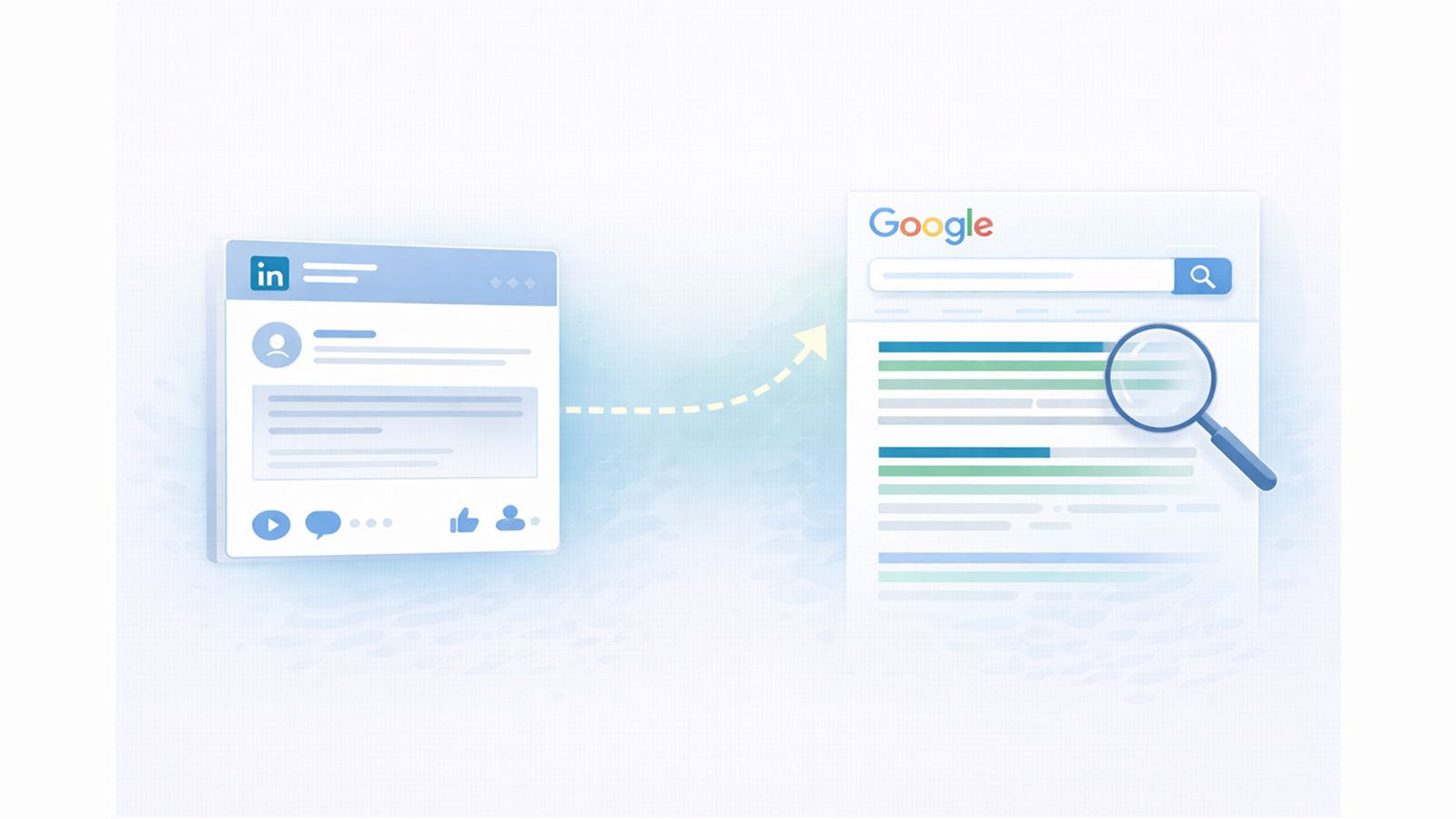
If you're a B2B SaaS founder focused on growth, we have news that will change how you think about content marketing: Your LinkedIn posts are now showing up in Google search results.
Not just your long-form LinkedIn Articles. Your regular posts too.
Most marketers don't know this yet. And that's exactly why this is such a massive opportunity.
For years, we were told that only LinkedIn Articles (those long-form blog-style posts) could be indexed by Google. Regular LinkedIn posts? They were invisible to search engines. But something changed in 2023-2024, and the playbook has been completely rewritten.
If you're building a SaaS marketing strategy and not leveraging LinkedIn for SEO, you're leaving serious visibility - and leads - on the table.
Here we show you exactly what changed, how to take advantage of it, and why this matters.
The Big Misconception About LinkedIn and Google
What We Used to Believe
Back in 2019, SEO expert JC Chouinard published a comprehensive case study examining how LinkedIn content appeared in Google. His conclusion was clear:
"Sharable posts that you make on LinkedIn are not indexed in Google. Even if you make a million posts on LinkedIn, you will not see any direct SEO value to your page."
For years, this was accepted wisdom. The consensus among SEO professionals was that:
- LinkedIn Articles (long-form content published through LinkedIn's native publishing platform) could be indexed
- Regular LinkedIn posts (the updates you share to your feed) were invisible to Google
- Only profiles and company pages had SEO value
This made sense at the time. LinkedIn posts were hidden behind JavaScript, locked in feeds, and seemed designed purely for the LinkedIn algorithm—not for search engines.
The Paradigm Shift: What Changed in 2023-2024
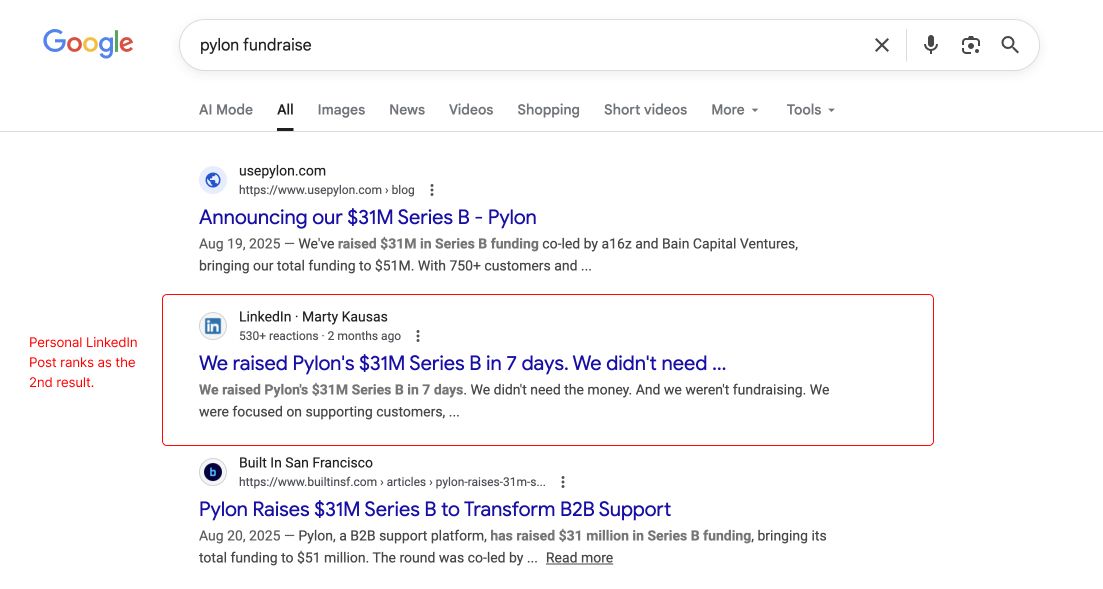
Then something fundamental shifted.
According to comprehensive research by Ethan Lazuk, published in October 2024, Google began a major "paradigm shift" starting in May 2023. This shift centered around what Google calls "hidden gems" and the "Perspectives" feature - both designed to surface more authentic, experience-based content in search results.
The timeline looks like this:
- May 2023: Google introduced the "Perspectives" filter and announced "hidden gems" ranking improvements
- November 2023: Google completed rolling out ranking system updates to prioritize "first-person perspectives" and experience-based content
- February-April 2024: SEO professionals began noticing individual LinkedIn posts appearing prominently in traditional Google search results
- Present day: LinkedIn posts regularly appear alongside website content in search results
As Jennifer Ibhafidon noted on Medium, most people still don't realize this is happening. The SEO community largely missed this transition because it happened gradually, without a major announcement from Google.
Why This Matters Now
This isn't just a minor technical change. It represents a fundamental shift in how Google evaluates and surfaces content.
Google is now prioritizing:
- Real human experiences over generic "SEO content"
- Social proof and engagement signals
- Authentic voices and perspectives
- Content from verified professionals on established platforms
LinkedIn posts check all these boxes. When you post on LinkedIn:
- Your content is tied to your verified professional identity
- Engagement signals (likes, comments, shares) are visible
- Your authority is backed by your profile, connections, and activity
- The content lives on a platform with massive domain authority (98/100)
When prospects Google your industry topics and find your LinkedIn posts, they see your expertise, click through to your profile, and arrive pre-qualified and warmed up. According to research from Kalungi: "Your CEO's LinkedIn should now be part of your SEO strategy because thought leadership posts are part of organic search." Personal LinkedIn posts feel more authentic than corporate content, and B2B buyers want to know the people behind the product.
For B2B SaaS founders, this changes everything. Your thoughts on product-led growth, your insights on the industry, your lessons learned - they can now appear in Google search results right alongside traditional blog posts and company websites.
"If you're doing LinkedIn content, the great thing is unlike a company blog, you can have as many blogs as you have employees essentially. You can have as many distribution channels for AEO as you have people that work at your business." (Jeffrey Zhao, Co-Founder at Ordinal)
Watch the full interview: Why LinkedIn Posts Show Up in AI Answers
And here's the kicker: You don't need to wait months for your domain authority to build up. LinkedIn's authority does the heavy lifting for you.
Understanding What Google Actually Indexes
First, you need to know what Google can and can't see on LinkedIn.
Google indexes:
- Public profiles (make sure yours is set to public)
- LinkedIn Articles (long-form posts with unique URLs)
- Company page updates (if set to public)
- High-engagement public posts (this is the new opportunity)
The critical requirement: Your content must be public. If your posts are restricted to connections only, Google won't see them. Check your LinkedIn privacy settings to ensure your content is visible to everyone.
How to Get Your LinkedIn Content Cited in Google Search Results
Now that you understand the opportunity, let's talk about execution. How do you actually get your LinkedIn content to show up in Google search results?
Here’s a framework based on Corey Hinde's excellent guide, combined with insights from Michael Oberther's LinkedIn SEO strategy.
10 Tactics to Rank Your LinkedIn Content in Google
- Research Google-Friendly Topics: Use Google Autocomplete, "People Also Ask" boxes, and tools like AnswerThePublic to find what your ideal customers are actually searching for. Create content that directly answers these queries.
- Choose the Right Format: Regular posts work for quick insights and daily engagement. Use LinkedIn Articles for in-depth guides, how-tos, and content targeting competitive keywords—they have unique URLs and rank better in search.
- Optimize Your Opening: Put your primary keyword in the first 1-2 sentences. Google pulls the first 150-160 characters as the snippet. Make it count with searchable phrases people actually type into Google.
- Use Natural Keyword Placement: Include target keywords in your headline, 1-2 subheadings, and naturally 1-2 times in the body. Write for humans first—Google understands context and synonyms.
- Structure for Scannability: Break up content with short paragraphs, line breaks, informal headers, and bullet points. Aim for at least 300 words on posts you want to rank. Google favors content that's easy to scan.
- Leverage Vertical Visuals: Post vertical images or videos - they get more attention and LinkedIn may favor them. Use keyword-rich filenames and descriptions. Google indexes image metadata.
- Create Link-Worthy Content: Share original data, unique frameworks, and insights from real experience. Answer niche questions better than anyone else. Backlinks from other sites signal authority to Google.
- Amplify Across Channels: Share your LinkedIn content in your newsletter, relevant Reddit communities, X (Twitter), and link to it from your own website. Cross-platform visibility helps Google discover and rank your content faster.
- Drive Real Engagement: Early engagement (first hour) matters most. Respond to comments, ask thoughtful questions, tag relevant contributors (not randomly), and post when your audience is active. More engagement = better indexing.
- Post Consistently: One viral post won't make you famous on Google. Publish 2-3 quality posts per week minimum, plus 1 in-depth Article monthly. Consistency builds authority that compounds over time.
How Ordinal Can Help You Dominate LinkedIn SEO
Understanding the opportunity is one thing. Executing consistently is another.
Most SaaS founders know they should be posting on LinkedIn, but between product development, fundraising, and running the business, creating optimized content often falls to the bottom of the priority list.
That's where Ordinal comes in.
Ordinal helps B2B SaaS companies build systematic, scalable content engines that turn LinkedIn into a predictable lead generation channel - without requiring founders to spend hours every week creating content.
Key LinkedIn-first features:
- Rich Post Formatting & Realistic Previews
- Create LinkedIn posts with native formatting, carousels, video, tagging, and true-to-life previews so content is optimized before publishing.
- Centralized LinkedIn Publishing
- Schedule and cross-post from one calendar to maintain consistent LinkedIn activity that builds topical authority over time.
- Built-In Engagement Acceleration
- Automatically trigger likes, comments, and reposts to increase early reach and distribution signals.
- LinkedIn-First Performance Analytics
- Track impressions, engagement, and post formats to identify which content earns visibility and citations.
- Team-Ready Content Workflows
- Draft, review, and approve posts collaboratively to publish higher-quality LinkedIn content at scale.
You focus on running your SaaS company. Ordinal handles the content strategy and execution that turns LinkedIn into your most cost-effective acquisition channel.
Ready to leverage LinkedIn as an SEO channel? Learn more about how Ordinal can help transform your B2B content strategy.
FAQ
Do LinkedIn posts really show up in Google search results?
Yes. As of 2023–2024, Google has begun indexing and ranking public LinkedIn posts, not just long-form LinkedIn Articles, especially when they show strong engagement and firsthand expertise.
What types of LinkedIn content does Google index?
Google can index public LinkedIn profiles, LinkedIn Articles, company page updates, and high-engagement public posts. Posts limited to “connections only” will not appear in search results.
Are LinkedIn Articles better than regular posts for SEO?
LinkedIn Articles are generally better for long-form, competitive keywords because they have unique URLs and blog-like structure. Regular posts can still rank, but Articles are more reliable for in-depth topics and evergreen search visibility.
How long does it take for LinkedIn posts to appear in Google?
In many cases, LinkedIn content can appear in Google within days or weeks, thanks to LinkedIn’s high domain authority - much faster than ranking new content on a standalone SaaS website.
What makes a LinkedIn post more likely to rank on Google?
Posts are more likely to rank when they are public, keyword-aligned, well-structured, at least ~300 words, and generate real engagement (comments, shares, meaningful interactions).
Does engagement on LinkedIn affect Google rankings?
Indirectly, yes. Higher engagement increases distribution, dwell time, and visibility—making posts more likely to be indexed and cited, which strengthens their ranking potential.
Can LinkedIn replace traditional SEO for SaaS companies?
Not entirely - but it can dramatically reduce time-to-visibility. LinkedIn complements traditional SEO by leveraging an established domain, making it especially powerful for early-stage and bootstrapped SaaS teams.
Should founders or company pages post for LinkedIn SEO?
Both work, but founder-led posts often perform better because Google favors authentic, first-person perspectives tied to real professional identities.pasted
How often should I post on LinkedIn for SEO impact?
A consistent cadence works best: 2–3 quality posts per week plus 1 in-depth LinkedIn Article per month to build topical authority over time.pasted
Related Posts
Looking to learn more? The below posts may be helpful for you to learn more about social media and content marketing.