

63.9% of the world's population uses social media, and the average user spends 2 hours and 21 minutes on it every day (Smart Insights, 2025). That's an enormous audience. But the social media sales funnel that's supposed to capture them usually gets treated like a copy of the search funnel, and that assumption breaks the moment you look at platform data.
The inherited model is linear: awareness, then consideration, then conversion, with every channel running the same play. In practice, buyers discover you on Instagram, research you on Google, come back to LinkedIn to validate, and might convert weeks later through a Facebook ad.
Each platform occupies a specific funnel role, and posting the same content everywhere ignores that entirely.
TL;DR
- Instagram leads product discovery (61%), TikTok now spans the full funnel with 43.8% buyer penetration, LinkedIn dominates B2B mid-funnel nurturing at a 6.50% engagement rate, and Facebook leads direct purchases at 39%.
- The social funnel isn't linear. Buyers loop between discovery, research, and validation before converting.
- The metric that ties social to pipeline is ICP engagement: tracking which decision-makers at target accounts are engaging with your content, not reach or impressions.
What follows is a platform-to-stage playbook built for B2B teams who need to connect social activity to revenue, not just impressions.
What Is a Social Media Sales Funnel?
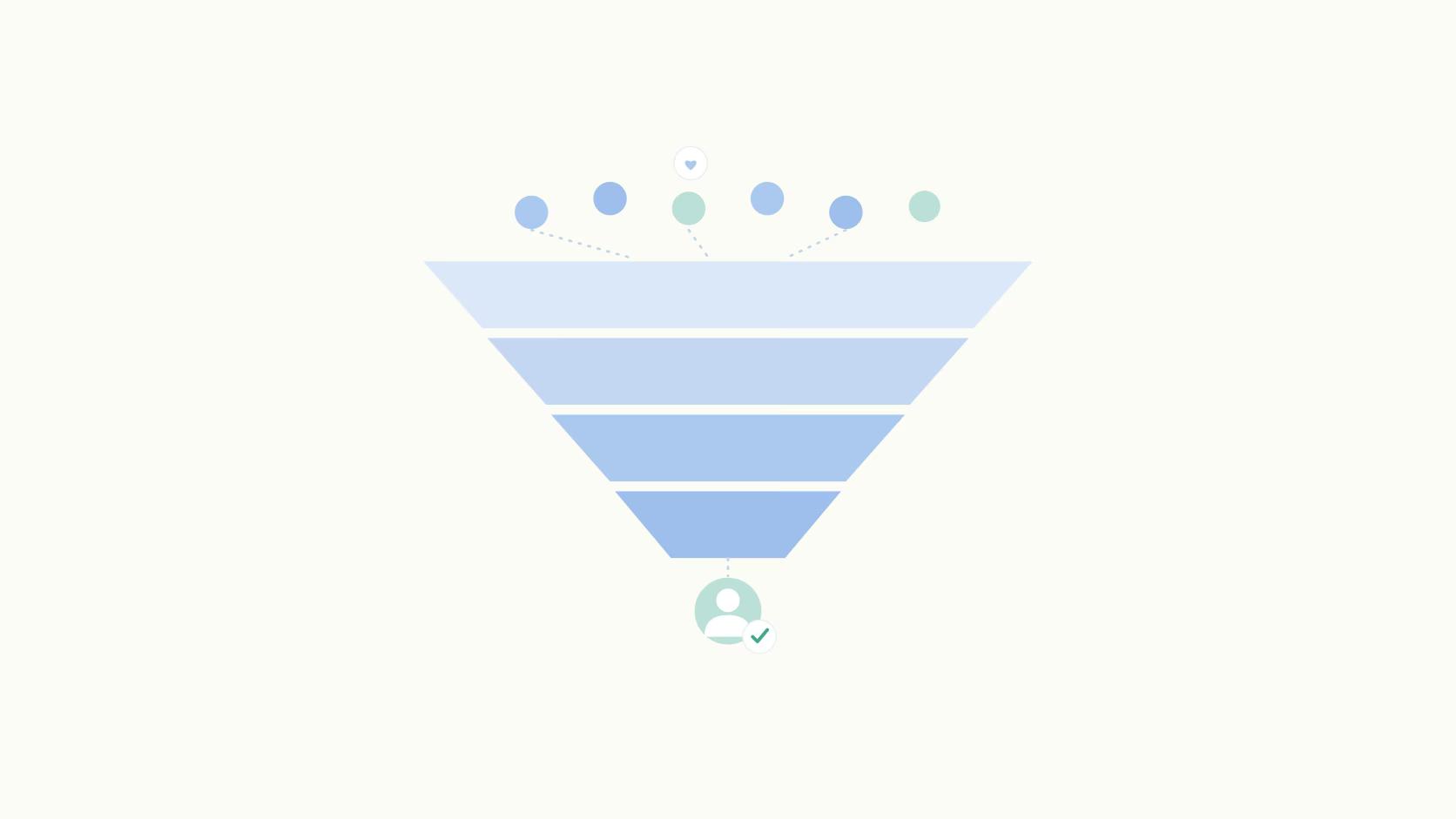
A social media sales funnel is the path a buyer takes across social platforms from first discovering a brand to becoming a customer, broken into three stages: discovery (TOFU), nurturing (MOFU), and conversion (BOFU). In a search funnel, intent is explicit and the journey is relatively linear.
The social funnel starts with interruption instead. Nobody opens Instagram looking to buy enterprise software. They need to get pulled in.
That distinction shapes how you build content.
Search marketing assumes a buyer who already knows what they want, while social marketing has to create that awareness before nurturing it. Discovery increasingly starts on social rather than Google, which means the top of your funnel lives on platforms your SEO strategy probably doesn't touch. For a deeper look at how these stages connect, the marketing funnel stages breakdown is worth reading alongside this piece.
The non-linear piece trips up most strategies. Buyers don't move cleanly from awareness to consideration to conversion. They discover you on LinkedIn, forget about you, see a case study on Instagram three weeks later, Google your category, then come back.
The funnel works better as a loop than a ladder.
Mapping Platforms to Funnel Stages
Not every platform does the same job. The data is clear on this, and ignoring it means posting the same content everywhere and wondering why it doesn't convert.
1. Top of Funnel: Discovery
Instagram leads product discovery: 61% of consumers use it to find their next purchase. The visual format, the algorithm's appetite for new content, and the way users browse without a specific intent make it ideal for interruption-based awareness. Your channel selection strategy for TOFU starts here.
TikTok is the more interesting story right now. 43.8% of US TikTok users are active buyers on the platform (social commerce trends, Swydo, 2025), making it the first social network to cross 40% buyer penetration. That's past discovery. TikTok is working as a full-funnel channel in a way Instagram and Facebook took years to develop, so it's worth treating as more than a brand awareness play.
2. Middle of Funnel: Nurturing
For B2B teams, LinkedIn is where the mid-funnel lives. LinkedIn leads with an average engagement rate of 6.50% (Dreamgrow, 2025), meaningfully higher than most major platforms.
That engagement appears as comments, reshares, and people tagging colleagues in posts because the content maps to a problem they're actively thinking about.
This is where thought leadership earns its keep. Buyers who discovered you somewhere else come to LinkedIn to validate. They read your founder's posts, check whether your team seems credible, and look at what your customers are saying. Mid-funnel content on LinkedIn should answer "can I trust these people?" rather than just "what does this company do?"
B2B social selling turns this stage into actual pipeline activity.
3. Bottom of Funnel: Conversion
Facebook leads direct purchases at 39% of consumers (SocialPixelPro, 2025). That's partly legacy infrastructure (retargeting, catalog ads, years of purchase behavior data) and partly format. The shift that matters going forward: 26% of marketers plan to start selling products directly on social media in 2026 (HubSpot marketing data, 2026), including through Instagram Shops and native checkout.
Conversion is moving on-platform, not just being influenced by it.
So BOFU content needs to work harder in the feed. Case studies, customer proof, and direct product content all need to show up in the same environments where people are already in a buying mindset.
The Funnel Is a Loop, Not a Line
B2B buying cycles don't follow a clean path. A marketing director sees your founder's LinkedIn post, thinks "interesting," and moves on.
Two weeks later, they search your category on Google. They visit your site, leave without converting, then see a retargeted post on LinkedIn. They click through, read a case study, and finally book a demo. That's four touchpoints across three platforms before a single conversation with sales.
The social-to-search handoff is real and measurable. Understanding the social-to-search handoff explains why branded search volume tends to rise when social activity rises, even when you can't draw a direct line between a specific post and a conversion.
Social warms the buyer, and sdearch closes the gap.
So stop optimizing exclusively for top-of-funnel reach. Some of the highest-value content you can create is for people who've already discovered you. Retargeting content, deeper educational material, and customer proof all re-engage buyers who are somewhere in the loop but haven't converted yet. Identifying where prospects drop between discovery and conversion (the "leaky funnel" frame) is more useful than measuring reach at the top.
Measuring Your Social Funnel: What Ties to Pipeline
The metric that matters is ICP engagement, not reach. That means tracking which decision-makers at target accounts are engaging with your content, then passing that signal to sales.
"You should be tracking ICP engagements. Look at the people that have actually engaged with your posts, see who hits your ICP, who's a new deal, pass that to your sales team, and have them close deals from there. Your goal with social is to drive pipeline." — Jeffrey Zhao
This is where most social programs fall apart. Teams report impressions and follower growth to leadership because that's what the dashboard shows. But impressions don't tell you whether a VP of Engineering at a target account just engaged with your product post.
ICP engagement does. To tie metrics to pipeline, you need analytics that go deeper than surface-level reach numbers.
Earned media value is a useful complement. It calculates what the same impressions would have cost in paid ads, giving leadership a dollar-adjacent number that connects organic social activity to spend efficiency. But EMV is a proxy. The real signal is who engaged and whether they match your buyer profile.
Ordinal surfaces ICP engagers directly, showing which LinkedIn users liked or commented on your posts and letting you pass those signals to sales without manual work. It's the layer between social activity and pipeline conversation that most schedulers don't offer. The Enterprise plan includes leads data for exactly this use case.
Align Your Platform Strategy and Your Metrics
Stop treating your social funnel like a search funnel. The platforms don't behave that way, and neither do your buyers.
Audit your current channel mix against the platform-stage matrix in this piece. If you're posting the same content on LinkedIn and Instagram and calling it a strategy, that's the first thing to fix. Match the content type to the platform's natural funnel role: discovery content on Instagram and TikTok, nurturing content on LinkedIn, and conversion content where buyers are already in a purchasing mindset.
Then make one measurement change this quarter: start tracking ICP engagement instead of reach. Identify which decision-makers at target accounts are engaging with your posts and pass those signals to sales. That single shift moves social from a reporting line on a dashboard to an actual pipeline input.
The funnel math works when the platform strategy and the measurement layer are aligned. Neither one alone is enough.
Frequently Asked Questions
What is a social media sales funnel?
A social media sales funnel is the path a buyer takes across social platforms from first discovering a brand to becoming a customer, typically broken into discovery, nurturing, and conversion stages. Unlike a search funnel, buyers rarely move through it in a straight line. They discover on social, research on Google, and return to social to validate before purchasing.
Which social media platform is best for each funnel stage?
Instagram leads product discovery at 61% of consumers (SocialPixelPro, 2025), making it the clearest top-of-funnel channel. LinkedIn dominates B2B mid-funnel nurturing with a 6.50% average engagement rate (Dreamgrow, 2025). Facebook leads direct purchases at 39%, and TikTok now spans the full funnel with 43.8% of US users acting as active buyers.
How do you measure a social media sales funnel?
Track ICP engagement rather than raw reach. The question isn't how many people saw your post. It's whether the right decision-makers at target accounts engaged with it. Earned media value gives leadership a revenue-adjacent number, while passing warm ICP engagers to sales connects social activity directly to pipeline.
Is the social media sales funnel still linear in 2026?
No. Buyers discover products on social, research on Google, then return to social to validate before purchasing. That loop means building content for people who've already discovered you matters as much as chasing new reach. Treating the funnel as linear is what causes teams to over-invest in awareness and underinvest in re-engagement.
How is a social media sales funnel different for B2B vs. B2C?
B2B funnels lean heavily on LinkedIn for mid-funnel nurturing and B2B social selling, with longer consideration cycles and more emphasis on thought leadership. B2C funnels move faster, skewing toward Instagram and TikTok for quick discovery-to-purchase paths and native social commerce.
How long does a social media sales funnel take to convert?
For B2B, it's rarely quick. Consideration cycles run weeks to months, and buyers typically touch several platforms before talking to sales. Rather than optimizing for speed, focus on staying present across the loop, so when a buyer moves from discovery to validation to decision, your content is there at each step. The teams that win track re-engagement, not just first-touch reach.
What content works best at each stage of the social funnel?
Discovery content should be visual, interruptive, and easy to consume, which suits Instagram and TikTok. Nurturing content should build trust through thought leadership, customer stories, and founder perspective, which is LinkedIn's strength. Conversion content should show proof, case studies, direct product demonstrations, and clear next steps, delivered where buyers are already in a purchasing mindset.
Related Posts
Looking to learn more? The below posts may be helpful for you to learn more about social media and content marketing.