


70% of social media users go to Google to research products they saw on social according to Wordstream. Yet most B2B teams treat social media SEO as a profile-optimization checklist. Social is run by one team chasing engagement metrics while SEO is run by another chasing rankings, and pipeline leaks at the handoff between them.
The fix needs to be a structural decision about how social and search work together, and who owns the seam.
TL;DR
- Social drives discovery. Search captures intent. Most B2B teams are losing pipeline at the transition between the two.
- SEO leads close at 14.6% vs. 3% for paid social, which means optimizing the social-to-search handoff is worth real money.
- Posts without links get 84% more impressions on average, but link posts drive higher engagement per impression. The right choice depends on your funnel goal.
- AI search traffic grew 527% year-over-year from 2024 to 2025 (Semrush). Social content is now being cited by AI tools alongside web pages, a third discovery layer most teams aren't building for.
What Is Social Media SEO?
Social media SEO is optimizing social content and profiles so they rank in both social platform search and traditional search engines. It's different from social algorithm optimization, which is about feed placement. Social SEO is about search placement, and the two require different approaches.
Think of it in two layers:
The first is in-platform search: LinkedIn's people and content search, YouTube's video search, TikTok's keyword-driven discovery.
The second is external search: Google increasingly surfaces social content in results, which means a well-optimized LinkedIn post or YouTube video can rank on Google without a single backlink. For more on how that works in practice, see how LinkedIn posts and Google indexing have changed since 2023.
Why This Matters for B2B in 2026
Organic traffic accounts for 53% of all trackable website traffic. Social drives 5%.
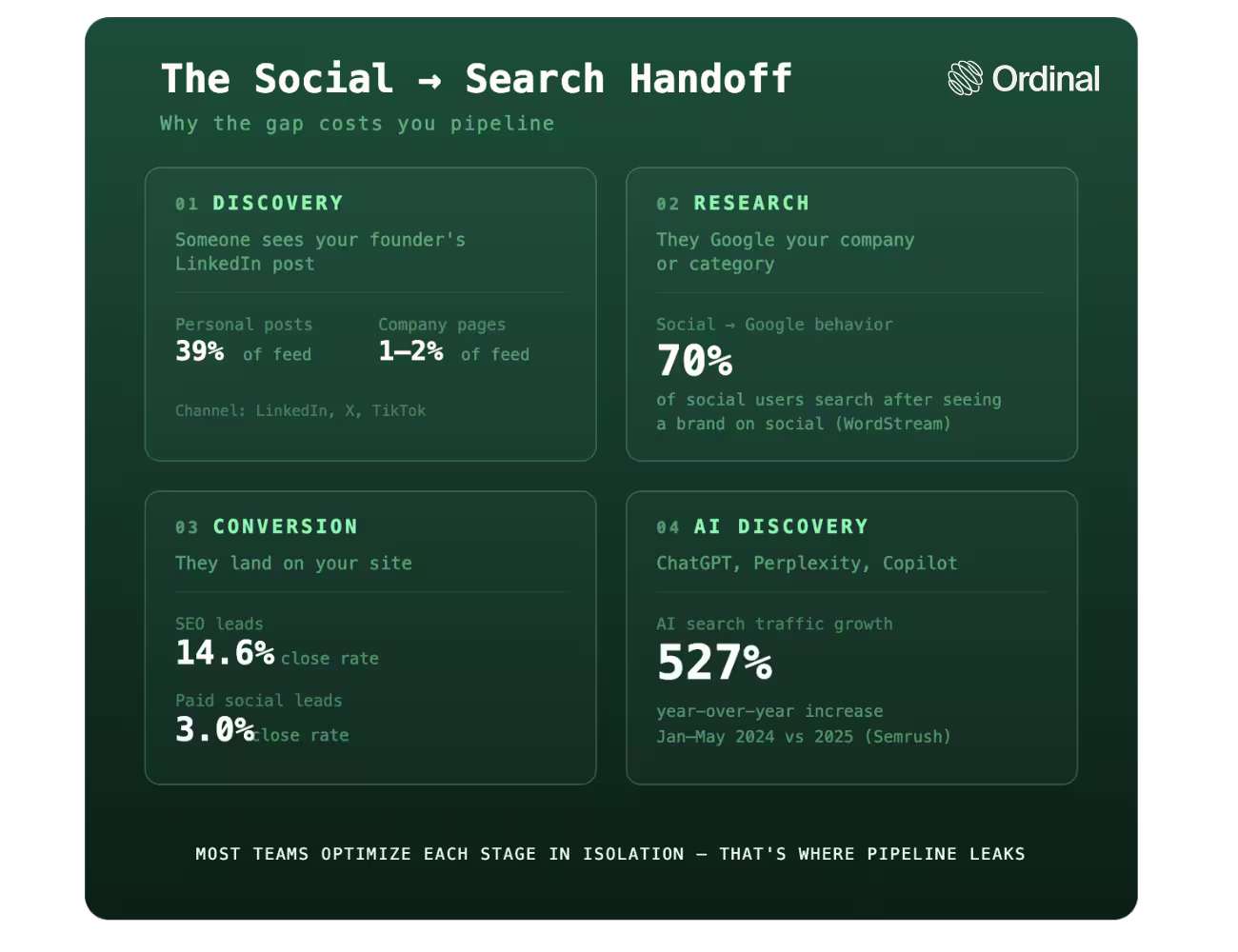
But social is where most B2B buyers first encounter your brand. That gap is the entire argument for social media SEO: discovery happens on social, conversion happens through search, and most teams are optimizing each in isolation. The close rate data makes the stakes concrete: SEO leads close at 14.6% versus 3% for paid social, a 386% difference.
That 70% social-to-Google behavior is a more realistic approach to the buyer journey than most traditional SEOs want to admit. Someone sees your founder's LinkedIn post, finds it interesting, then Googles your company name or category.
If your SEO isn't set up to catch that branded search, the pipeline leaks right there. Spending more on ads to compensate is a poor substitute for getting the organic handoff right.
Then there's the AI search layer. Traffic from AI tools like ChatGPT, Perplexity, and Copilot grew 527% year-over-year from January–May 2024 to January–May 2025. Social content with specific, citable claims is increasingly showing up in AI responses alongside web pages. Teams siloing social and SEO are already behind on a third discovery layer they haven't started building for.
Social Search vs. Traditional SEO vs. Social Algorithm
These three get conflated constantly, and conflating them leads to bad strategy.
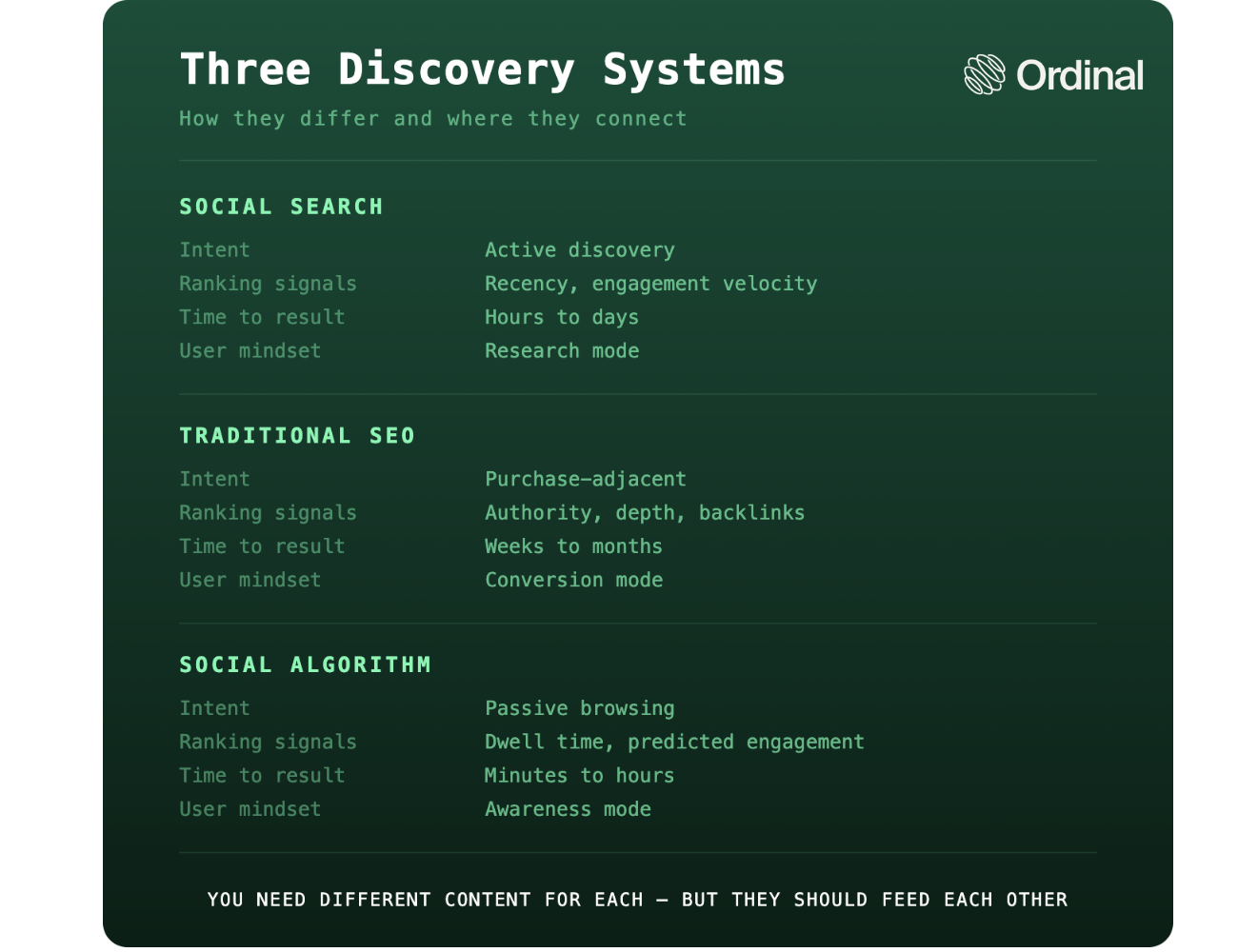
Social search rewards recency and engagement velocity. The intent is active discovery, and results surface in hours to days. Users are in research mode.
Traditional SEO rewards authority, depth, and backlinks. The intent is purchase-adjacent, and results take weeks to months. Users are closer to conversion.
Social algorithm rewards dwell time and predicted engagement. The intent is passive browsing, and results surface in minutes. Users are in awareness mode.
The B2B implication: you need different content for each, but they should feed each other. A LinkedIn post optimized for feed reach surfaces your brand. A follow-up Google search converts the interest. A YouTube explainer optimized for in-platform search captures the buyer actively comparing vendors.
None of these work as well in isolation as they do connected.
How LinkedIn Became a Search Channel
We analyzed 256,000+ non-ad LinkedIn posts from 2024, excluding posts with zero impressions. Engagement is defined as likes, comments, shares, saves, and sends divided by impressions.
The findings complicate the simple advice to "always put your link in the first comment."
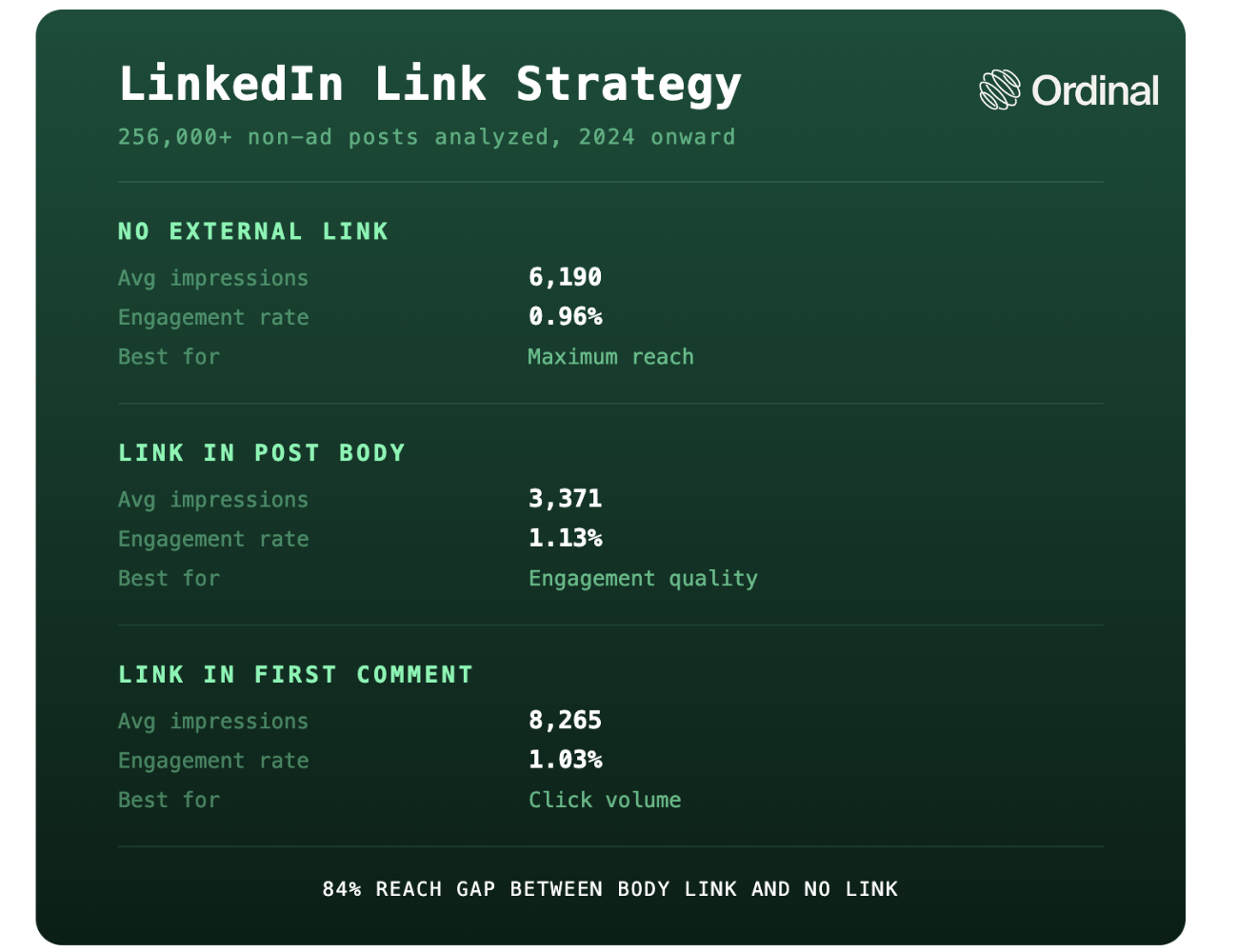
Across the dataset, 25.26% of posts included an external link in the post body. Posts without any external link averaged 6,190 impressions per post. Posts with a body link averaged 3,371 impressions, an 84% reach gap. But link posts had a higher engagement rate per impression (1.13% vs. 0.96% for no-link posts).
More engaged, less reach.
First-comment links tell a different story. Of posts with external links, only 2.01% put the link in the first comment rather than the body. Those posts averaged 8,265 impressions per post, the highest reach of any category, with 85 average engagements per post. The trade-off is engagement rate: 1.03% versus 1.13% for body links. See the full methodology in the link penalty study.
The decision framework: no link for reach, body link for engagement quality, first-comment link for click volume. Each serves a different funnel goal.
Platform-by-platform playbook
Highest priority for B2B social SEO because public posts now get indexed by Google. Keyword-optimize your headline, About section, and custom URL. At the post level, front-load your keyword in the first sentence, use 3–5 relevant hashtags, and write at least 300 words for posts you want Google to surface.
See how multi-channel social scaling works in practice.
YouTube
The second-largest search engine and often the first place B2B buyers go when they need to understand how a product works. Optimize title, description, and chapters for target keywords. Add a full transcript since YouTube's auto-captions are indexed but manual transcripts are more accurate.
Timestamps help both search indexing and viewer retention.
Twitter/X
Matters most for technical and developer audiences. Keyword-rich bios, pinned posts, and consistent topic focus help Grok's semantic search surface your content.
Threads work well for structured arguments that double as searchable reference content.
TikTok and Instagram
Lower priority for most B2B teams today, but TikTok's search behavior among Gen Z buyers entering purchasing roles is rising fast. On TikTok, captions and on-screen text carry keyword weight. On Instagram, alt text and caption keywords drive discoverability in both platform search and Google image results.
A 5-step social media SEO strategy
1. Keyword audit
Identify where your audience searches across platforms and map those terms against your current SEO targets. Most teams discover significant gaps here.
2. Alignment
Find the overlap between social and SEO keyword sets. Build content that can rank in-platform while also priming the branded Google search that follows.
3. Profile metadata
Every platform profile should reflect your target keywords in the bio, headline, and wherever custom fields allow. This is the foundation.
4. Content that ranks in two places
A LinkedIn post that surfaces in LinkedIn search and gets shared enough to drive branded Google searches is doing double duty. The goal is content that works at each layer, not content optimized for one and ignored by the others.
5. Measure the handoff
Use Google Search Console to track branded search lift after social campaigns. Check LinkedIn search appearances in native analytics. Link-builders who incorporate social into outreach see a 22% higher link-building rate (Search Logistics), which is a real signal that social activity compounds into SEO authority over time.
For broader framing, see building a social strategy that connects to pipeline.
Measuring Social Media SEO Performance
Platform-native analytics are the starting point: LinkedIn search appearances, YouTube impressions from search, TikTok keyword reach. Google Search Console is where you track branded search volume lift after social campaigns. If a product launch post goes live on Monday and branded searches jump 30% by Wednesday, that's the handoff working.
AI search visibility is the newest measurement challenge: track which specific claims and stats from your social content are being cited by Perplexity, ChatGPT, and Copilot. For proof that attribution at scale is achievable, see how revenue-attributed social growth played out at Clay.
Earned Media Value ties it together. It converts organic impressions into a dollar figure based on what the same reach would have cost in paid ads, giving you something concrete when leadership asks what social is doing for pipeline.
Final Thoughts
The social-to-search handoff is where most B2B teams lose pipeline. Not because they're doing social wrong or SEO wrong, but because they're running them as separate programs with separate owners and separate definitions of success. That 70% buyer behavior stat isn't trivia. It's a structural problem with how most marketing organizations are built.
Start with the audit. Map where your social and SEO keyword targets currently overlap and where they don't (that gap is your first priority).
Then look at how your LinkedIn content is being optimized: for reach, for engagement quality, or for clicks. Each is a legitimate goal, but only if it's intentional and tied to a funnel stage.
Teams that figure this out early compound the advantage. Coordinating LinkedIn content across profiles, scheduling, and attribution is where Ordinal fits into that workflow.
Frequently Asked Questions
What is social media SEO?
Social media SEO is optimizing social content and profiles to rank in both social platform search engines (LinkedIn, YouTube, TikTok) and traditional search engines like Google. It treats social media as a discovery layer that feeds search intent rather than a standalone channel. The goal is to be findable wherever your audience is looking, not just inside one platform's feed algorithm.
How is social media SEO different from regular SEO?
Traditional SEO targets Google's algorithm using backlinks, page authority, and content depth. Social media SEO targets in-platform search plus the indirect way social content surfaces in Google results. Social SEO rewards engagement velocity and recency far more than traditional SEO does, which means content strategy has to account for both signals.
Do LinkedIn posts get indexed by Google?
Yes. Since 2023–2024, regular LinkedIn posts (not just Articles) are indexed by Google when they're public, keyword-aligned, and generate engagement. LinkedIn carries a domain authority of 98/100, so posts can rank faster than new content on most standalone websites.
Should I include links in my LinkedIn posts?
It depends on the goal. Posts with body links average 3,371 impressions versus 6,190 for posts without links, an 84% reach gap. But link posts generate higher engagement per impression (1.13% vs. 0.96%). If reach is the priority, skip the body link or move it to the first comment. If clicks matter more, body links work at a reach cost.
Which social platforms matter most for B2B social media SEO?
LinkedIn is the highest priority because of professional intent and Google indexing of public posts. YouTube ranks second for any product that benefits from explainer or demo content. Twitter/X matters for technical and developer audiences. TikTok and Instagram are lower priority for most B2B teams but rising for younger buyer personas entering purchasing roles.
How do I measure social media SEO ROI?
Track three layers: in-platform search visibility (LinkedIn search appearances, YouTube impressions from search), branded search lift in Google Search Console after social campaigns, and AI search citations in tools like Perplexity and ChatGPT. Earned Media Value gives you a single dollar figure to report when leadership asks what social is doing for pipeline.
Related Posts
Looking to learn more? The below posts may be helpful for you to learn more about social media and content marketing.