


Everyone keeps saying social media engagement is dying, but the data says it's stratifying. We analyzed 248,310 LinkedIn posts published since 2024, and the answers are more specific than "post more often."
The median post-level engagement rate on LinkedIn is 1.90%, and the behaviors that move that number are almost universally underused.
TL;DR
- Median LinkedIn post-level engagement rate: 1.90%
- Accounts under 1K followers outperform large accounts on rate: 2.86% vs. 1.33% for 50K+ accounts
- Author response within the first hour drives a 12% engagement lift (1.10% vs. 0.98%)
- Auto-engagement increases total engagements per post by 27% (67.58 vs. 53.12)
- X's engagement collapse makes LinkedIn the only defensible B2B platform on engagement rate alone
What Social Media Engagement Measures
Social media engagement is the ratio of meaningful interactions on a post (likes, comments, shares, saves, and sends) divided by total impressions. Clicks are excluded because they reflect curiosity more than content resonance.
Someone who clicks a link might have ignored the post, but someone who comments almost certainly didn't.
The distinction between post-level and account-level engagement rate matters more than most teams realize. Post-level tells you whether a specific piece of content resonated. Account-level is an average across all posts, which means a handful of outlier posts can mask consistently weak performance.
That's also why median is more useful than mean. A single viral post can drag the mean upward by 3x while the rest of your content flatlines.
For more on the metrics that connect to pipeline, see our guide to key LinkedIn metrics.
2026 Engagement Benchmarks by Platform
The engagement-is-dying narrative is mostly wrong. According to Goat Agency's 2026 research, 48–49% of consumers report interacting with brands more on social now than six months ago. What's dying is engagement on X. Teams that built their distribution around X are feeling that collapse. LinkedIn's softening from 6.4% in 2024 to 6.2% in 2025 is a rounding error by comparison.
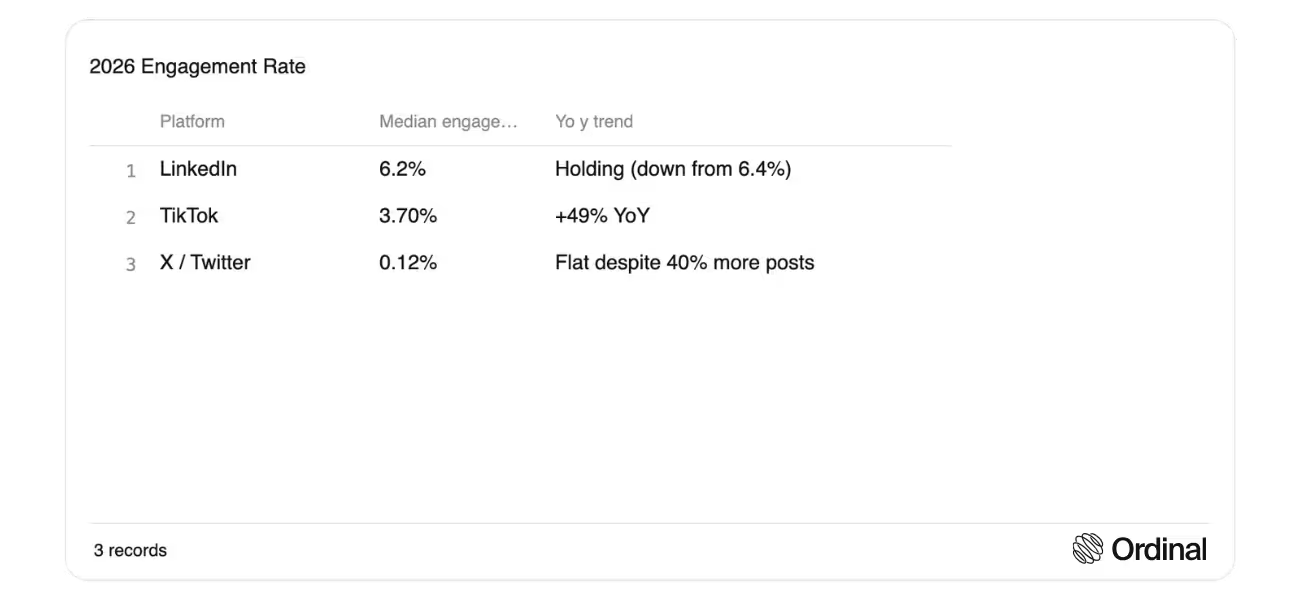
For B2B teams, the read is simple. X's engagement rate is structurally 50x lower than LinkedIn's. The question really isn't whether to optimize for X, but whether to be on it at all.
It's worth understanding what's happening with declining company page reach on LinkedIn too, because that shapes how you split effort between personal profiles and brand accounts.
What Drives LinkedIn Engagement: Findings From 248,310 Posts
LinkedIn's algorithm in 2026 rewards signals that indicate a human actually read something. Our dataset reflects that in ways that should change how most teams operate.
1. Smaller Accounts Have Higher Engagement Rates
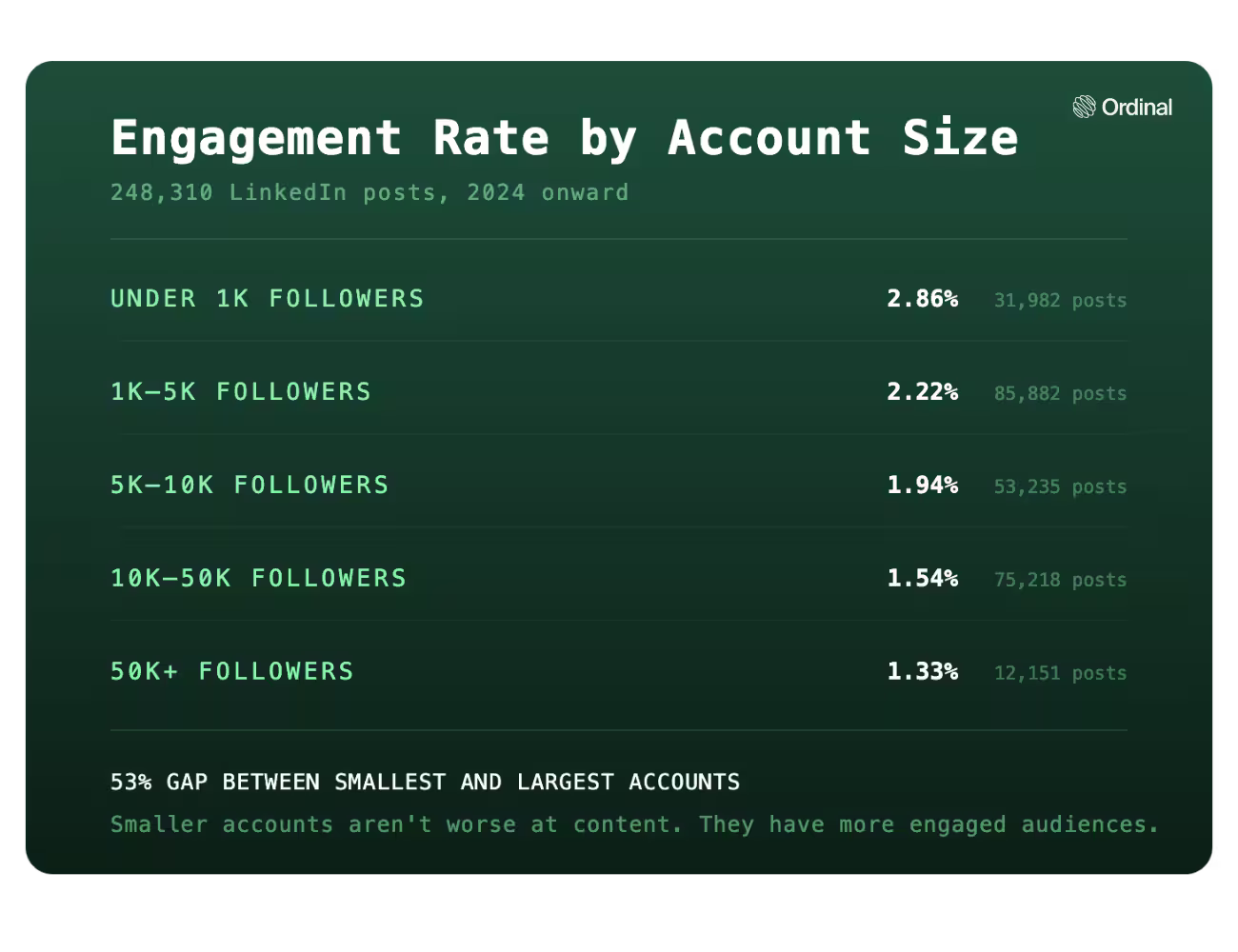
Accounts under 1K followers have a 2.86% median engagement rate. Accounts with 50K+ followers sit at 1.33%. That's a 53% gap, and it's structural: large accounts accumulate passive followers who scroll without engaging.
Follower count grows faster than engaged audience does.
For early-stage marketing teams and founders, this is an advantage. The content engine you're building right now reaches a higher-engagement audience than a 100K-follower brand page. Don't optimize away from that by trying to look bigger than you are.
2. Author Response in the First Hour Drives a 12% Lift
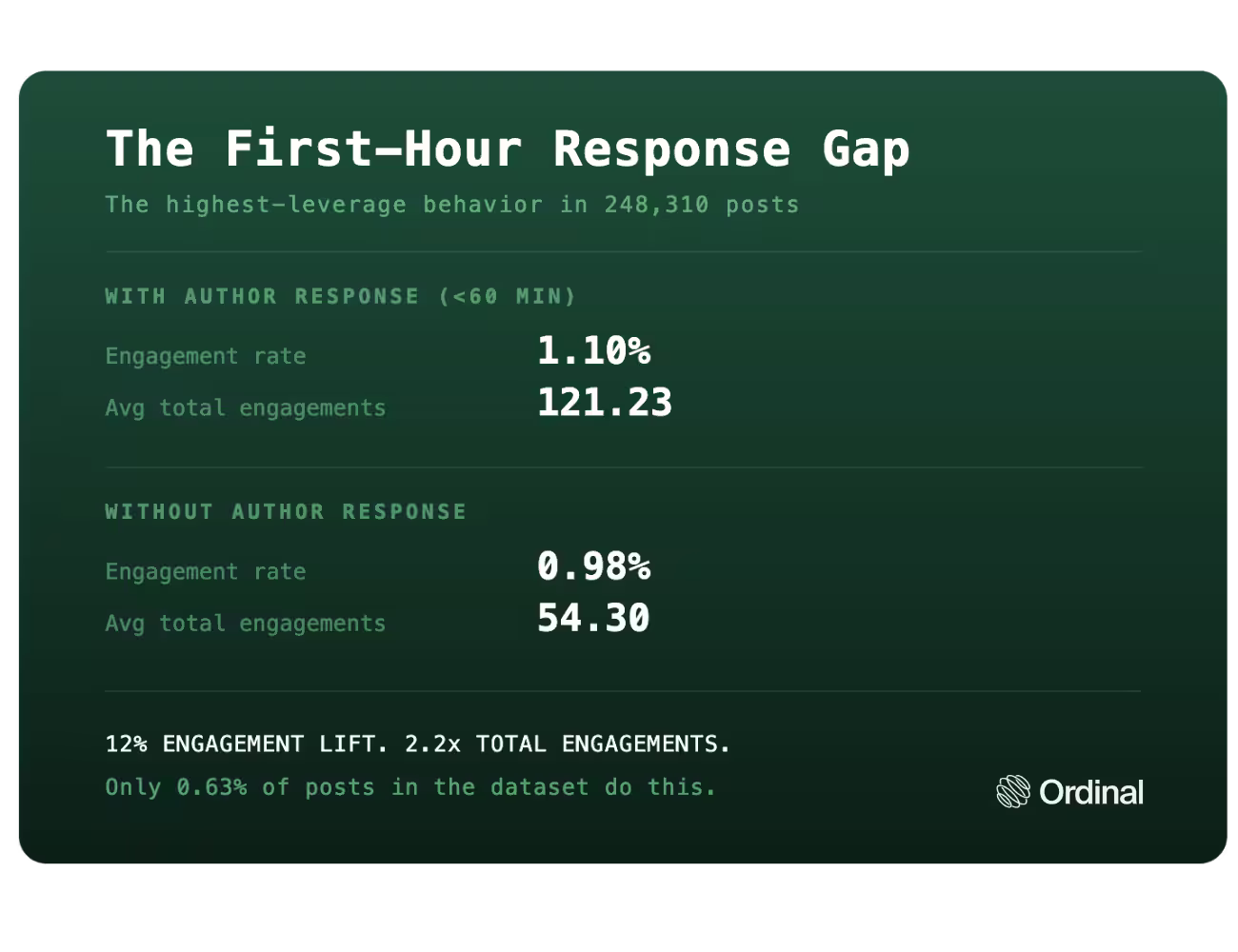
Posts where the author commented within 60 minutes of publishing had a 1.10% engagement rate vs. 0.98% for posts without early author response. A 12% relative lift. Those posts also averaged more than double the total engagements: 121.23 vs. 54.30. And only 0.63% of posts in our dataset show this behavior.
Almost no one is doing it.
The mechanism is simple. Early comments signal to LinkedIn's algorithm that a post is generating conversation, which accelerates distribution. The author's own comment counts.
Clay has used this kind of systematic engagement coordination to scale LinkedIn dramatically, documented in their case study.
3. Auto-Engagement Increases Total Engagement by 27%
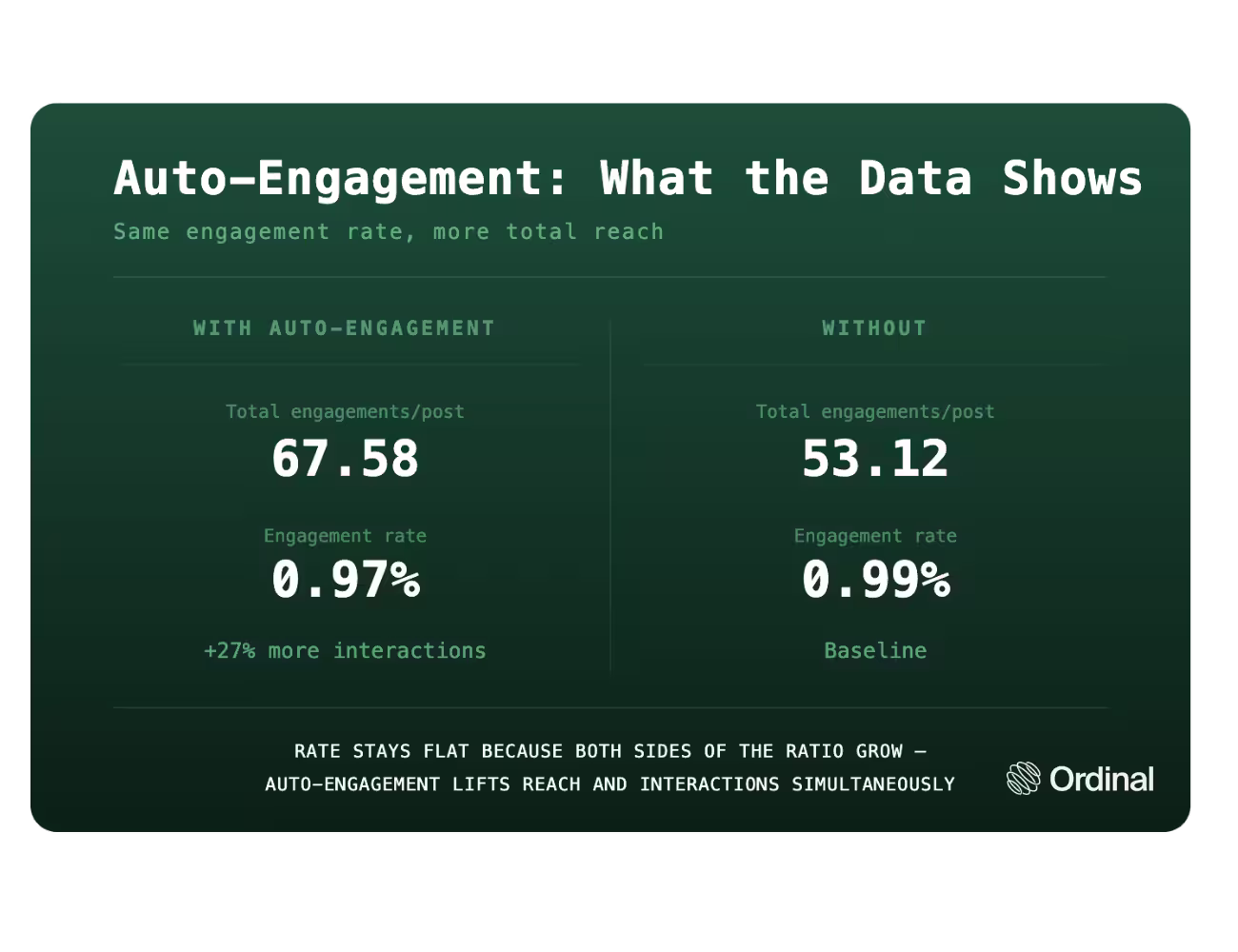
Posts that received auto-engagement averaged 67.58 total engagements vs. 53.12 for posts without. The engagement rate stayed roughly flat (0.97% vs. 0.99%) because auto-engaged posts also received more impressions. That's the point. Auto-engagement lifts reach and total interactions simultaneously, even when rate holds steady.
Ordinal's auto-engagement features fire within the first 10 minutes after a post goes live, with randomized timing so interactions feel organic. Combined with our posting frequency data, the pattern is clear: early momentum compounds. beehiiv's employee advocacy results showed what systematic early engagement can do for distribution across channels.
The Shift From Paid to Organic
73% of businesses now prioritize organic social over paid, according to Goat Agency's 2026 research, which makes sense. Paid distribution generates impressions without engagement signals, and those signals are what drive algorithmic distribution on every major platform.
A post that gets 10,000 paid impressions and 50 engagements tells LinkedIn's algorithm less than a post that gets 500 organic impressions and 40 engagements.
Each comment and share extends organic distribution without additional spend. The engagement signals themselves determine how broadly a post circulates next. Paid impressions don't create that feedback loop. That's the compounding dynamic that makes organic worth prioritizing as a primary channel.
How to Increase Social Media Engagement in 2026
Respond to the first comment on your post within 60 minutes. Not because it's polite. Because it drives a measurable 12% lift in engagement rate and only 0.63% of posts in our dataset do it. That's the single highest-leverage behavior we found.
Use auto-engagement to generate early momentum. Posts with auto-engagement averaged 27% more total interactions, and they reached more people. The mechanism is the same one that makes author response work: early signals tell the algorithm a post deserves wider distribution. Timing matters too, so check the optimal posting times to make sure early engagement fires when your audience is online.
If your account is under 5K followers, lean into your engagement rate advantage rather than obsessing over impressions. A 2.22% median rate is structurally better than what most large accounts deliver. Build the content engine first. The follower count follows.
Final Thoughts
Engagement isn't dying. It's concentrating on platforms and behaviors that reward authentic interaction. LinkedIn holds at 6.2%. TikTok is growing. X has structurally collapsed.
If you take one thing from this analysis: respond to your first comment within 60 minutes of publishing. The data shows a 12% lift, and only 0.63% of posts do it.
That gap is your opportunity.
Frequently Asked Questions
What Is a Good Social Media Engagement Rate in 2026?
It depends on the platform. LinkedIn leads at around 6.2% median, TikTok sits at 3.70%, and X has collapsed to 0.12%. For B2B teams on LinkedIn, there's a median post-level engagement rate of 1.90%, so anything above 2% is solid.
How Is Social Media Engagement Calculated?
The standard formula is (likes + comments + shares + saves + sends) divided by impressions. Clicks are excluded because they reflect curiosity rather than content resonance. Median is more useful than mean since a few viral posts can skew the average dramatically.
Why Does My LinkedIn Engagement Rate Drop as My Account Grows?
This is structural, not a content problem. Accounts under 1K followers have a 2.86% median engagement rate, while 50K+ accounts sit at 1.33%. Larger accounts accumulate passive followers who scroll without engaging, so rate compresses even as total engagement grows.
Does Responding to Comments Quickly Increase Engagement?
Yes. Posts where the author responded within the first hour had a 1.10% engagement rate compared to 0.98% without early response. A 12% relative lift, and only 0.63% of posts show this behavior.
Is Social Media Engagement Declining Across All Platforms?
No. Engagement is stratifying. LinkedIn has held around 6.2%, TikTok grew 49% year-over-year, and roughly 48–49% of consumers report interacting with brands more than six months ago (Goat Agency). The decline narrative comes mostly from X's collapse to 0.12%.
What's the Best Platform for B2B Social Media Engagement?
LinkedIn, by a wide margin. Its 6.2% median engagement rate outperforms every other major platform, and the audience of decision-makers makes that engagement more pipeline-relevant than anywhere else.
Do Auto-Likes and Auto-Comments Work?
Posts that received auto-engagement averaged 67.58 total engagements versus 53.12 without, about 27% more per post. The engagement rate stayed roughly flat (0.97% vs. 0.99%) because auto-engaged posts also reached more people. Auto-engagement lifts both reach and total interactions simultaneously.
How Long Does It Take to See Engagement on a LinkedIn Post?
Most engagement happens fast. Median time to first comment is about 30 minutes, though some posts pull the average to 12.8 hours. The first 60 minutes are critical because LinkedIn's algorithm uses early engagement signals to decide whether to expand distribution.
Related Posts
Looking to learn more? The below posts may be helpful for you to learn more about social media and content marketing.