

Ask three different social media tools when you should post on Facebook and you'll get three different answers. Sprout Social's analysis of nearly 2 billion engagements points to weekday mornings. Buffer's 14-million-post study flags Thursday 9 a.m. MeetEdgar's aggregated posting research lands on Wednesday 9 a.m. They can't all be right. Or can they?
We pulled engagement data from 22,208 Facebook posts published since 2024 to find out. Engagement rate is calculated as (reactions + comments + shares) / impressions, which is more precise than raw engagement count.
The results resolve the contradiction and surface a finding most guides miss entirely.
The best times to post on Facebook depend on what you're optimizing for. If you want engagement rate, Monday morning wins. If you want raw reach, weekend posts average 68% more impressions per post than weekday posts.
But most industry guides conflate these two goals, which is why they keep contradicting each other.
TL;DR
Based on Ordinal's analysis of 22,208 Facebook posts since 2024:
- Best day for engagement rate: Monday at 0.84%, followed by Wednesday at 0.68%
- Worst day for engagement rate: Friday at 0.44%, despite the highest average weekday impressions per post (1,001)
- Best hour: 10:00 UTC at 1.67% engagement rate
- Weekday vs. weekend: weekdays win on engagement rate (0.62% vs. 0.55%); weekends win on reach (1,197 vs. 712 impressions per post)
- Best format by day: carousels peak Tuesday at 2.01%; images peak Friday at 1.54%; videos get the most impressions but the lowest engagement rates (0.19%–0.40%)
If you can only pick one slot, post Monday or Tuesday morning. But the right answer depends on whether you're chasing engagement rate or impressions.
What Industry Studies Say (and Where They Disagree)
The contradiction between tools ultimately comes down to a measurement problem. Each study answers a slightly different question, and most readers don't notice.
Buffer's analysis of 14 million posts identified Thursday at 9 a.m. as the single best time. Sprout Social's analysis of nearly 2 billion engagements across roughly 307,000 social profiles found that weekends yield the lowest engagement across almost all industries.
MeetEdgar's aggregated posting data synthesizes multiple studies and lands on Wednesday at 9 a.m. as the consensus best single time, with an 8–11 a.m. weekday window as the broader sweet spot.
A cross-study analysis from Postfa.st, pulling from HubSpot and Hootsuite research, validates Tuesday through Thursday, 9–11 a.m. as the most consistently effective window.
So why do they disagree on the best day? Buffer measures total engagement count. Sprout measures reach and engagement volume across a massive multi-industry dataset. And neither is wrong. They're just not measuring the same thing.
Engagement count favors high-traffic days. Engagement rate per impression, which is what Ordinal's data tracks, can surface entirely different winners because it normalizes for reach volume.
A post on Friday might rack up impressive raw numbers, but if it got three times the impressions to do it, the rate is mediocre. That distinction matters more than most teams realize.
What Our Data Shows
Methodology: Ordinal analyzed 22,208 Facebook posts published from January 2024 through May 2026, excluding any posts with zero or missing impressions.
Engagement rate is (reactions + comments + shares) / impressions. The Facebook API does not expose an advertisement flag, so paid posts could not be filtered out, though the dataset skews heavily toward organic content from B2B-oriented pages.
Monday is the strongest day for engagement rate at 0.84%, followed by Wednesday at 0.68% and Thursday at 0.65%. Friday is the weakest at 0.44%, despite averaging the highest weekday impressions per post at 1,001.
- Monday: 442 avg. impressions, 0.84% engagement rate
- Tuesday: 809 avg. impressions, 0.64% engagement rate
- Wednesday: 678 avg. impressions, 0.68% engagement rate
- Thursday: 656 avg. impressions, 0.65% engagement rate
- Friday: 1,001 avg. impressions, 0.44% engagement rate
- Saturday: 1,328 avg. impressions, 0.56% engagement rate
- Sunday: 1,054 avg. impressions, 0.53% engagement rate
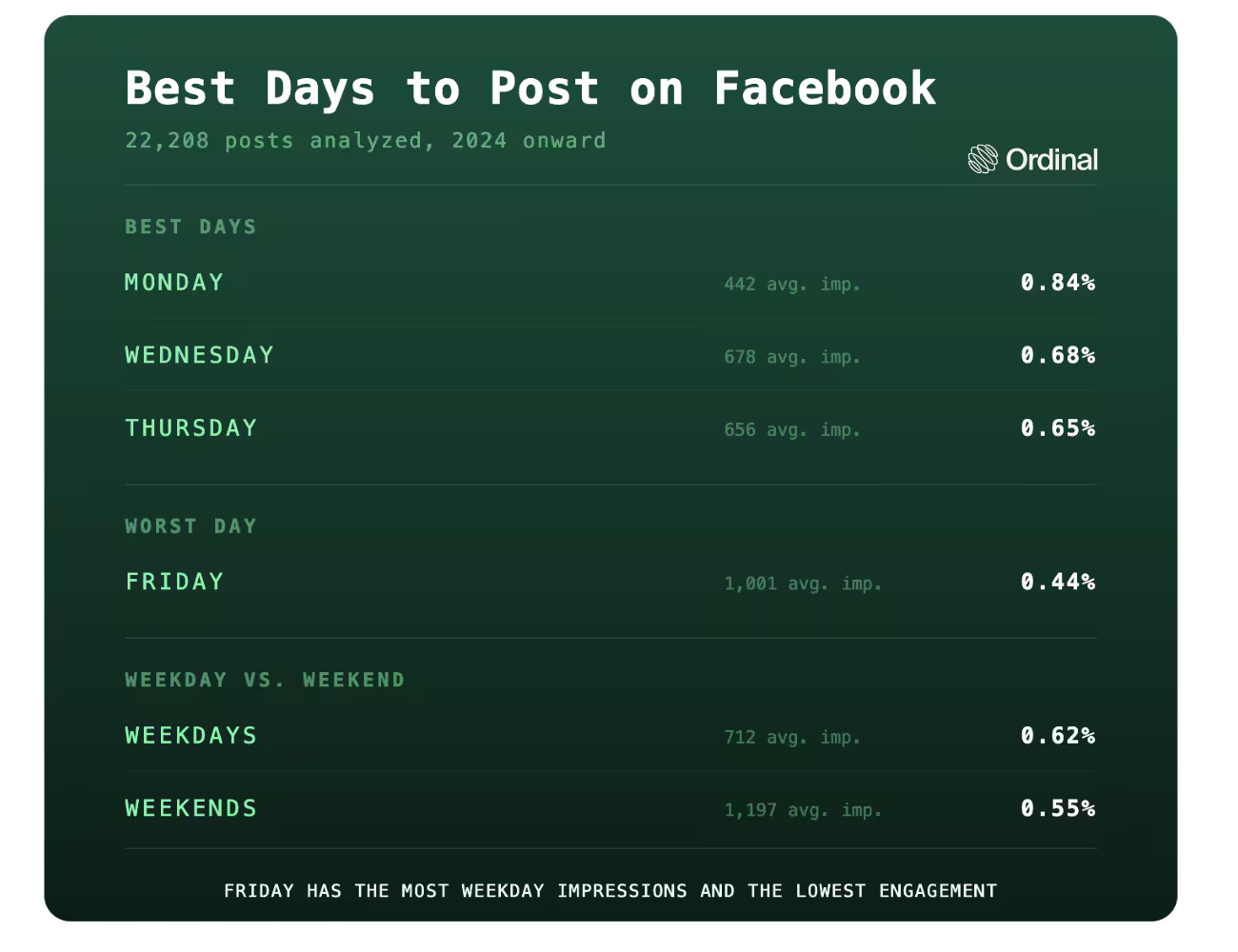
Monday over-indexes likely because posting competition is lower at the start of the week. Fewer brands are publishing, so each post faces less feed competition and captures audiences returning from the weekend.
Friday audiences are distracted. End-of-week mindset doesn't translate to meaningful engagement even when impressions are high.
The weekday vs. weekend split is worth unpacking. Weekday posts average a 0.62% engagement rate compared to 0.55% on weekends, but weekend posts average 1,197 impressions per post versus 712 on weekdays. If you're running a brand awareness campaign where raw reach is the goal, weekend posting has a case. For engagement rate, weekdays win.
Best Hour of Day to Post on Facebook
10:00 UTC is the highest engagement-rate hour at 1.67%. That's followed by 03:00 UTC at 1.48% and 04:00 UTC at 1.33%, though those early-morning hours have much smaller sample sizes (under 250 posts each), so treat them as directional.
- 10:00 UTC: 696 posts, 1.67% engagement rate
- 14:00 UTC: 3,466 posts, 1.01% engagement rate
- 16:00 UTC: 2,419 posts, 1.28% engagement rate
- 17:00 UTC: 1,990 posts, 0.89% engagement rate
- 20:00 UTC: 858 posts, 0.21% engagement rate
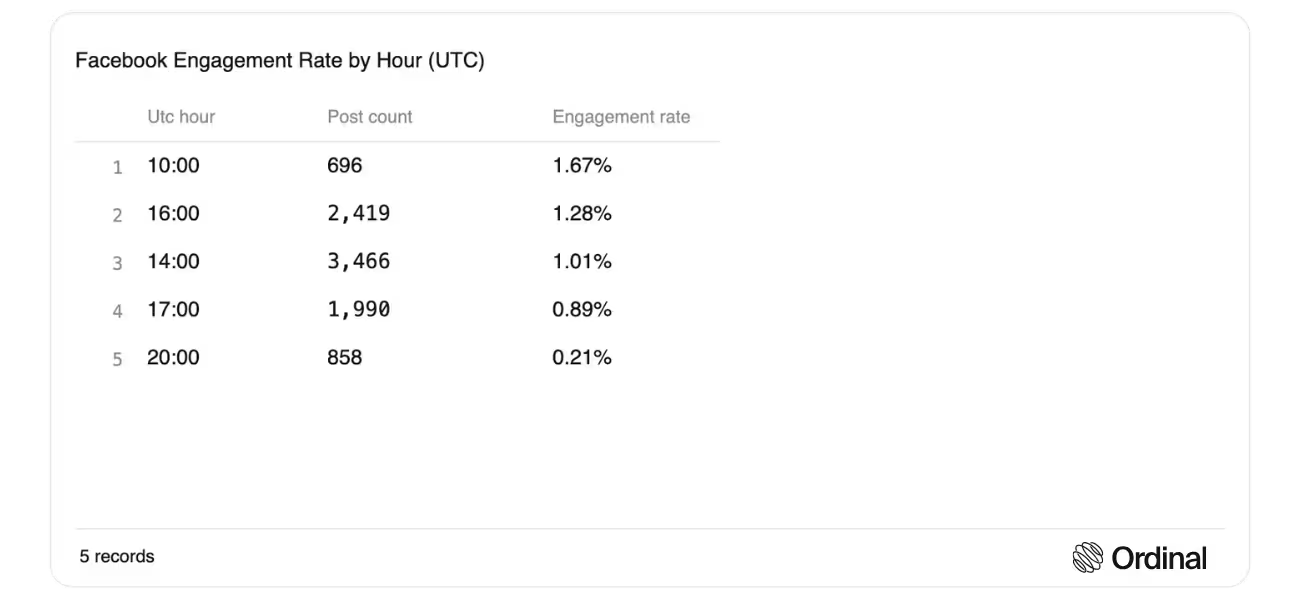
The busiest posting window, 13:00 to 16:00 UTC, is where most teams default, scheduling content during their afternoon workflow. But it's not where engagement peaks.
The 10:00 UTC slot has both a strong sample size and the highest rate in the dataset. For U.S.-based teams, 10:00 UTC is roughly 5–6 a.m. Eastern, so this maps to audiences in time zones where early morning is already active, like Europe and the Middle East.
The practical takeaway for B2B teams in North America: post earlier than your competitors. If everyone schedules at 1 p.m. ET (18:00 UTC), you're competing for the same feed real estate at a notably lower engagement rate.
Best Times by Content Format
Posting time interacts with format in ways that matter for how you build your content calendar.
Carousels are the standout format for engagement rate. Tuesday delivers 2.01% and Thursday 1.73%, both well above the overall dataset average. If carousels are part of your content mix, mid-week is where they earn the most traction relative to how many people see them.
Images are the most consistently reliable high-volume format. Friday at 1.54% and Monday at 1.40% lead the week for images. Notable because Friday otherwise underperforms on overall engagement rate. Friday isn't a write-off if you're posting a single strong image rather than a link or text update.
Videos pull the highest average impressions of any format. Friday averages 3,096 impressions per video post. But engagement rates sit between 0.19% and 0.40% across the entire week. That's not a failure of timing. It's how audiences consume video on Facebook: they watch without reacting. For reach, video works.
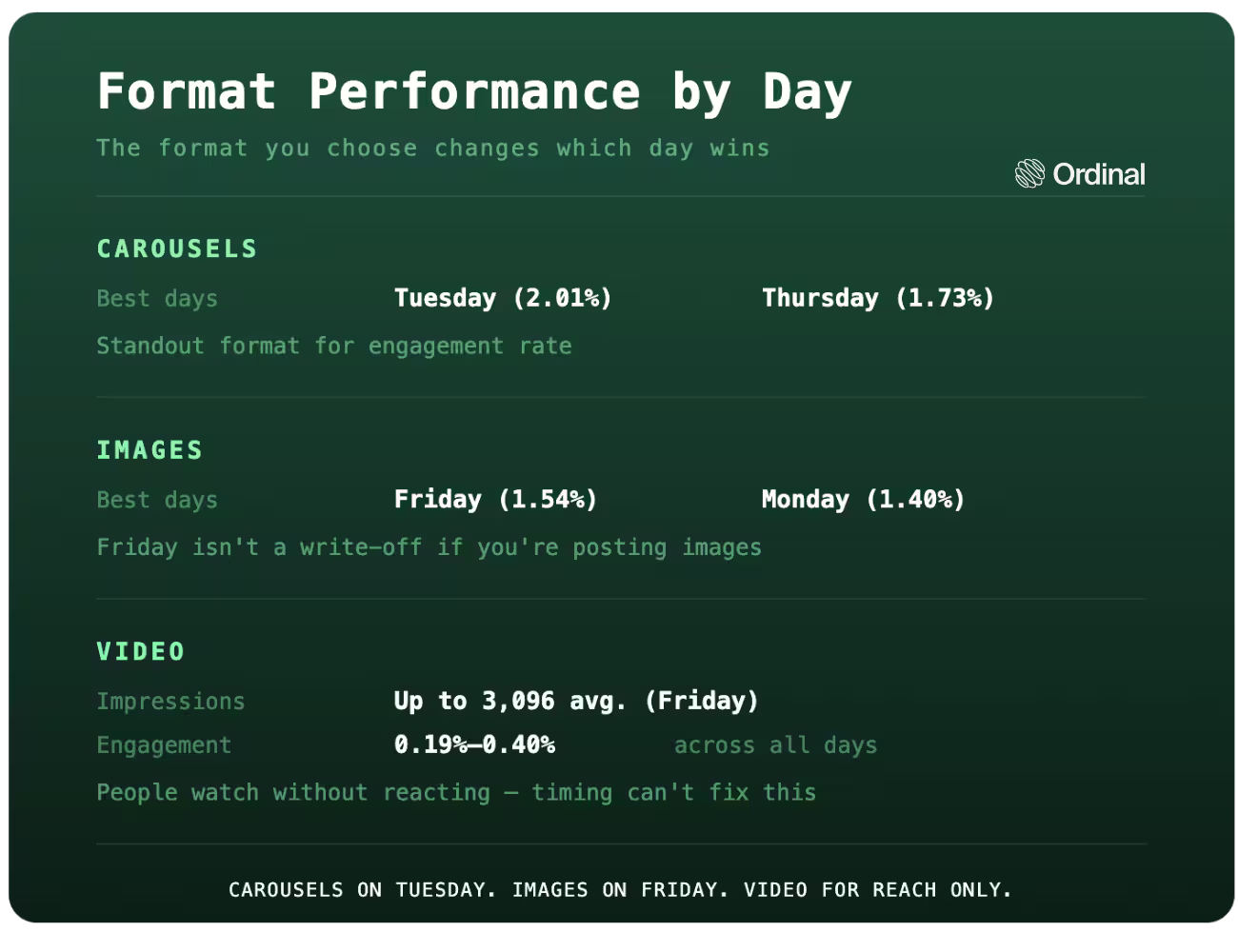
For engagement rate, timing can't close that format gap.
For Facebook Reels specifically, Reels timing research from Sprinklr identifies Wednesday through Saturday, 10 a.m. to 12 p.m. and 7 p.m. to 8:30 p.m., as the strongest windows.
Best Times by Industry
Industry matters. The Tuesday–Thursday morning pattern holds broadly, but Sprout Social's breakdown shows meaningful variation by sector.
Education performs best on Wednesdays from 10 a.m. to 4 p.m. Government accounts peak Tuesday through Thursday afternoons. Retail performs best Monday and Tuesday mornings and tends to underperform on Sundays. E-commerce follows a similar weekday morning pattern, with weekend afternoons lagging.
B2B SaaS generally aligns with the Tuesday–Thursday morning window, similar to what the data shows for LinkedIn posting times and consistent with decision-makers being most active mid-week.
If you're in a consumer-facing vertical, Instagram timing data shows similar weekday concentration but different peak hours.
How to Find Your Own Best Time
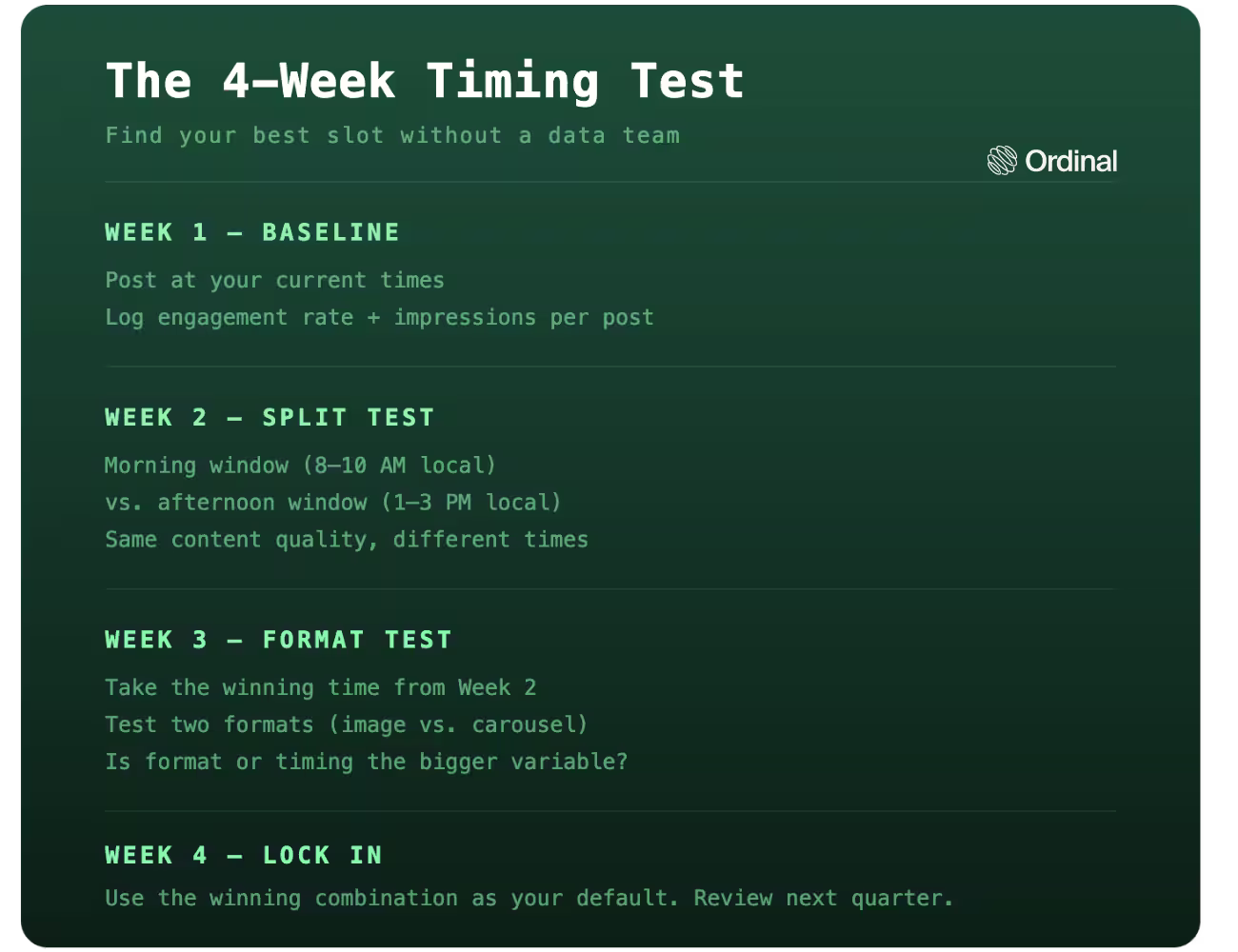
Generic timing data gets you into the right ballpark. Your audience's behavior is what sets the schedule. A 4-week test gets you there without a data team.
Week 1 is your baseline: post at your current times and log engagement rate and impressions for every post.
Week 2, split your posts between an 8–10 a.m. local window and a 1–3 p.m. local window, same content quality, different times, and compare.
Week 3, take the winning window and test it across two content formats (image vs. carousel, for example) to see whether format or timing is the bigger variable.
Week 4, lock in the winning combination and treat it as your default until the next quarterly review.
Track engagement rate, impressions per post, and click-through rate if your content includes links.
A cross-platform publishing tool with format-level analytics filtering makes this faster than sorting through post-by-post data. beehiiv's multi-channel strategy is worth reading if you're managing more than two or three platforms.
For the broader question of how often to post, our posting frequency research found that 3–5 posts per week is the engagement sweet spot on LinkedIn. Similar logic applies to Facebook. Consistency matters more than volume. A solid content planning framework keeps the cadence from collapsing when your week gets busy.
Final Thoughts
The studies aren't wrong. They're answering different questions. Monday wins on engagement rate (0.84%). Friday wins on raw impressions (1,001 per post). Weekend posts reach more people. Weekday posts convert more of them.
If you're forced to pick one slot: Monday or Tuesday morning. If you're running video, prioritize reach windows over engagement windows and accept the rate trade-off. If carousels are in your mix, Tuesday is where they perform best.
The teams that figure this out fastest are the ones tracking engagement rate by format, not just by day. Ordinal surfaces exactly that breakdown, so you can run the 4-week test and see the results without building a custom spreadsheet.
Frequently Asked Questions
What Is the Best Time to Post on Facebook in 2026?
Monday is the highest engagement-rate day at 0.84%, with the best hour at 10:00 UTC (1.67% engagement rate). If you're optimizing for reach rather than engagement, weekend posts average 68% more impressions per post. Based on 22,208 Facebook posts since 2024.
What Is the Worst Time to Post on Facebook?
Friday has the lowest engagement rate at 0.44% despite the highest average weekday impressions (1,001 per post). Late evening hours (20:00 UTC) also underperform at 0.21% engagement rate. High impressions with low engagement rate hurts algorithmic distribution on subsequent posts.
Are Weekdays or Weekends Better for Facebook?
Weekdays win on engagement rate (0.62% vs. 0.55%). Weekends win on reach (1,197 vs. 712 average impressions per post). If engagement is the goal, post on weekdays. If you're running a brand awareness campaign where raw impressions matter, weekends have a case.
What Content Format Performs Best on Facebook?
Carousels lead on engagement rate, peaking at 2.01% on Tuesdays. Images are the most reliable high-volume format, leading at 1.54% on Fridays. Videos get the most impressions but the lowest engagement rates (0.19%–0.40% across the week). The format you choose should match whether you're optimizing for engagement or reach.
How Often Should I Post on Facebook?
Three to five times per week, consistent with what posting frequency research shows for LinkedIn. Consistency matters more than volume. Space posts at least 24 hours apart to avoid cannibalizing your own reach.
How Do I Find My Best Posting Time?
Run a 4-week test. Week 1: baseline at your current times. Week 2: split between morning and afternoon slots. Week 3: test the winning time with two different formats. Week 4: lock in the winner. Track engagement rate, not just impressions, and filter by format.
Related Posts
Looking to learn more? The below posts may be helpful for you to learn more about social media and content marketing.