

You'll read a fair amount of social media competitor analysis guides that hand you a spreadsheet and call it a day. You end up with a column of follower counts and engagement rates and no idea whether 1.2% is good, bad, or median for your space. The templates tell you what to track, but nobody ever tells you what the numbers should mean.
- Company pages average 1.56% engagement rate vs. 0.91% for personal profiles, but personal profiles drove 1.22 billion impressions compared to 162.5 million for company pages.
- Content category matters more than most teams realize: "Shorts" hit 5.40% engagement while "Thought leadership" sits at 0.64%.
- Early auto-engagement (likes, comments, reposts in the first 10 minutes) doesn't move the needle: 0.97% vs. 0.99% for posts without it.
- According to platform growth trends from Hootsuite, TikTok grew its audience 17% year-over-year, LinkedIn 14%, Instagram 13%.
This guide focuses on B2B social, primarily LinkedIn, with cross-platform benchmarks where the data supports it. The goal is a repeatable process you can run quarterly and defend in a planning meeting.
What Social Media Competitor Analysis Means in 2026
Social media competitor analysis is a structured process for benchmarking competitor content, engagement, and share of voice against your own performance. The emphasis is on "structured."
Most teams already look at competitor posts, but few do it consistently enough to spot patterns, and almost none tie what they find back to their own content calendar.
Why this matters more now than two years ago comes down to algorithm shifts and channel maturity. LinkedIn's algorithm has moved toward personal content, and understanding how that algorithm works is a prerequisite before you can interpret what a competitor's engagement rate is actually telling you.
Meanwhile, according to Hootsuite's platform growth data, TikTok grew its audience 17% year-over-year, LinkedIn 14%, Instagram 13%. Channel prioritization decisions have real consequences now, not just vibes.
What competitor analysis isn't: screenshotting competitor posts, tracking raw follower counts, or running a monthly check on how many times a brand posted. Those are inputs, not analysis.
The output that matters is a defensible answer to "what content categories are working for competitors, at what engagement rates, and where are the gaps we could exploit?"
How to Pick the Right Competitors
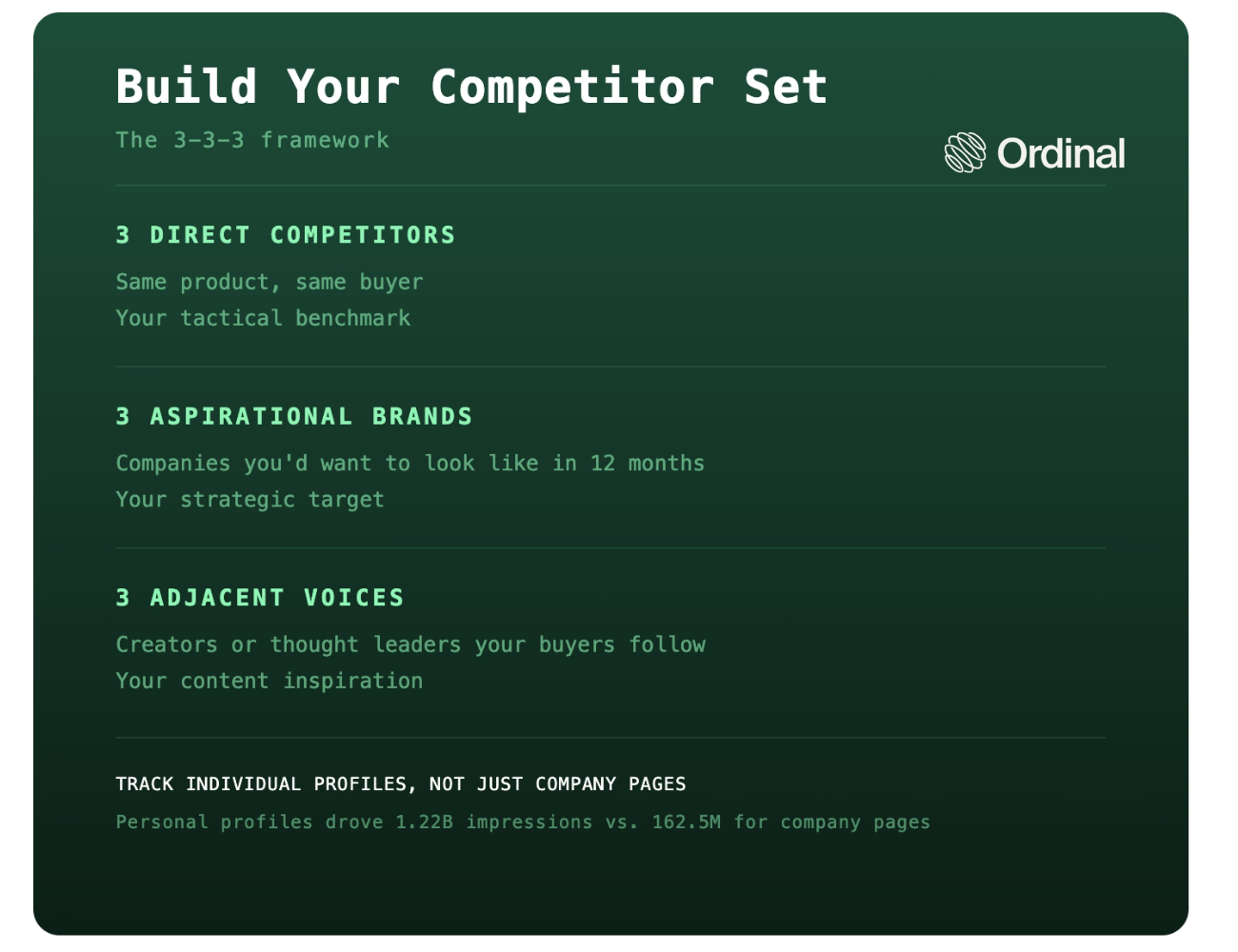
A competitor analysis is only as useful as the comparison set. Track the wrong accounts and you'll optimize for the wrong benchmarks.
Pick three direct competitors (same product, same buyer), three aspirational brands (companies you'd want to look like in 12 months), and three adjacent voices (creators or thought leaders your buyers already follow). This mix keeps you grounded in tactical reality while giving you something to reach toward. Pure direct-competitor tracking tends to produce a race to the middle.
One thing most guides skip: track individual profiles, not just company pages.
Personal profiles drove 1.22 billion impressions versus 162.5 million for company pages. Your competitor's VP of Marketing posting three times a week is a more meaningful signal than their company page. Most teams aren't tracking it.
The 5 Metrics That Matter
1. Engagement Rate
For LinkedIn success metrics, engagement rate means (likes + comments + shares + saves + sends) / impressions.
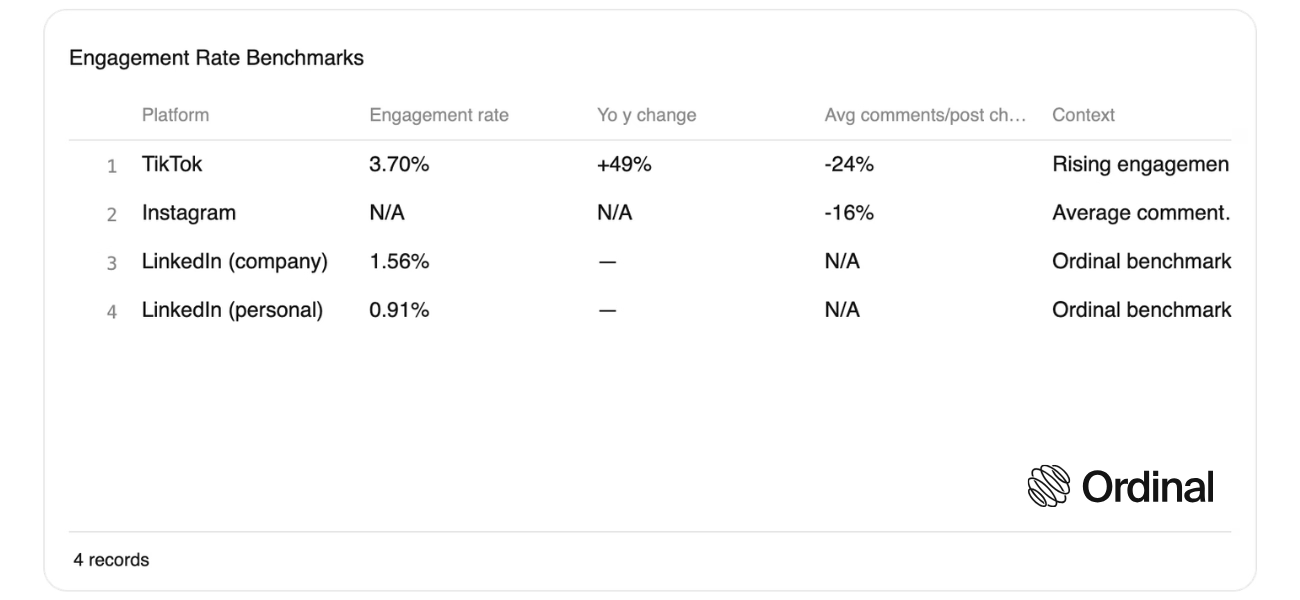
Company pages average around 1.56% and personal profiles 0.91%. Cross-platform, TikTok hit 3.70% in 2026, a 49% year-over-year increase per engagement benchmarks from Socialinsider. Use these as floors, not ceilings.
One counterintuitive finding from the Socialinsider data: despite rising overall engagement rates, average comments per post fell 24% on TikTok and 16% on Instagram in 2026.
Rising metrics don't always mean more active audiences. When a competitor's engagement rate looks impressive, check whether comments are actually there.
2. Posting Frequency and Cadence
Frequency matters, but the relationship isn't linear.
When tracking competitors, note their cadence and whether they're spacing posts by at least 24 hours, since posts published within 12 hours of each other average 17% lower engagement.
Also track posting times. Competitors consistently publishing on Tuesday mornings or Thursday midday aren't doing it randomly.
3. Content Mix by Category
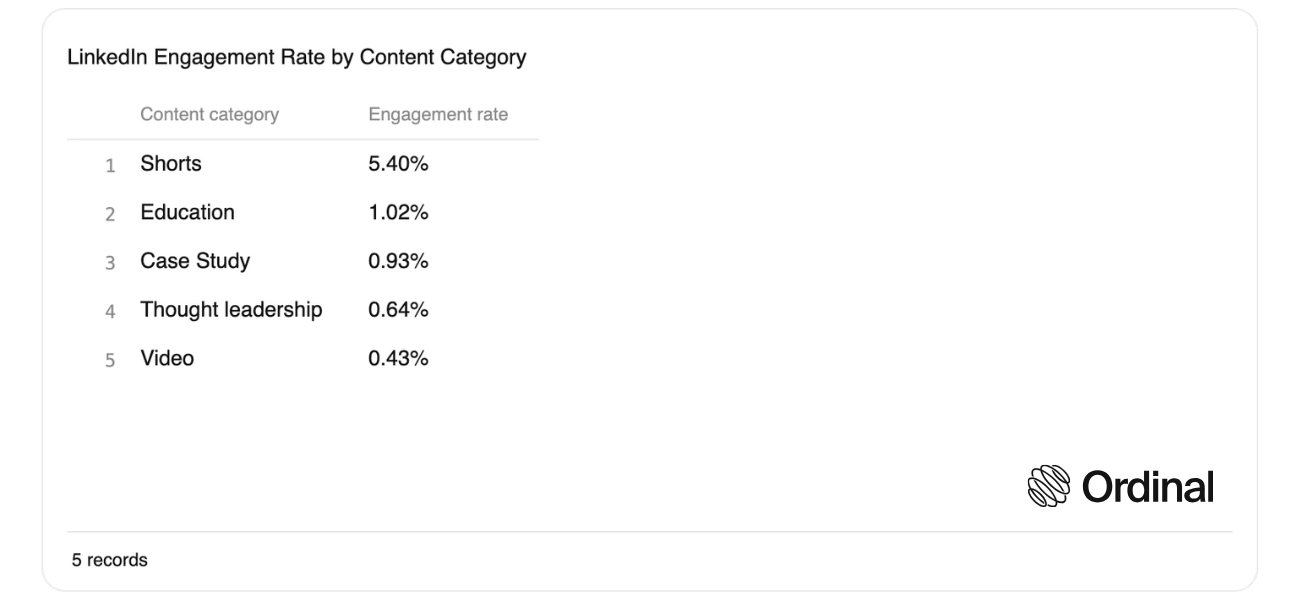
This is where most teams leave the most insight on the table. Ordinal's categorized post data shows dramatic variation by content type: Shorts hit 5.40% engagement, Education 1.02%, Case Study 0.93%, Thought leadership 0.64%, Video 0.43%.
An eightfold gap between Shorts and Thought leadership isn't just noise. When you look at competitor content, label each post by category. If they're heavy on thought leadership and you can produce short-form content, that's a gap worth testing.
4. Share of Voice
Share of voice is your brand's mentions and engagement as a percentage of total mentions and engagement across your competitor set. A reasonable starting target for most B2B categories is 12 to 25% among your top five rivals, though this varies by category maturity.
A free approach: search your brand and competitors manually on LinkedIn and X. Mid-tier tools pull this automatically. Either way, track it monthly so you can see directional movement.
5. Audience Growth Rate
Raw follower count is nearly meaningless as a benchmark. A competitor at 50,000 followers growing 3% per month is a more active threat than one at 200,000 that's been flat for a year. Calculate month-over-month growth rate and watch the trend, not the absolute number.
Platform-Specific Playbooks
LinkedIn is where most B2B competitor analysis should start. According to B2B engagement data from Sprinklr, multi-image posts hit 6.6% engagement versus 5.6% for video in B2B contexts.
If a competitor is consistently running carousels and outperforming your single-image posts, format is the likely explanation. The gap between company page reach and personal profile reach is wide enough that tracking only a competitor's company page gives you an incomplete picture.
Twitter/X
Track thread performance separately from standalone tweets. Threads drive disproportionate reach when the first tweet hooks well. For B2B accounts, look at whether competitors are posting original opinions or just amplifying content. The former builds audience. The latter rarely does.
TikTok
The engagement rate headline (3.70%, up 49%) is real, but the comment drop is the more important signal for B2B brands considering the platform. High engagement with falling comments suggests audiences are watching but not converting into community. That's worth knowing before committing budget to TikTok for a B2B product.
B2B brands using Instagram well, like beehiiv, tend to treat it as a deliberately separate channel from LinkedIn: Instagram for top-of-funnel brand awareness, LinkedIn for conversion-adjacent content.
When analyzing competitors here, look at whether they're running platform-native content or cross-posting from LinkedIn. The accounts doing the former tend to perform better.
Turning Competitor Data Into a Content Strategy
The most useful output from a competitor analysis is three specific gaps: format gaps (they don't use carousels, you could), topic gaps (they avoid product-specific content, you won't), and cadence gaps (they post twice a week, you can post five times).
Start by labeling your own content with the same categories you used to analyze competitors. If you tagged a competitor's posts as Education, Thought leadership, and Case Study, your posts need those same labels before you can run a meaningful comparison.
Where to Go From Here
Pick three direct competitors. Pull their last 30 days of posts and label each one by content category (Education, Thought leadership, Shorts, whatever fits). Calculate engagement rate by category. Then find one format gap to test in the next 14 days.
That's the whole process. The teams that do this quarterly, with consistent labels and a running baseline, are the ones who show up to planning meetings with defensible answers instead of screenshots.
Frequently Asked Questions
What Is a Social Media Competitor Analysis?
A social media competitor analysis is a structured process for benchmarking competitors' content performance, posting behavior, and audience growth against your own. It covers engagement rate, content mix, posting frequency, and share of voice across the channels where your buyers spend time. The goal isn't knowing what competitors post. It's knowing whether it's working and where the gaps are.
How Often Should I Run a Competitor Analysis?
A full analysis quarterly is enough for most B2B teams. Monthly lightweight tracking (engagement rate and top posts) keeps you calibrated without creating noise. More frequent than that tends to produce anxiety rather than insight.
What's a Good Engagement Rate to Benchmark Against?
It depends on platform and account type. Company pages average 1.56% and personal profiles 0.91%. On TikTok, Socialinsider puts the cross-platform average at 3.70% in 2026. Use these as floors when setting targets.
Which Competitors Should I Track?
Three direct competitors (same product, same buyer), three aspirational brands (companies you'd want to look like in 12 months), and three adjacent voices (creators or thought leaders your buyers already follow). This mix balances tactical benchmarking with strategic inspiration.
What Tools Should I Use?
Native analytics plus a spreadsheet works for three to five competitors. For cross-platform benchmarks, Socialinsider provides solid data. For ongoing tracking with internal performance attribution, a LinkedIn analytics platform like Ordinal lets you label content categories and benchmark against your own historical baseline.
Should I Copy Competitor Content That's Performing Well?
Copy the format, not the content. If a competitor's interview series is driving engagement, test interviews with your own guests and angle. Content category matters more than topic: Shorts outperform Thought leadership by an order of magnitude regardless of what's actually said in the post.
Does Auto-Engagement Help Posts Perform Better?
Probably less than most teams assume. Posts with auto-engagement in the first 10 minutes averaged 0.97% engagement versus 0.99% for posts without. Two basis points. Treat early engagement as a small accelerant, not a content strategy.
Related Posts
Looking to learn more? The below posts may be helpful for you to learn more about social media and content marketing.