The sentence "That's good news for a CTO with 1,800 followers." makes an unverifiable claim (implying a specific unnamed CTO's follower count as evidence).
For Series A and B SaaS marketers, employee advocacy usually starts with a CEO asking why the competitor has a program and you don't. But is a leaderboard-style reshare program worth the budget, or does a small bench of real voices deliver more pipeline?
The history here is older than LinkedIn.
IBM once enforced a dress code so strict that "dark suit, white shirt" became shorthand for corporate conformity. It held until Lou Gerstner relaxed it in 1995. A decade later, the same company let its employees write the rules for how they'd talk in public. In 2005, IBM staff drafted the company's first blogging guidelines on an internal wiki, and one of the core rules told people to write in the first person.
The company that had scripted what its people wore decided their unscripted voices were worth more than a uniform one.
The leaderboard-style employee advocacy program is that dress code all over again. Two hundred employees resharing the same brand post in the same week look identical in the feed. A Series A or B SaaS company gets more pipeline from five to ten people posting in their own words, and the budget earmarked for a gamified reshare tool should go into ghostwriting and approvals for that small bench.
Employee advocacy is the practice of employees sharing their company's content, expertise, or point of view on their own social profiles.
In B2B SaaS that mostly means LinkedIn. It ranges from one-click reshares to executives publishing original posts under their own names. The gap between those two ends is where this whole argument lives.
TL;DR:
- Only 27.3% of CMOs had an employee advocacy program running in 2026 (DSMN8 advocacy statistics), so you're less behind than your CEO thinks.
- Programs are built for visibility: 81% target brand awareness while 46% target leads and sales (DSMN8 2026 benchmarks).
- A ghostwritten bench of 5-10 named voices beats a reshare leaderboard for pipeline, because buyers respond to people with opinions.
- The hard part is the workflow. You need voice capture, blocking approvals with a fixed turnaround, and sourced meetings tracked per voice.
- Leaderboards are optional. You can bolt one on later.
What Does Employee Advocacy Mean for a B2B SaaS Team?
For a Series A or B SaaS company, employee advocacy means a small, named group posting on LinkedIn every week about the problems your product solves. Usually that's the CEO, a cofounder, the head of sales, and one or two subject matter experts.
It's rarer than it looks from outside. Only 27.3% of CMOs said they had any program running in 2026, according to DSMN8's 2026 data.
Ownership explains why so many programs drift toward participation contests. HR manages 39.6% of employee advocacy programs, compared with 33.9% run by marketing and 17% by corporate communications (DSMN8, 2026).
An HR-owned program is built to make the company look like a good place to work. That's a fine goal. But it's measured by how many people joined in.
The usual benefits (reach, trust, recruiting) are real enough to skip arguing about. The distinction that matters is simpler. A brand page speaks for the company. A person speaks for themselves. Buyers on LinkedIn mostly listen to the second one.
Why the Leaderboard Advocacy Model Measures the Wrong Thing
Advocates are posting more often than ever. The benchmark data shows the problem.
68% now share company content at least three times per week, up 13 percentage points year over year, with 21% sharing more than five times weekly (DSMN8, 2026). Cadence is climbing, while leads still trail awareness by 35 points as a stated objective.
The system is very good at producing activity. A leaderboard counts shares, so it rewards whoever clicks "repost" most. The person at the top is rarely the one a buyer wants to hear from. When twelve people at one company reshare the same product announcement on a Tuesday, their overlapping connections see one post twelve times.
More resharers won't fix reach either. Our analysis of company page reach showed how little distribution brand content earns on its own. A reshare is still brand content, just with a person's photo next to it. The fix is a different author.
Reshare leaderboard
- Who posts: Dozens to hundreds of employees resharing brand posts
- What it optimizes: Share counts and participation rate
- Pipeline visibility: Low, since activity isn’t tied to accounts or meetings
Ghostwritten exec bench
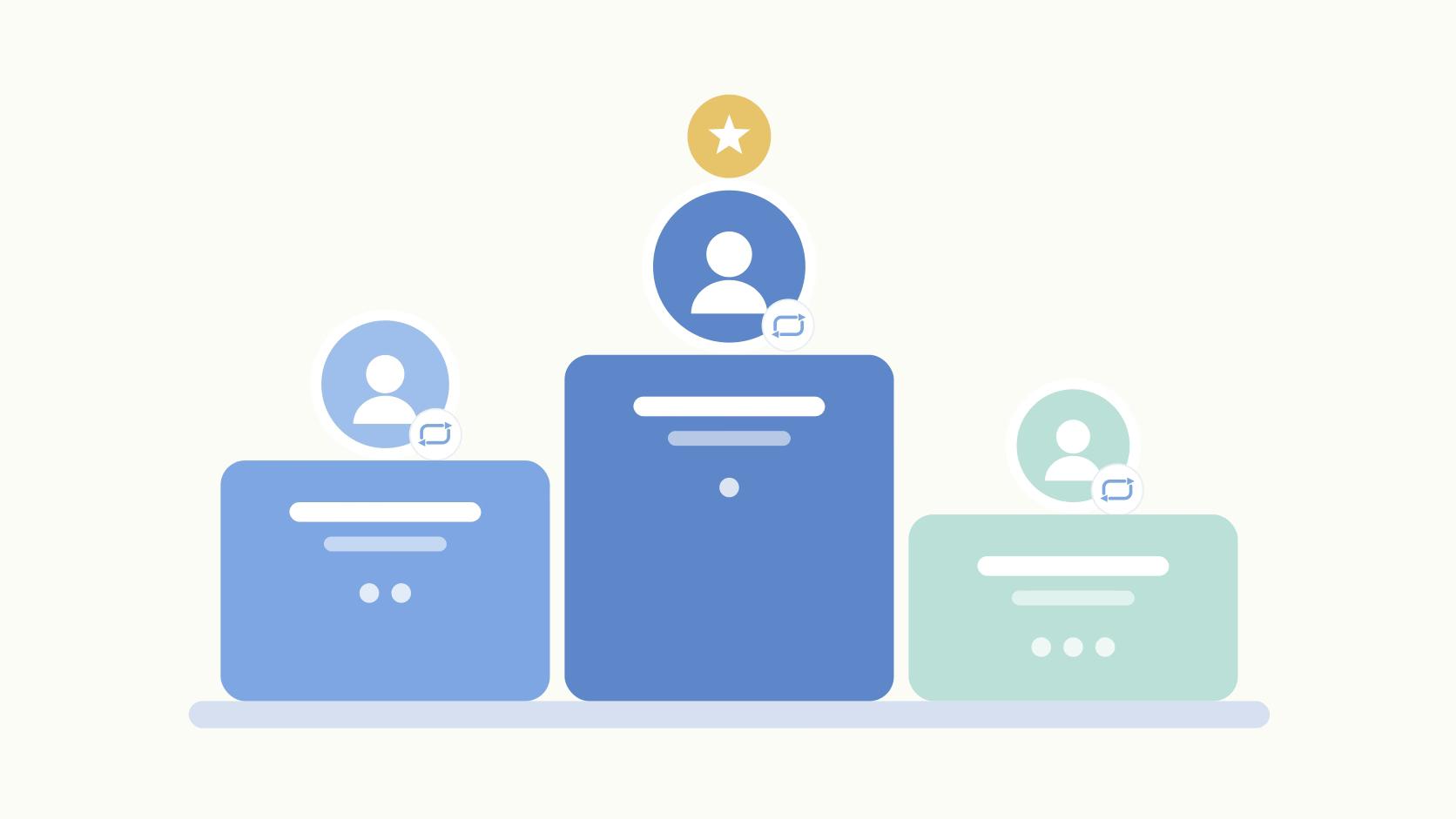
- Who posts: 5–10 named people posting original content in their own voice
- What it optimizes: Inbound conversations from buyers
- Pipeline visibility: High, with sourced meetings tracked per voice
Ad-hoc Slack pings
- Who posts: Whoever sees the message and has a minute
- What it optimizes: Early likes on a single post
- Pipeline visibility: None, because nobody records anything
If you're in row three today, row one feels like the obvious next step. We'd skip it.
How to Ghostwrite for Five Executives Without Sounding Like AI
The bench works because personal profiles pull far more impressions than company pages. Our B2B LinkedIn playbook breaks down the gap.
Our influencer content strategy research also shows smaller profiles engaging at higher median rates than the biggest accounts. That's good news for executives who haven't built a large following yet. What you need is people with a point of view and a system that gets their thinking onto the page without eating their week.
- Pick the bench by buyer relevance. Start with the CEO. Then add the people buyers already want to talk to: the CTO who can explain the architecture, the head of sales who hears every objection, a customer success lead who knows what breaks after month three. Five is plenty. Anyone who won't give you 30 minutes a week shouldn't be on the list.
- Build a voice file before writing anything. Pull their last 20-30 LinkedIn posts, a few long Slack messages, and two or three recorded calls (Gong clips and podcast appearances work well). Write down the phrases they repeat, the words they'd never use, how long their sentences run, and whether they write dense paragraphs or short lines. Keep a running story bank of every anecdote, tagged by topic.
- Interview weekly and write from the recording. A 30-minute call where the writer asks "what annoyed you this week?" beats any content calendar. A ten-minute tangent about why a deal slipped becomes a post, in the exec's own wording wherever possible.
- Batch drafts per voice. Two or three drafts per person per week is sustainable for one writer covering five people. Approvals happen once a week instead of daily.
Moving Drafts to Sign-Off Without Slack Ping-Pong
Approvals are where ghostwriting setups quietly die.
The draft goes to the CEO in a Slack DM. The CEO rewrites it at 11 p.m. The writer can't tell which version is final. The post either sits for nine days or goes out unreviewed. Both outcomes teach the exec that the program is more work than it's worth.
Start with blocking approvals, so a post literally can't publish until its author approves it. That removes the "did this go out without me?" fear that makes executives hover. Next, have the exec edit inline on the post itself, so changes and comments live in one place with version history. Finally, give every approver one inbox and a defined turnaround (we like 48 hours). Missed posts slide to the next slot instead of publishing.
Set a two-round limit too. If a draft needs a third round, the brief or the voice file is broken. Fix that instead of rewriting the post again.
What Makes a Post Sound Like Its Author?
Executives clock AI-written posts faster than anyone, because they know how they talk. The tells are structural: a one-line hook, three tidy bullets, a closing "What's your take?", and an anecdote with no name, number, or date.
Posts that sound like their author do three things:
- They include one detail only that person would know, like the customer who churned in week six or the hiring mistake from 2022.
- They state an opinion the exec would defend at dinner, even one that irritates part of the audience.
- They keep the exec's natural structure, even if it breaks every formatting rule a growth guide ever published.
Our test is blunt. If you could swap the name and run the post on a competitor CEO's profile, kill it.
How to Tie an Employee Advocacy Bench to Pipeline
A bench of five is small enough to measure by hand. That's its big advantage over a 200-person program. Track these per voice, monthly, in a single sheet:
- Inbound DMs and connection requests from people at ICP accounts, logged with a one-line note on what prompted them.
- Sourced meetings, captured through a free-text "How did you hear about us?" field on your demo form and a CRM source value for each bench member.
- Influenced opportunities, meaning open deals where a contact engaged with a bench post in the previous 90 days.
That last one is softer, so report it separately from sourced meetings. Our guide to social selling covers the CRM side.
The industry has mostly moved past spreadsheets. 67% of advocacy programs use dedicated platforms, while 28% are still managed manually (DSMN8, 2026). But a platform built around share counts will hand you share counts. A bench needs approvals, drafts, and engagement data in one place, plus a way to cross-reference your CRM.
Leaderboards can earn a place once the bench works and other people want in. Some teams build their own on top of their posting data:
"We've seen folks vibe code dashboards to manage their employee advocacy program on top of the Ordinal data - they create leaderboards about the top advocates, it's really gamified, and it's in the company's brand." (Jeffrey Zhao, Ordinal)
That's the right order. Voices first. Scoreboard second, if at all.
How Ordinal Supports a Small Advocacy Bench
Ordinal is built for the bench model. Blocking approvals stop posts from publishing without sign-off. Approvers get Slack notifications and edit inline, and social managers can see which approvals are overdue.
Through the MCP, AI-assisted drafts pull from each exec's actual posting history (tone, formatting, style cues). The writer starts from something that already sounds like them. Auto-likes, auto-comments with randomized timing, and Slack boost channels cover the first minutes after a post goes live.
To be straight about the gap: Ordinal doesn't have native leaderboards or onboarding flows for 200-plus person programs yet. An AI-powered advocacy solution is on the roadmap, and today teams build their own dashboards through the MCP. If a large gamified program is a hard requirement, our roundup of employee advocacy platforms compares the options.
Start With Five Names Before Signing a Leaderboard Contract
Before you sign anything, write down five names. Run the bench for six weeks.
Interview each person weekly. Ship two posts each per week through a real approval step. Log every inbound DM and sourced meeting in one sheet.
When your CEO asks why you don't have a program like the competitor's, hand them that sheet with names, posts, and meetings on it. It's a better answer than a participation rate.
Frequently Asked Questions
What Is a Benefit of Employee Advocacy for an Employer?
The clearest benefit of employee advocacy is reach you don't pay for, since personal LinkedIn profiles consistently out-reach company pages. A handful of employees posting in their own words will outperform the brand page without touching the ad budget.
What Are the Four Steps of Effective Advocacy?
Pick a bench of 5-10 voices, capture each person's voice from past posts and recorded calls, route drafts through a fast blocking approval, and track pipeline signals per voice. Inbound DMs and sourced meetings matter far more than share counts.
Which Social Media Platform Is Best for Employee Advocacy?
LinkedIn is the best platform for B2B SaaS employee advocacy, because buyers already expect founders and employees to talk shop there. Twitter/X works as a secondary channel, but LinkedIn should be the default.
What Is an Example of Employee Advocacy?
A sales rep posting a specific story about a customer win, in their own words, is employee advocacy. So is a founder sharing a real opinion about a product decision instead of a scripted company update.
What Is Sprout Advocacy?
Sprout Social's advocacy tool lets companies push pre-approved content to employees for one-click resharing, typically tracked through leaderboards. It's built for breadth (many employees sharing occasionally) rather than a few people posting original content often.
How Many Employees Do You Need for an Employee Advocacy Program?
Five to ten named people posting consistently is enough for a Series A or B employee advocacy program. Start with the executives and salespeople closest to the pipeline instead of a company-wide rollout.
How Do You Measure Employee Advocacy ROI?
Measure employee advocacy ROI through inbound DMs, sourced meetings, and influenced opportunities per voice. Only 46% of programs are built around leads and sales according to DSMN8's 2026 benchmarks. That's why so few can show pipeline impact.
Related Posts
Looking to learn more? The below posts may be helpful for you to learn more about social media and content marketing.