

"Free competitor analysis tool" is a phrase that collides with reality fast. Ahrefs runs a genuinely free tier for verified site owners, Social Status has a free plan capped at one report, and everything else in this category gates the interesting data behind a trial or a paid month. So this roundup covers both: the tools with a real free entry point, and the ones where the cheapest paid tier is low enough to justify a single month of digging into your competitors before you cancel.
One warning before you start signing up.
Across Trustpilot, the loudest complaint about nearly every tool here is billing rather than data quality. Cancelled trials that charged anyway come up again and again, along with cancellation flows that hide a confirmation step and refund requests that got denied outright. So if you're trialling any of these, put the cancellation date in your calendar and screenshot the confirmation page. The table below covers pricing, standout features and ratings for each tool at a glance.
At a glance
What Makes a Good Free Competitor Analysis Tool
Real free access vs. trial gimmick
Only one tool here gives genuinely free ongoing access; the rest either cap a free plan at a single report or rely on a paid trial you have to remember to cancel. Whether there's an actual $0 entry point, versus a low-cost first month, changes how you should approach testing the tool at all.
What kind of competitor data it surfaces
These tools don't all answer the same question — some reverse-engineer paid search and ad history, some track backlinks and organic traffic, others measure content shares or media/journalist mentions. Matching the tool's core data type to what you actually need to know about a competitor matters more than overall feature count.
Pricing versus who it's built for
Starting prices span from $29/month to $199/month, and the value only makes sense against the intended user — a single site owner, an agency, or a high-volume content team. The article's verdicts repeatedly hinge on this fit rather than on price alone.
Data accuracy complaints
Multiple entries carry reviewer disputes over whether keyword volumes, traffic estimates, or authority scores can be trusted, sometimes pitting one tool's numbers against another's. It's worth checking a tool's estimates against your own analytics rather than taking dashboards at face value.
AI-answer and search-visibility tracking
Several tools have added features tracking how a brand appears in AI-generated answers or AI search assistants, alongside traditional rank tracking — a newer axis worth checking if AI-driven discovery matters to your category.
The Competitor Analysis Tools Worth Shortlisting
1. SpyFu
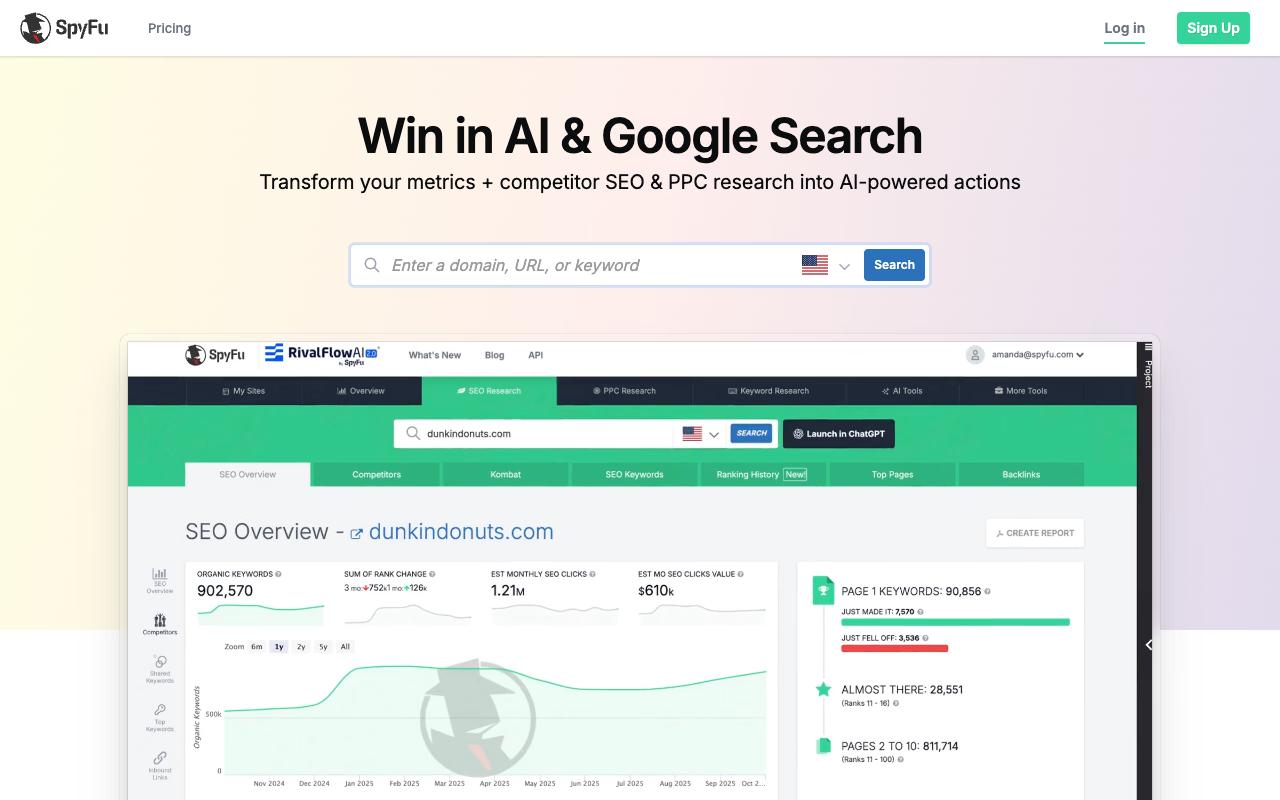
SpyFu is built around one specific question: what your competitors are buying and ranking for on Google. You enter a domain and get every SEO keyword it ranks for, every PPC keyword it's bought, and the full history of ads it's tested, including the campaigns it abandoned. It's aimed at digital marketers, SEO/PPC specialists and agency owners who want to reverse-engineer a competitor's paid search strategy rather than just audit their own site.
Pros:
- Consolidates keyword, PPC, ad copy, CPC, and competitor data in one dashboard
- More affordable than competitors like Semrush/Ahrefs, plans starting around $39/month
- Highly praised, responsive customer support
- User-friendly interface with helpful tooltips explaining terms
- SpyGPT add-on for tracking how AI/LLMs present a brand
Cons:
- Multiple reports of unauthorized or fraudulent billing/charges after cancellation
- Reliability issues: freezing, crashing, slow searches
- SEO/backlink tools and reporting visuals feel outdated compared to competitors
- Data/estimate accuracy questioned in some cases
- Weaker data and support for UK-based users
- No free trial available
Pricing starts at $39/month for Basic (10k row exports, 1 Live Site project, 5k weekly tracked keywords), with Pro + AI at $119/month after a $59 first month and Team/Agency at $249/month, according to SpyFu's pricing page. Note that there's no free trial.
On TrustPilot, SpyFu holds 4.4/5 across 152 reviews. Reviewers consistently praise the consolidation of keyword data, paid search insights, ad copy examples, CPC and search volume in a single dashboard, with one five-star reviewer saying the "domain overview was especially helpful because it gave me a clear snapshot of what competitors were ranking for and what keywords they were buying." Support comes up repeatedly as a strength, and the sub-$40 entry price gets flagged as more affordable than the bigger platforms. The negative reviews are harder to shrug off, with multiple reports of unauthorized or fraudulent charges after cancellation, plus complaints about freezing and slow searches, dated backlink tooling, and weaker data coverage for UK users.
On Capterra, SpyFu holds 4.4/5. Reviewers commonly praise affordable, easy-to-use tool for competitor and keyword research and note limited depth or precision of certain data and reporting features. See the Capterra reviews page.
On G2, SpyFu holds 4.6/5 across 513 reviews. Reviewers commonly praise competitive keyword and competitor research capabilities and note interface usability issues and data accuracy limitations.
See the G2 reviews and pros and cons pages.
Verdict: The best value in the category if your competitors run Google Ads, provided you keep a close eye on your billing.
2. Moz
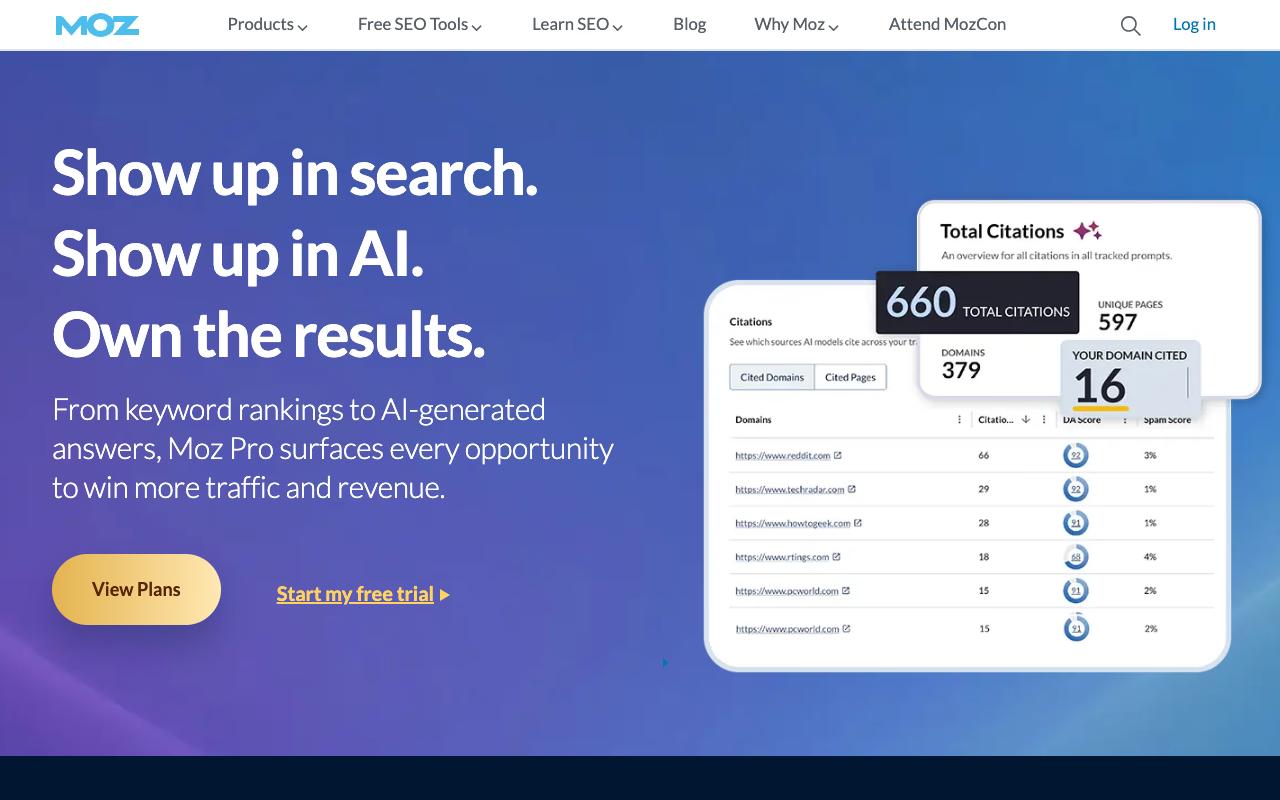
Moz Pro covers keyword research, competitive research, link research, rank tracking and site auditing, with newer features tracking how often a brand appears in AI-generated answers across tracked prompts. The competitive side surfaces a rival's top keywords and best-performing pages alongside Domain Authority and Brand Authority scores. Moz says it's trusted by 500,000+ brands and agencies, and it skews toward SEO professionals and marketers who want guided, learnable tooling rather than raw data volume.
Pros:
- Beginner-friendly, good for learning SEO fundamentals with hand-holding guidance
- Reasonable value/price point for beginners
- Some reviewers report responsive customer service that follows through on bug reports
Cons:
- Frequent billing/cancellation complaints (users charged after cancelling or after free trial ended)
- Difficulty obtaining refunds
- Customer support seen as overly reliant on AI, hard to reach a human for urgent issues
- Reports of unreliable/missing SEO data delivery
- Domain/Page Authority metrics perceived as inaccurate compared to competitors like Ahrefs
Plans run from $49/month for Starter (one website), through Standard at $99/month, Medium at $179/month and Large at $299/month, with Enterprise quoted on request. Annual billing saves roughly 20%, per Moz's pricing page.
Moz sits at 2.4/5 on TrustPilot from 243 reviews, and the score is driven almost entirely by billing rather than the product. One reviewer wrote "Cancelled my free trial on time and they still charged," another said "I cancelled my Moz account, but the cancellation was not honored," and a third described the cancellation page as "A deliberately confusing cancelation page clearly designed to make people think they have canceled when in fact there is another" hidden step. Refunds are reported as difficult to get, and support is criticised for leaning too heavily on AI when someone needs a human. On the positive side, reviewers who stayed found it beginner-friendly and reasonably priced for learning SEO fundamentals, though some question whether Domain and Page Authority hold up against Ahrefs' equivalents.
On Capterra, Moz holds 4.5/5. Reviewers commonly praise easy-to-use seo toolkit and helpful reporting and note higher pricing and occasional accuracy limitations. See the Capterra reviews page.
On G2, Moz holds 4.3/5 across 608 reviews. Reviewers commonly praise user-friendly interface and keyword research tools and note smaller keyword database and limited integrations. See the G2 reviews and pros and cons pages.
Verdict: A gentle on-ramp for someone new to competitive SEO, but read the cancellation flow twice.
3. BuzzSumo
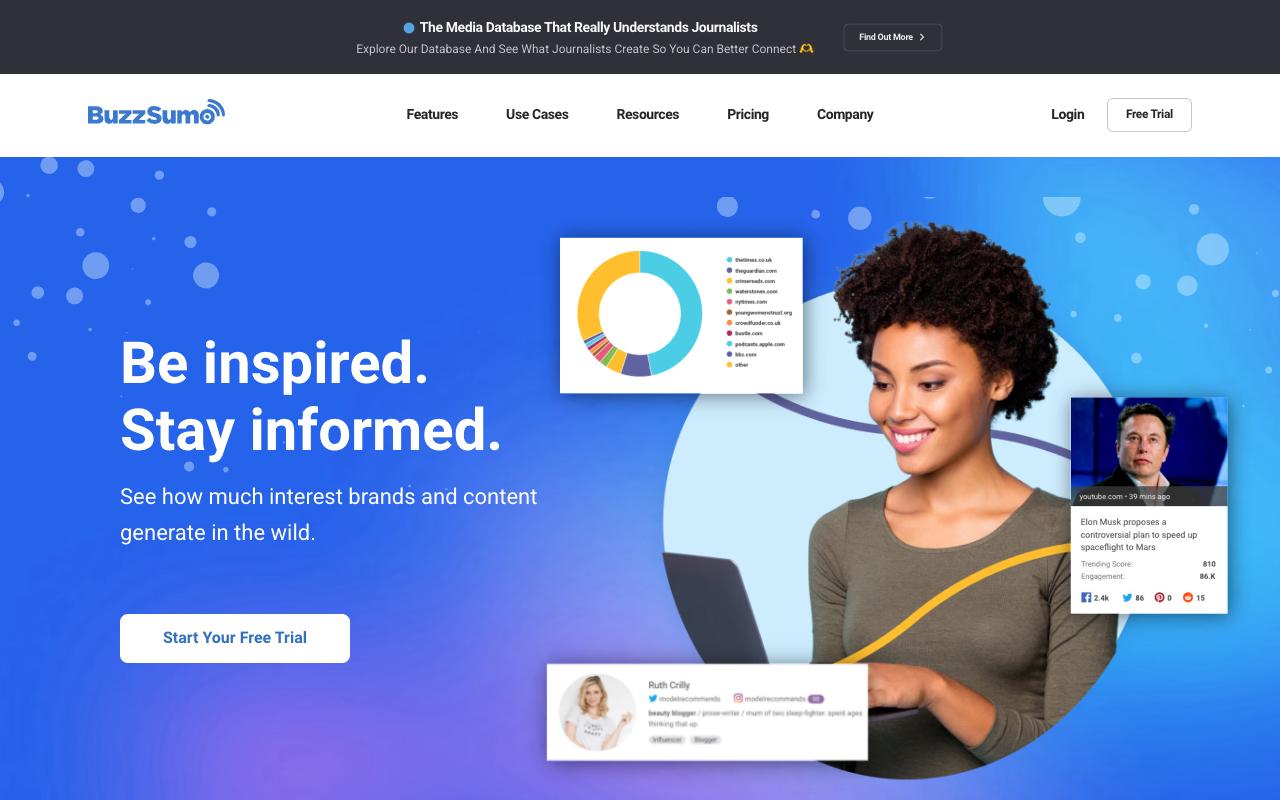
BuzzSumo answers a different question than the SEO platforms. It tells you what gets shared rather than what ranks. Search a competitor's domain and you get their top-performing content by social engagement across Facebook, Twitter, Reddit and YouTube, drawn from an index of 5 billion articles with up to five years of history. It also runs a 700K-journalist media database with coverage reports and mention monitoring, so it's aimed squarely at content marketers, agencies and PR teams.
Pros:
- Effective at finding trending content, blogs, forums and articles on any topic
- Useful and enjoyable tool for content/topic research
- Long-term customers report loving the service for years
Cons:
- Pricing seen as expensive, and has risen significantly over time for some long-term customers
- Features are limited without a Premium membership
- Customer service reportedly unwilling to negotiate on rising prices
- At least one reviewer described a very negative ('scam') experience
Pricing starts at $199/month for Content Creation (1 user, 2 alerts) billed yearly, rising through PR & Comms at $299/month, Suite at $499/month and Enterprise at $999/month. All plans include a free trial.
In an r/SEO thread asking whether BuzzSumo was worth it alongside other tool subscriptions, one commenter called it a great and valuable tool for content research but said it's best suited to agencies or companies producing a high volume of content, and not worth the price for a single site on a budget. Another said they'd run it for six months and found exactly one good journalist through it.
TrustPilot has BuzzSumo at 2.8/5 from just 6 reviews, which is a small enough sample to read individually rather than average. A 2024 three-star reviewer who'd paid since 2020 said they loved the service but described pricing climbing from $1,805 to $2,868 over three years and then to $3,500, with customer service unwilling to negotiate. A German-language four-star review from 2023 praised how quickly it surfaces blogs, forums and articles on any topic while noting features are limited without Premium. One 2025 one-star reviewer called it a scam and said to stay away.
On Capterra, BuzzSumo holds 4.5/5. Reviewers commonly praise comprehensive and reliable content analysis tools that are easy to use and effective for discovering viral topics and monitoring brands and note expensive subscription plans and limited functionality on the free plan, making it less accessible for smaller businesses. See the Capterra reviews page.
On G2, BuzzSumo holds 4.5/5 across 107 reviews. Reviewers commonly praise powerful content research and analytics capabilities for identifying popular topics and influencers and note high pricing and a steep learning curve due to an overwhelming interface and limited mobile support. See the G2 reviews and pros and cons pages.
Verdict: Worth it if you're publishing constantly or pitching press, and hard to justify for one website.
4. Ahrefs
Ahrefs runs on its own web index (170 trillion pages, 41.9 billion keywords tracked), and Site Explorer is the tool most people mean when they say competitor analysis: backlinks, organic traffic, top pages for any domain you point it at. Keywords Explorer adds SERP analysis, full ads history, traffic potential and organic share of voice. It's used by content marketers, PPC specialists, link builders and agencies through to enterprise SaaS teams.
Pros:
- Powerful, comprehensive SEO toolset praised by long-time users as a category leader ("the gold standard")
- Strong core functionality for keyword research, competitor analysis, and backlink data
- Support has issued refunds in some cases when the tool didn't fit a customer's use case
- Actively evolving product, adding new AI-related features over time
Cons:
- Frequent complaints of accounts being locked for "suspicious activity" with little explanation and slow/unhelpful support
- Credit-based plans can leave users blocked from meaningful use once credits are spent, even on expensive tiers
- Perceived as overpriced relative to value, especially after recent pricing changes
- Some reports of unreliable or outdated data (keyword data, SERP data issues)
- Difficulty exporting/printing reports cleanly
Ahrefs Free gives verified site owners limited access to Site Explorer and Site Audit at $0, which is the one no-cost option in this roundup. Paid plans start at $29/month for Starter, then Lite at $129/month, Standard at $249/month, Advanced at $449/month and Enterprise from $1,499/month on annual commitment.
An r/SEO thread running to about 100 comments picks apart the accuracy of Ahrefs' keyword and traffic estimates. One commenter said "ubersuggest has shown better performance for me so far probably because their system gets updated regularly." Another argued that "When there were 10 blue links on Google, Semrush and Ahrefs had it easy" and that "neither of them can produce anything much better than GSC." A third had dropped Semrush because "their metrics were so far off," which cuts both ways as a comment on the category.
One LinkedIn post from a practitioner summed up their position on the toolset simply: "don't see the value in paying for all the others."
TrustPilot puts Ahrefs at 2.1/5 from 319 reviews, and the reviews are genuinely polarized. A user of more than two years said "Ahrefs is still the gold standard" despite recent pricing changes, and another noted support "happily provided a refund" for a tool that didn't fit. But the negative side dominates, with accounts locked for unexplained "suspicious activity," slow support even on expensive plans (one reviewer noted "I bought the 250 USD per month plan"), and a credit system that can block meaningful work once credits run out.
On Capterra, Ahrefs holds 4.7/5. Reviewers commonly praise keyword research, backlink analysis, and overall feature depth and note high pricing, learning curve, and value concerns. See the Capterra reviews page.
On G2, Ahrefs holds 4.5/5 across 714 reviews. Reviewers commonly praise accurate backlink data, user-friendly interface, and comprehensive seo features and note high pricing, credit-based limits, and occasional data or ai accuracy concerns. See the G2 reviews and pros and cons pages.
Verdict: The deepest backlink and traffic data here, and the free tier is worth claiming even if you never upgrade.
5. Semrush
Semrush covers competitive and market data across search, ads and AI answers, with newer AEO features tracking whether a brand shows up when people ask questions of an AI assistant rather than a search box. It's segmented tightly by role and company size, covering solopreneurs and freelancers up through enterprise, with industry cuts for professional services, retail, SaaS and local business.
Pros:
- Core SEO toolset (keyword research, competitor tracking) is valued enough that some customers stay subscribed for years despite billing frustrations
- AI-driven AEO/AI-visibility feature gives an easy starting point for tracking how a brand shows up in AI-led discovery, per a hands-on LinkedIn review
- Support did eventually resolve at least one billing dispute after escalation, per a Trustpilot review update
Cons:
- Widespread complaints about the 7-day free trial converting to an immediate, hard-to-cancel paid charge
- Reviewers describe the cancellation flow as deliberately confusing, including a hidden confirmation step needed to fully cancel
- Unauthorized or surprise add-on charges (e.g. AdClarity) leading to bills of thousands of pounds/dollars
- Refund requests are frequently denied, citing a strict no-refund policy on monthly subscriptions
- Perceived as very expensive for what is delivered
- AEO/AI-visibility feature still immature (recommended prompts can be broad or unrelated to the brand, skewing visibility scores)
The SEO plan starts at $139/month ($117.33 billed annually) for 5 websites and 500 keywords tracked daily. Starter SEO + AI Search is $199/month, Pro+ is $299/month, Advanced is $549/month, with Enterprise quoted custom.
Reddit splits cleanly between power users and people fed up with the pricing. In an r/localseo thread titled "I'M OFFICIALLY DONE WITH SEMRUSH," an eight-year customer paying nearly $400 a month hit a PDF export limit and was asked to pay more to export their monthly reports. Commenters agreed on cost ("Semrush is so dang expensive"), with one switching to a cheaper alternative on a lifetime licence, while others flagged cancellation practices around the 7-day trial.
A practitioner reviewing the AEO feature on LinkedIn was measured about it: "Overall, I like the direction SEMrush is taking here. The feature makes it easy to explore how a brand might show up in AI-led discovery, and it gives a starting point for tracking and analysis." Their caveat was that "the AEO feature still has a long way to go compared to how strong SEMrush is on the SEO side. A lot of the recommended prompts felt not just broad but completely unrelated to the brand."
TrustPilot rates Semrush 1.7/5 across 1,372 reviews, the lowest in this roundup, and almost none of it concerns the product. Free trial billing dominates, with one reviewer describing "scam software, can not unsubscribe from 7 day free trial then charges you." Another said Semrush uses "a deliberately misleading cancellation process designed to charge you an extra month" involving "a hidden confirmation button that needed to be clicked to actually complete the cancellation." Surprise add-on charges (AdClarity comes up specifically) and denied refunds under a strict no-refund policy round out the pattern.
On Capterra, Semrush holds 4.6/5. Reviewers commonly praise accurate website audits and comprehensive seo analytics that are easy to use and feature rich and note expensive plans and limitations in data accuracy for competitive analysis, especially for smaller teams. See the Capterra reviews page.
On G2, Semrush holds 4.4/5 across 4,031 reviews. Reviewers commonly praise powerful all-in-one seo and competitive research toolkit with robust keyword and site audit features and note high pricing and extra cost for add-on features, with a steep learning curve for new users. See the G2 reviews and pros and cons pages.
Verdict: Broad, capable, and the one where you should be most careful about the trial-to-paid transition.
6. Similarweb

Similarweb sells traffic and market intelligence rather than keyword tooling: where a competitor's visitors come from, how engaged they are, what the audience demographics look like, and which marketing channels are doing the work. Higher tiers layer on SEO, AEO and ads intelligence. It's built for marketing leaders, growth and RevOps teams, and it claims over 6,000 customers including 200+ of the Fortune 500.
Pros:
- Easy to use and simple interface
- Useful browser extension that quickly surfaces site data
- Strong customer support responsiveness in some cases (praised for fast, helpful refund/account resolution)
- Seen as a valuable tool for competitive/traffic insights
Cons:
- Expensive, especially for small businesses, with some feeling it's poor value vs. Semrush/Ahrefs
- Basic plan is heavily restricted and requires additional paid upgrades for expected features
- Free trial requires a credit card and can auto-charge ~$199-200 if not cancelled in time
- Some users report unresponsive support when disputing trial charges/refunds
- Homepage URL-lookup criticized as misleading, pushing users toward a paywall after collecting personal info
The self-serve Web Intelligence tiers start at $125/month billed annually ($199 month-to-month) for Competitive Intelligence with 1 user and 3 months of history. Adding SEO and AEO takes it to $333/month annually, and adding Ads Intelligence plus 6 months of history reaches $542/month annually. Business and Enterprise are sales-quoted.
Similarweb sits at 4.4/5 on TrustPilot from 747 reviews, with a lot of short, positive entries ("It's really a great tool", "Easy to use and install"). The browser extension draws specific praise, with one reviewer noting "It reveals outstanding information with only a click away," and support gets named too, including a verified reviewer describing "Outstanding customer support" and an agent who "handled my refund request with genuine kindness and speed."
The negatives cluster on cost and billing. It's expensive for small businesses, the basic plan is restricted enough that expected features need paid upgrades, and the free trial requires a credit card that can auto-charge roughly $199 if you miss the window. Some reviewers also found the homepage URL lookup misleading, since it collects personal details before pushing you toward a paywall.
On Capterra, Similarweb holds 4.6/5. Reviewers commonly praise powerful web traffic intelligence and reliable market and competitor analysis and note high cost and occasional difficulty navigating to specific features. See the Capterra reviews page.
On G2, Similarweb holds 4.4/5 across 1,178 reviews. Reviewers commonly praise comprehensive competitive traffic insights and easy-to-use analytics interface and note data accuracy limitations for smaller sites and high pricing for advanced plans. See the G2 reviews and pros and cons pages.
Verdict: The pick if you care about a competitor's traffic mix and audience rather than their keyword list.
7. Social Status
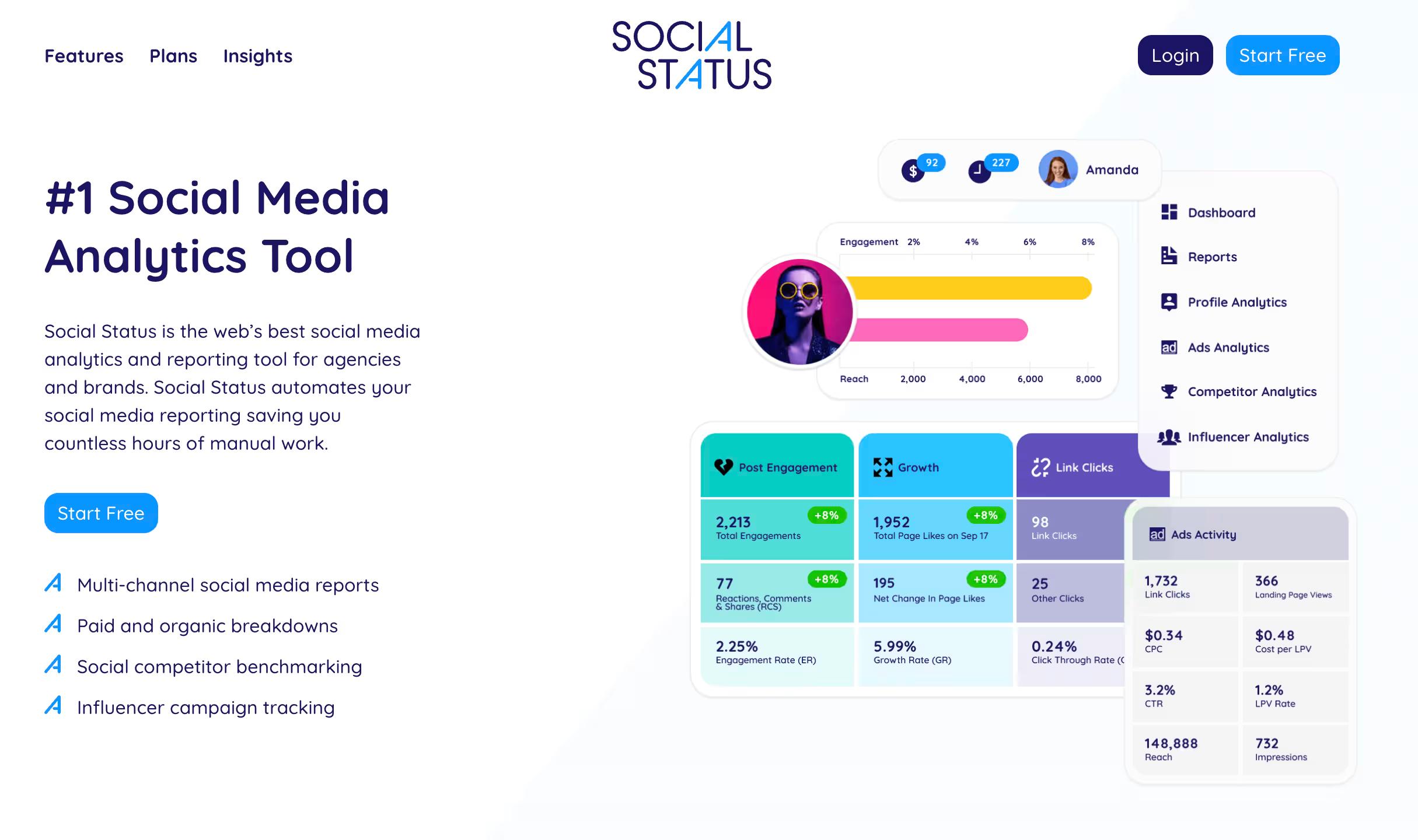
Social Status is the social-side counterpart to everything above. Its Competitor Analytics module benchmarks your performance against any public Facebook Page, Instagram Business/Creator profile, TikTok profile, X profile or YouTube channel, tracking posting frequency, timing, reactions and top-performing posts. Alongside that sit Profile Analytics, Ads Analytics for Meta campaigns and Influencer Analytics, aimed at agencies and brands that spend real time on reporting.
There's a free plan at $0/month (1 plan quota, 1 month of data history, report exports). Paid small business tiers run $9/month for Micro, $29/month for Basic and $49/month for Essential, with Professional plans from $99/month up to $799/month for agencies and enterprises, according to Social Status's plans page. Annual billing saves 25%.
On G2, Social Status holds 4.6/5 across 90 reviews. Reviewers commonly praise ease of use and reporting clarity and note slow report generation and occasional feature limitations. See the G2 reviews and pros and cons pages.
Verdict: The cheapest real entry point here, and the only one that benchmarks social channels rather than search.
Ordinal sits on the other side of this workflow. Once you know what your competitors are publishing and how often, Ordinal is where you draft, plan and schedule your own content across LinkedIn, X, Instagram, Facebook, Threads, TikTok and YouTube Shorts, with a shared content calendar, LinkedIn auto-engagements, and analytics that tie posts back to revenue. It's used by content agencies, founders, social media managers and growth teams running multiple brand accounts at once.
FAQ
Is There a Genuinely Free Competitor Analysis Tool?
Two of the tools here have real free tiers. Ahrefs Free gives verified site owners limited access to Site Explorer and Site Audit at $0/month. Social Status offers a $0/month plan with 1 plan quota, 1 month of data history and report exports. Everything else in this list starts with a paid plan or a card-required trial.
What's the Cheapest Paid Competitor Analysis Tool?
Social Status Micro at $9/month is the lowest paid entry point, though it's social analytics rather than search. For search and PPC competitor data, Ahrefs Starter is $29/month and SpyFu Basic is $39/month. Semrush ($139/month) and BuzzSumo ($199/month) are the most expensive starting points in this roundup.
Why Are TrustPilot Scores So Low for These Tools?
Because the reviews are overwhelmingly about billing rather than the software. Moz (2.4/5 from 243 reviews), Ahrefs (2.1/5 from 319 reviews) and Semrush (1.7/5 from 1,372 reviews) all draw complaints about trials converting to charges, cancellation flows with hidden confirmation steps, and denied refunds. Reviewers who discuss the products themselves are often positive about the same tools they've rated one star for the invoice.
Related Posts
Looking to learn more? The below posts may be helpful for you to learn more about social media and content marketing.