

Competitor search means two different jobs, and the tool you need depends on which one you're doing. If the question is "what keywords are they ranking for and what ads are they buying," you want a search intelligence platform. If the question is "what are they posting, how often, and is it working," you want something that reads social performance. Both matter for B2B, and teams usually end up running one of each.
The five tools below cover both sides. Ordinal handles the social side (competitor content benchmarking plus the publishing engine that acts on what you find), while Ahrefs, Moz, Similarweb, and SpyFu each attack search and ad intelligence from a different angle. Pricing ranges from $29/mo to custom enterprise contracts, and the review picture varies a lot between them. Here's how each one stacks up.
At a glance
What Makes a Good Find Competitor Websites
Search vs. Social Coverage
The article splits competitor research into two distinct jobs: seeing what rivals rank for and advertise on search, versus tracking what they post and how it performs socially. A tool built for one side often can't touch the other, so buyers need to know which gap they're actually filling.
Depth of Underlying Index
The size and freshness of a tool's web, keyword, or traffic index directly determines how trustworthy its competitor numbers are, and reviewers across the board question whether the data matches reality in their niche.
Insight-to-Action Gap
Some tools stop at surfacing what a competitor is doing, while others let you act on that finding inside the same product, whether that's posting content or running a campaign. Whether a platform closes that loop changes how much extra stack you need around it.
Pricing Structure and Predictability
Flat monthly tiers, credit-based limits, and custom sales-only enterprise quotes create very different buying experiences, and several entries show credits or hidden seat costs eating into value even on expensive plans.
Billing and Cancellation Trustworthiness
Beyond the sticker price, how a vendor handles trials, cancellations, and refunds shows up repeatedly in reviews as a real differentiator, with some tools accused of charging after cancellation or burying the cancel flow.
AI Search Visibility Tracking
Several tools now extend competitor research into how brands show up inside AI answers and chatbots, not just traditional search results, which matters if a buyer's competitive landscape is shifting toward AI-driven discovery.
The Best Competitor Search Tools for B2B
1. Ordinal
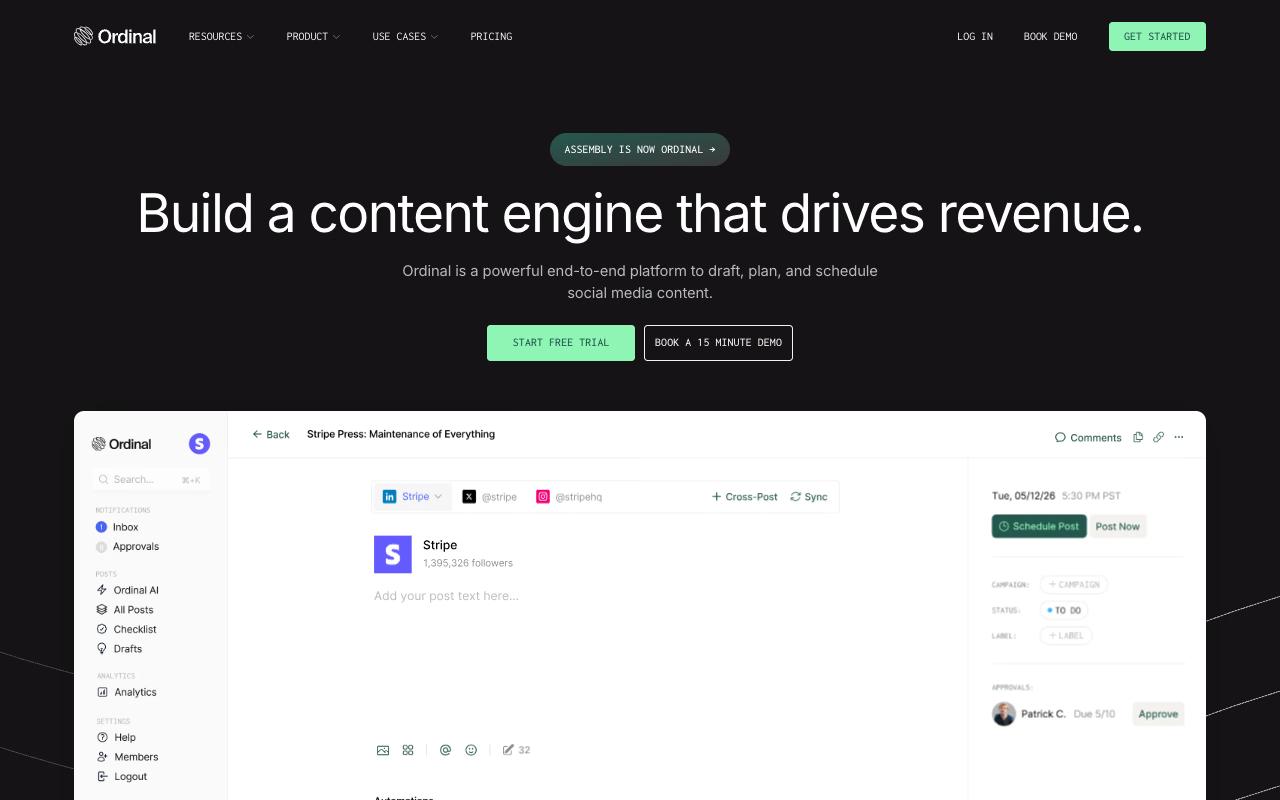
Ordinal is an end-to-end platform for drafting, planning, and scheduling social content across LinkedIn, Twitter/X, Instagram, Facebook, Threads, TikTok, and YouTube Shorts. It's built for content agencies, founders and execs, social media managers, and growth teams who run social as a standing function. For competitor search specifically, it's the tool that turns what you learn about a rival's content into a posting system of your own.
Pricing starts at $95/mo for Starter (up to 3 seats, 4 social profiles, 50 scheduled posts and 30 AI content generations per month, approvals, 14-day analytics), with Pro at $265/mo adding unlimited seats, unlimited scheduled posts, all-time account analytics, automated engagement, approval workflows, and API/MCP/webhook access. Annual billing drops those to $85/mo and $235/mo. Enterprise is custom and adds leads data, employee advocacy, custom permissions, and SAML/SSO. Both paid plans include a 14-day free trial, according to Ordinal's pricing page.
Here's why Ordinal belongs in a competitor-search shortlist. The search tools tell you what your competitors rank for, but they can't tell you which of their LinkedIn posts is pulling engagement or which format gap you should test next. Ordinal's approach to social media competitor analysis is to pull a rival's recent posts, label them by content category, and calculate engagement rate per category so you can find the gap. Then you act on it in the same tool.
All-time account analytics on the Pro plan let you benchmark your own content mix against what you found, and the API, MCP server, and webhooks mean you can pipe that data into your own dashboards or hand your posting history to an AI agent for analysis. The auto-engagement suite (likes, comments, and reposts from any connected LinkedIn account) plus personal profile tagging, PDF carousels, and a realistic preview showing the exact "see more" cutoff cover the publishing side that a keyword tool never touches. It replaces the usual stack of scheduler plus Notion plus Zapier plus Google Sheets plus Slack pings. Ordinal says it's trusted by 1,000+ modern marketing teams.
Verdict: the right pick when your competitor research is about content and social performance, and you want the publishing engine attached to it.
2. Ahrefs
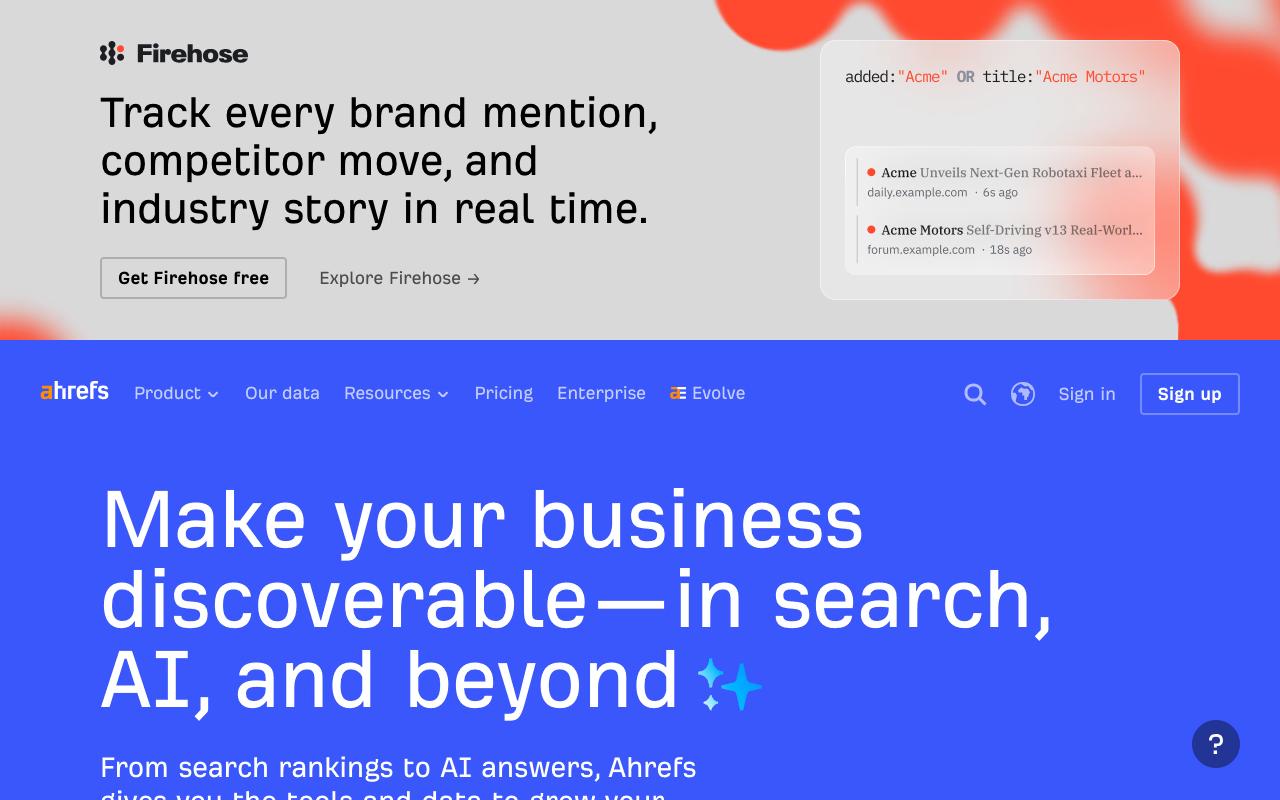
Ahrefs is an AI marketing platform built on its own web index, covering 170 trillion pages and 41.9 billion tracked keywords. Site Explorer is the competitor-search workhorse here, letting you study a rival's backlinks, organic traffic, and top pages, while Keywords Explorer handles research at scale with Keyword Difficulty, Traffic Potential, Parent Topic, full ads history, and organic Share of Voice tracking. It's aimed at content marketers, SEO and link builders, PPC specialists, AEO specialists, agencies, and SaaS companies.
Pros:
- Powerful, comprehensive SEO toolset praised by long-time users as a category leader ("the gold standard")
- Strong core functionality for keyword research, competitor analysis, and backlink data
- Support has issued refunds in some cases when the tool didn't fit a customer's use case
- Actively evolving product, adding new AI-related features over time
Cons:
- Frequent complaints of accounts being locked for "suspicious activity" with little explanation and slow/unhelpful support
- Credit-based plans can leave users blocked from meaningful use once credits are spent, even on expensive tiers
- Perceived as overpriced relative to value, especially after recent pricing changes
- Some reports of unreliable or outdated data (keyword data, SERP data issues)
- Difficulty exporting/printing reports cleanly
There's a free tier with limited Site Explorer and Site Audit for verified site owners. Paid plans are Starter at $29/mo, Lite at $129/mo, Standard at $249/mo, and Advanced at $449/mo, per Ahrefs' pricing page. Seats are single-user by default on the paid tiers, with additional users at $40, $60, or $80/mo depending on plan. Enterprise requires an annual commitment and adds uncapped API access, SSO, and unlimited historical data.
On Trustpilot, Ahrefs holds 2.1/5 from 321 reviews, and the sentiment is sharply split. Long-time users defend it, with one calling it "still the gold standard" for SEO after 2+ years despite recent pricing changes, and another noting the team "happily provided a refund" when the tool didn't fit their use case. The negatives dominate the volume though. Reviewers report account lockouts for unexplained "suspicious activity" and unhelpful support even on expensive plans, with one writing "I bought the 250 USD per month plan." And the credit-based system draws repeated complaints for leaving paying users unable to do meaningful work once credits run out.
A roughly 100-comment thread in r/SEO focused on data accuracy, with commenters arguing the keyword and traffic numbers don't match reality. One said "ubersuggest has shown better performance for me so far probably because their system gets updated regularly," and another claimed that when there were 10 blue links on Google, Semrush and Ahrefs "had it easy," adding that "neither of them can produce anything much better than GSC." A third user said they dropped a competing tool "because their metrics were so far off."
On Capterra, Ahrefs holds 4.7/5. Reviewers commonly praise keyword research, backlink analysis, and overall feature depth and note high pricing, learning curve, and value concerns. See the Capterra reviews page.
On G2, Ahrefs holds 4.5/5 across 713 reviews. Reviewers commonly praise accurate backlink data, user-friendly interface, and comprehensive SEO features and note high pricing, credit-based limits, and occasional data or ai accuracy concerns. See the G2 reviews and pros and cons pages.
Verdict: the deepest index of the group for backlink and organic competitor research, but budget for the credit limits and check that the data holds up in your niche.
3. Moz
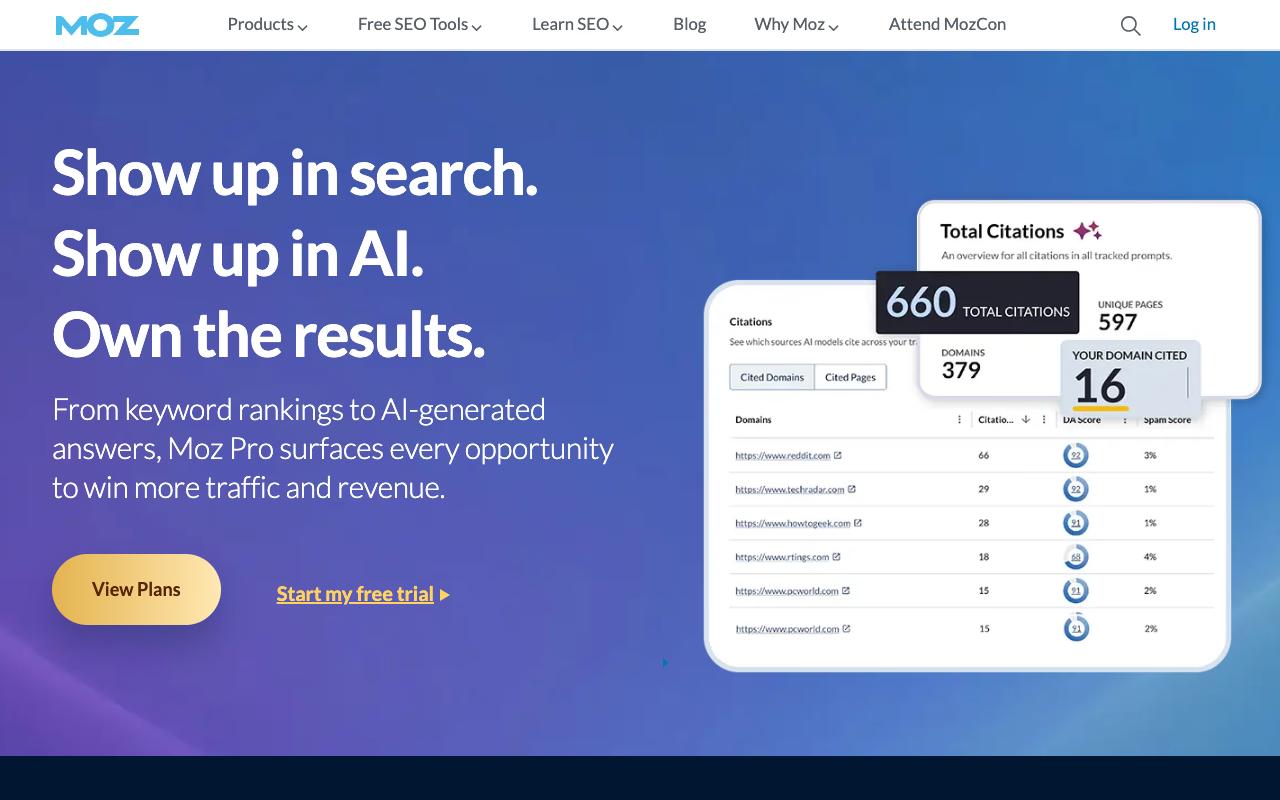
Moz Pro is an all-in-one SEO and AI search toolkit covering keyword research, competitive research, link research, rank tracking, site auditing, and local listings. For competitor work, the Competitive Research and SERP Analysis tools surface a rival's top keywords and best-performing pages, while the newer AI-side features track brand presence across LLM prompts and identify which sites are fueling AI recommendations. Moz states it's trusted by 500,000+ brands and agencies, with an audience of SEO professionals, digital marketers, and agencies.
Pros:
- Beginner-friendly, good for learning SEO fundamentals with hand-holding guidance
- Reasonable value/price point for beginners
- Some reviewers report responsive customer service that follows through on bug reports
Cons:
- Frequent billing/cancellation complaints (users charged after cancelling or after free trial ended)
- Difficulty obtaining refunds
- Customer support seen as overly reliant on AI, hard to reach a human for urgent issues
- Reports of unreliable/missing SEO data delivery
- Domain/Page Authority metrics perceived as inaccurate compared to competitors like Ahrefs
Plans start at $49/mo for Starter (built for individuals managing one site), then Standard at $99/mo, Medium at $179/mo, Large at $299/mo, and custom Enterprise pricing. Annual billing saves roughly 20%, bringing Standard to $79/mo and Medium to $143/mo, according to Moz's pricing page. All paid plans include MozBar Premium, 24/7 support, and the Moz AI tools.
Moz sits at 2.4/5 from 242 reviews on Trustpilot, and the complaints are mostly about billing rather than the product. Cancellation is the recurring theme. One reviewer wrote "Cancelled my free trial on time and they still charged," another said "I cancelled my Moz account, but the cancellation was not honored," and a third described the cancellation page as "A deliberately confusing cancelation page clearly designed to make people think they have canceled when in fact there is another" hidden step. Refunds are reportedly hard to get, support is criticized for leaning too heavily on AI when users need a human, and some reviewers report unreliable or missing SEO data along with Domain Authority and Page Authority scores they consider less accurate than what Ahrefs produces.
On Capterra, Moz holds 4.5/5. Reviewers commonly praise easy-to-use SEO toolkit and helpful reporting and note higher pricing and occasional accuracy limitations. See the Capterra reviews page.
On G2, Moz holds 4.3/5 across 608 reviews. Reviewers commonly praise user-friendly interface and keyword research tools and note smaller keyword database and limited integrations. See the G2 reviews and pros and cons pages.
Verdict: the most approachable option for someone learning competitive SEO, though the billing and cancellation reports are worth taking seriously before you enter a card.
4. Similarweb
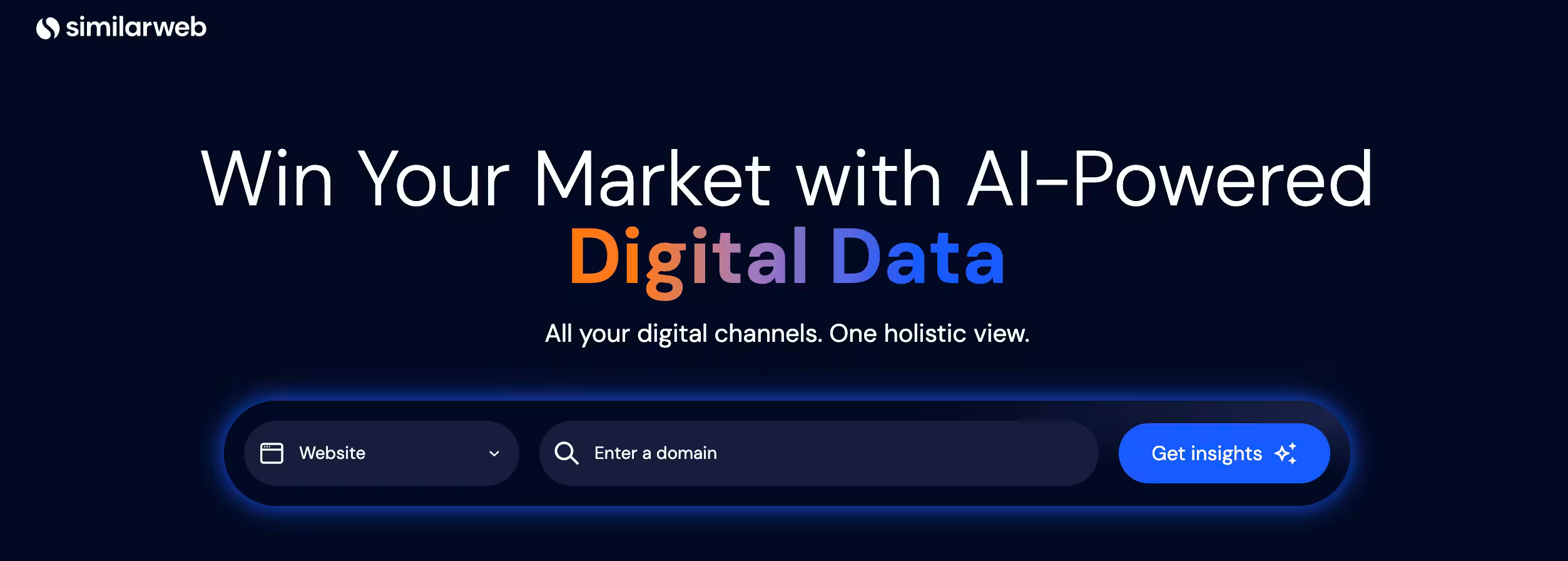
Similarweb is a digital data intelligence platform that pulls traffic, audience, and channel data into one view across 100M+ websites, 4M+ apps, and 20M+ tracked companies, with 10 years of historical data. Its Web Intelligence product handles market research, competitor analysis, keyword research, and rank tracking, while AI Search Intelligence tracks brand visibility, citations, and sentiment inside AI search engines and chatbots. It serves marketing, SEO/AEO, research, growth, sales, RevOps, and eCommerce teams, and says it has over 6,000 customers including 200+ of the Fortune 500.
Pros:
- Browser extension is praised as fast and easy for quick competitor/website insights
- Provides deep, useful data for competitive analysis
- Fast, helpful customer support response
- Smooth, intuitive user experience
Cons:
- Pushes users to submit extensive personal info before revealing data, then requires payment
- Complaints of being charged despite an advertised free trial
- Prior query limits (e.g. 14 queries/week) frustrated some free/extension users
There's no published price list. Similarweb's pricing page splits into self-service packages for entrepreneurs and small teams (startable with a free trial and a credit card) and custom enterprise packages covering the Competitive Intel Suite, Strategic SEO Suite, Ads Intel Suite, Gen AI Intel Suite, historical data, APIs and data feeds, and SSO, all sold through sales conversations. No dollar figures appear anywhere on that page.
Trustpilot puts Similarweb at 4.4/5 from 770 reviews, the strongest score in this group. The browser extension drives much of that, with reviewers calling it "superb extension" and saying "Love using the extension tool when i need quick insight into a website!" Others praised "The stable and smart work, perfect UX and deep data" and an "Excellent and fast response" from support. The negative reviews cluster on billing and trial mechanics, including one reviewer who warned "Do not enter your info. They're going to force you to pay before they give you any info," describing being asked for extensive personal details and then redirected to a paid plan requiring card details before seeing anything.
On Capterra, Similarweb holds 4.6/5. Reviewers commonly praise reliable market research and competitive benchmarking with detailed traffic analytics and note pricing viewed as high for smaller teams and occasional limitations in data accuracy or granularity. See the Capterra reviews page.
On G2, Similarweb holds 4.4/5 across 1,211 reviews. Reviewers commonly praise comprehensive competitive and market intelligence data with strong website traffic and audience insights and note data coverage gaps in certain niches and regions and a learning curve for advanced features and interface. See the G2 reviews and pros and cons pages.
Verdict: best-reviewed of the bunch and the strongest traffic-estimation data, but expect a sales call and no upfront number.
5. SpyFu
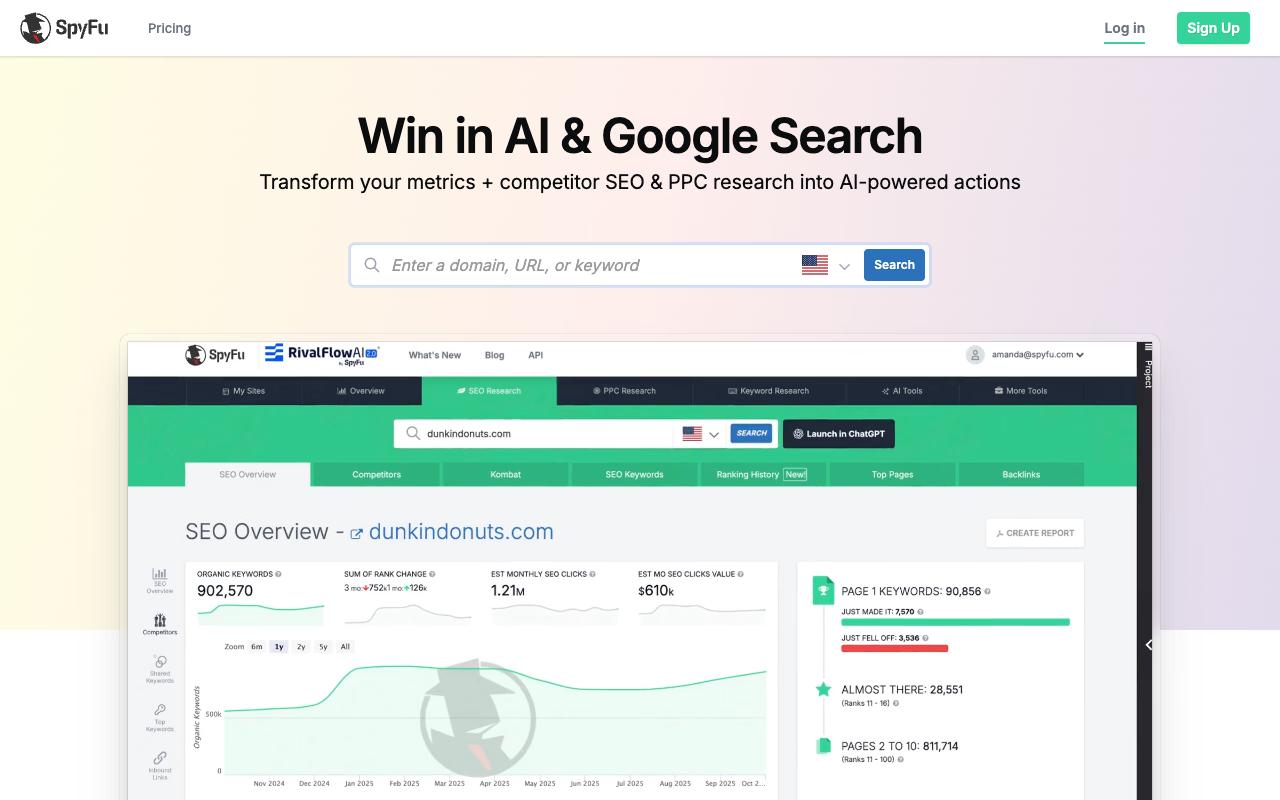
SpyFu is built around one job: showing you every SEO keyword a competitor ranks for and every PPC keyword and ad they've ever bought on Google. It goes deeper on the paid-search side than anything else here, with a full campaign and ad split-test history, negative match recommendations based on keywords competitors already tried and failed with, and a Google Ads Advisor that recommends profitable terms you aren't buying yet. It suits digital marketers, SEO and PPC specialists, growth engineers, and agencies.
Pros:
- Consolidates keyword, PPC, ad copy, CPC, and competitor data in one dashboard
- More affordable than competitors like Semrush/Ahrefs, plans starting around $39/month
- Highly praised, responsive customer support
- User-friendly interface with helpful tooltips explaining terms
- SpyGPT add-on for tracking how AI/LLMs present a brand
Cons:
- Multiple reports of unauthorized or fraudulent billing/charges after cancellation
- Reliability issues: freezing, crashing, slow searches
- SEO/backlink tools and reporting visuals feel outdated compared to competitors
- Data/estimate accuracy questioned in some cases
- Weaker data and support for UK-based users
- No free trial available
Basic is $39/month with 10k row exports, 1 Live Site tracking project, 5k weekly tracked keyword rankings, and 10 automated reports. Pro + AI is $59 for the first month then $119/month, adding unlimited search results and exports, 10 Live Site projects, 10+ years of historical data, RivalFlow AI on one site, ChatGPT integration, AI brand monitoring, GSC integration, white-labelled reporting, and API access. Team / Agency is $249/month with unlimited Live Site projects, RivalFlow on 5 sites, and 50k weekly tracked rankings according to SpyFu pricing page.
SpyFu holds 3.4/5 from 152 reviews on Trustpilot. Reviewers like having keyword data, paid search insights, ad copy examples, CPC, search volume, and competitor performance in one dashboard, with one 5-star reviewer saying the "domain overview was especially helpful because it gave me a clear snapshot of what competitors were ranking for and what keywords they were buying." Affordability comes up repeatedly, with reviewers noting plans that "start around $39 per month," and support gets singled out often, including one customer describing a "10/10 experience." On the other side, there are multiple reports of unauthorized or fraudulent charges after cancellation, complaints about freezing, crashing, and slow searches, SEO and backlink tooling that feels dated next to rivals, questions about estimate accuracy, thinner data for UK users, and no free trial.
On Capterra, SpyFu holds 4.4/5. Reviewers commonly praise affordable, easy-to-use tool for competitor and keyword research and note limited depth or precision of certain data and reporting features. See the Capterra reviews page.
On G2, SpyFu holds 4.6/5 across 518 reviews. Reviewers commonly praise competitive keyword and competitor research capabilities and note interface usability issues and data accuracy limitations. See the G2 reviews and pros and cons pages.
Verdict: the cheapest entry point and the best PPC competitor intelligence in the group, provided you can live with dated SEO reporting and watch your billing closely.
FAQ
What's the Cheapest Way to Start Competitor Research?
Ahrefs offers a free tier with limited Site Explorer and Site Audit access for verified site owners, which costs nothing but only covers sites you own. For researching competitors, SpyFu's Basic plan at $39/month is the lowest paid entry point among these tools, followed by Ahrefs Starter at $29/month for basic keyword and competitor research.
Which Tool Is Best for PPC and Ad Competitor Research?
SpyFu. It shows every PPC keyword and ad a competitor has bought on Google, including full campaign history, split tests, and abandoned keywords, plus a tool that identifies which domains are bidding on your own Google Ads terms and how their spend changes over time. Ahrefs includes full ads history in Keywords Explorer, and Similarweb offers an Ads Intel Suite, but SpyFu is the most focused on it.
Do Any of These Tools Cover Social Media Competitor Analysis?
Ahrefs, Moz, Similarweb, and SpyFu are search and ad intelligence platforms, so they measure organic rankings, backlinks, traffic, and paid campaigns, and their data stops short of what competitors post on LinkedIn or X. Ordinal covers the social side, letting you benchmark competitor content by category and engagement rate, then schedule and publish against those gaps from the same platform.
Related Posts
Looking to learn more? The below posts may be helpful for you to learn more about social media and content marketing.