

LinkedIn Sponsored Content averages a 0.44% to 0.65% click-through rate across industries (AdSpyder, 2025). That's the bar. Almost every roundup of LinkedIn ad examples shows you the creative without telling you whether it cleared that bar or died under it, which makes the whole genre useless as a decision tool.
So this one attaches a number to every format, plus one honest note on where each breaks. Most of it goes to Thought Leader Ads, the format with the best performance data in B2B right now, because that format is a distribution wrapper around an organic asset your executives either have or don't.
TLDR:
- Average Sponsored Content CTR sits at 0.44% to 0.65%. Judge every example you see against that number before you judge how it looks.
- Lead Gen Forms convert at roughly 13% versus roughly 4% for landing page campaigns.
- Thought Leader Ads pull 1.7x the CTR of standard brand ads, and only work when the sponsored profile already has a posting history.
- LinkedIn B2B campaigns average 113% ROAS, the highest among major B2B platforms.
- The two best-performing formats both sit downstream of organic work you can't buy with media budget.
What Makes a LinkedIn Ad Example Worth Copying?
A LinkedIn ad example is worth copying when it clears the platform's 0.44% to 0.65% CTR baseline, matches one format to one objective, and opens with a hook specific enough that a wrong-fit reader scrolls past on purpose. Everything else is decoration.
Three questions do the filtering:
- Does the format match the ask (a demo request through a Message Ad, a benchmark report through a Document Ad)?
- Did it beat the baseline, or do you only know it won an award?
- And does the first line name a role and a problem, or does it name a category?
"It looks good" is a standard borrowed from brand campaigns, where the goal is recall. LinkedIn ad formats get judged in a feed where the reader has already decided to scroll. A screenshot in a listicle tells you nothing about whether the ad earned a click.
LinkedIn Ad Examples by Format (With Benchmarks)
Seven formats, one benchmark note each. Six get a paragraph. One gets the rest of the section, because it's the one you're most likely to buy for the wrong reasons.
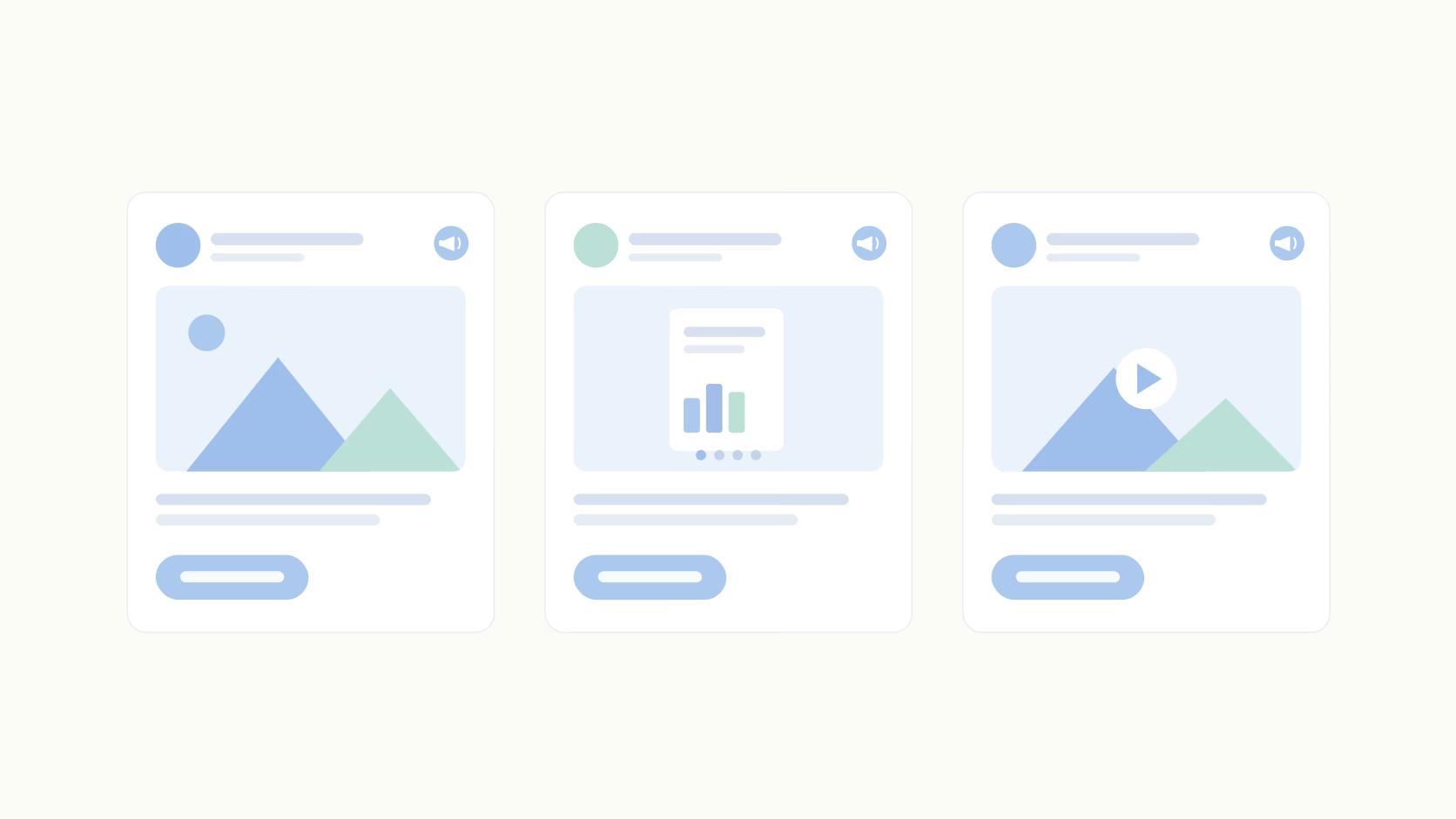
1. Single Image Ad Examples
The pattern that works: one value claim, a headline under 70 characters, and either a product screenshot or a human face. The SMB version, competitive on CTR, is a founder photo with a customer quote as the headline. Single image ads fatigue fastest, often inside two to three weeks at moderate frequency, so build four to six variants before launch rather than after performance drops.
2. Video Ad Examples
First three seconds carry the entire ad. Burn in captions, stay under 30 seconds for cold audiences, and skip the logo animation that costs you viewers before the point lands. There's a tailwind here worth noting given LinkedIn video growth on the organic side.
A 20-second unedited founder clip explaining one problem outperforms a lot of agency-produced brand film.
3. Carousel Ad Examples
Four to five cards, sequenced as problem, data, solution, CTA. The common flaw is treating cards as a slideshow, so there's no reason to swipe past card one. If you have an organic carousel that already performed, use that instead of designing net-new.
4. Document Ad Examples
The most underrated format on the list. Readers consume the value in-feed before any form appears, which is why benchmark reports and checklists do well here.
Teams kill the advantage by gating at page two, turning a native reading experience back into a landing page.
5. Lead Gen Form Ad Examples
LinkedIn Lead Gen Forms convert at roughly 13% on average, versus roughly 4% for standard landing page campaigns (LinkedIn Ads benchmarks, 2025). Three fields maximum, and name the offer in the headline instead of the value proposition.
The risk stays invisible until you check lead-to-opportunity rate, because a prefilled form makes it very easy for someone with zero intent to convert.
6. Thought Leader Ad Examples
Thought Leader Ads get 1.7x higher click-through rates than standard brand ads. Read that carefully, because the mechanic explains the number. You're taking a post a real person already published from their personal profile and paying LinkedIn to put it in front of a targeted audience, so the ad unit is a human being's profile: their photo, their name, their follower count, their words.
Which is why that click-through lift has a prerequisite most teams skip. In our experience, posts from personal profiles tend to reach far more people than the same content posted from a company page (often by a wide margin).
The feed rewards content that reads like a person thinking out loud. Sponsorship doesn't manufacture that quality. It buys more distribution for whatever quality is already there.
But here's the failure mode: a VP Marketing sees a competitor's founder ad performing in her own feed, opens Campaign Manager, and discovers her CEO's last post was six weeks ago and it was a repost of a press release. She drafts something in his voice, has him publish it, sponsors it the same day, and watches the click-through rate come in well below the format's baseline.
The creative wasn't the problem. She paid to send strangers to a profile with nothing behind it, and the format's whole advantage (this is a real person with a real point of view) collapsed on inspection.
Before you greenlight a Thought Leader Ads budget, run the profile through four checks:
- Has this person published at least twice a month for the last three months, from their own account?
- Does the specific post you want to sponsor already beat their own median engagement organically?
- Would a stranger reading their last five posts come away with a recognizable position on something?
- Does the profile look worked-on (current headline, real about section, more than a few hundred relevant followers)?
Four yeses means sponsor it.
Two or three means fix the posting cadence first and revisit in a quarter. One or zero means you're buying reach for a cold profile, and no creative brief saves that. The honest sequence is unglamorous: get the cadence running, watch which posts outperform on their own, then put money behind the proven ones.
7. Message and Conversation Ad Examples
Highest intent, highest cost, least forgiving. One ask per message, and a named sender the recipient could plausibly recognize. Generic openers get reported, and LinkedIn's send limits mean bad creative burns an audience you can't rebuild for months.
Why Personalized Hooks Outperform Generic Brand Copy
Format choice gets most of the attention in these conversations and deserves maybe a third of it. The hook decides the outcome first. 78% of B2B buyers won't respond to outreach that isn't personalized (personalization research, 2026), and that instinct doesn't switch off when the message arrives as a sponsored post instead of an InMail.
Compare two openers for the same product. "Modern revenue intelligence for high-growth teams" versus "If your SDRs are logging calls in three places, your pipeline number is wrong." The first is a category description that could sit on forty homepages. The second names a role, a specific behavior, and a consequence. It also repels everyone whose SDRs don't have that problem, which is the point.
The reasonable objection: narrow targeting raises your CPM. It does.
Narrowing your audience significantly will cost you more per thousand impressions, and if you're reporting on CPM you'll look worse. Cost per lead usually moves the other way, because CTR climbs enough to offset the CPM increase. Watch CPL and lead-to-opportunity rate, and let CPM go up.
Bad LinkedIn Ad Examples (And Why They Underperform)
Five patterns, each with the fix.
- The award-show ad: beautiful creative that buries the value claim in metaphor. The reader has to decode the image to learn what you sell, and they won't. Fix by stating the outcome in plain language in the first line, then making it look good.
- The logo wall: "trusted by 400 companies" with no named customer and no specific result. One named logo plus one number ("cut onboarding from 14 days to 3") beats a grid of forty.
- The stock photo handshake signals template and triggers an automatic scroll. Use a real screenshot of the product or a real photo of a real person at your company.
- The everything-offer: one ad promising a demo, a whitepaper, and a newsletter signup. Every extra option lowers action on all of them. One CTA per ad, always.
- The retargeting loop: the same creative served fourteen times because nobody set a frequency cap. Cap at three to four impressions per week per person and rotate creative every three weeks.
How To Find LinkedIn Ad Examples From Your Competitors
LinkedIn's Ad Library is free, needs no login, and shows every ad a company page has run in the past year. Five steps:
- Open the Ad Library and search your competitor's company page name.
- Filter by date range to separate what's live now from what they dropped.
- Check run duration. Anything live 60 days or more is almost certainly working, since nobody funds a losing ad for two months.
- Screenshot the ad together with the landing page it points to, as one artifact.
- Log format, hook structure, and CTA in a shared sheet monthly, so you're tracking changes rather than snapshots.
This beats browsing roundups because you see what competitors kept running, which is the closest thing to performance data you'll get from outside.
The limitation is real though: the Ad Library shows creative and dates, never spend or results, so treat run duration as a proxy and price it accordingly.
Where Organic Content Fits Into Your LinkedIn Ad Strategy
Both formats with the strongest numbers in this article depend on work that happens before Campaign Manager opens. Thought Leader Ads need a profile with a history. Lead Gen Forms convert best against audiences who've seen you somewhere already.
The cost picture makes the sequencing obvious. For B2B SaaS, paid leads cost substantially more than organic leads do, based on organic vs. paid comparisons on the same channel. Build a personal-profile posting cadence across three to five executives and subject matter experts, let it run for a quarter, then sponsor the posts that already earned engagement on their own. You're amplifying a validated hook instead of guessing at one.
Teams that run this well usually need infrastructure for the posting layer, which is what Ordinal handles: drafting on behalf of connected profiles, approvals so nothing publishes without exec sign-off, and post-level analytics that tell you which posts are worth promoting.
Start With the Two Posts You Already Have
Pick your two highest-performing organic posts from the last quarter, published from personal profiles, and run them as Thought Leader Ads against a tightly defined audience. Compare CTR to your standard Sponsored Content over the same two weeks. If the lift is meaningfully higher than your standard Sponsored Content, you've found where your budget belongs and you didn't write a single new ad to find it.
If you don't have two posts that qualify, that's the actual finding, and it's a cadence problem rather than a creative one. Fix it before the budget clears procurement. Paid is worth running here (LinkedIn B2B campaigns average 113% ROAS, the highest among major B2B platforms per Dreamdata's 2025 benchmarks), but only against a foundation that exists.
Frequently Asked Questions
What Is a Good CTR for a LinkedIn Ad?
Average Sponsored Content CTR on LinkedIn runs 0.44% to 0.65% across industries. A CTR that clears the baseline by a healthy margin is strong for a cold audience, and a retargeting campaign should perform even better. Judge your creative against the format's own baseline rather than a flat platform average.
Which LinkedIn Ad Format Performs Best?
Lead Gen Forms win on conversion, converting around 13% of clicks versus roughly 4% for standard landing page campaigns, and Thought Leader Ads win on click-through at 1.7x the rate of standard brand ads. Single image ads stay the default for reach and testing because they're the cheapest format to produce and iterate on.
How Much Do LinkedIn Ads Cost?
LinkedIn is the most expensive major B2B ad platform per click, and cost per lead for B2B SaaS companies averages around $310. The tradeoff is return: LinkedIn B2B campaigns average 113% ROAS, the highest among major B2B ad platforms. Budget for a longer payback period than you'd expect from search ads.
Can I See My Competitors' LinkedIn Ads?
Yes. LinkedIn's Ad Library shows every ad a company page has run over the past year, free, with no login required. You'll see the creative and how long each ad ran, but not spend or performance data, so treat long-running ads as your best available signal that something's working.
What Are LinkedIn Thought Leader Ads?
Thought Leader Ads let a company sponsor a post published from someone's personal profile instead of a branded company asset. They pull 1.7x the click-through rate of standard brand ads because the post reads as a person's genuine opinion. The format only works if that person already has a real posting history, since an inactive profile makes the sponsorship look hollow.
How Long Should LinkedIn Ad Copy Be?
Keep your intro text under 150 characters so it doesn't get cut off behind "see more" on mobile, and keep headlines under 70 characters. The strongest LinkedIn ad examples put the specific pain point or outcome in the very first line and treat anything past the truncation point as optional reading.
Are LinkedIn Ads Worth It Compared to Organic Content?
Run both, in sequence. Organic content costs roughly $164 per lead for B2B SaaS against $310 for paid, but paid buys you reach on demand, and the best-performing ad formats depend on organic groundwork already in place. Build a consistent personal-profile posting cadence first, then sponsor the posts that already proved themselves.
How Many LinkedIn Ad Creatives Should I Test at Once?
Run four to six variants per campaign at minimum. Single image ads fatigue fastest of any format, often within two to three weeks at moderate frequency, so keep a refresh queue ready instead of waiting until performance drops.
Related Posts
Looking to learn more? The below posts may be helpful for you to learn more about social media and content marketing.