

"Build a social media presence" is the most common advice in B2B marketing and the least specific. What does posting consistently actually mean, and what does it get you?
So we ran the numbers. We analyzed LinkedIn posting data across roughly 3,900 accounts from 2024 through 2026 to figure out what moves the needle on social presence and what doesn't. Some of what we found contradicts the standard playbook.
TL;DR
- Higher posting frequency drives more impressions, but engagement rate stays flat at ~1.9% regardless of how often you post.
- Consistent posters don't meaningfully outperform inconsistent ones on month-over-month impressions growth (232% vs. 235%).
- Average impressions per post drop ~17% from month one to months three through six. That's normal, not failure.
- 94.7% of internet users are active on social monthly, and the average person uses 6.5 platforms (DataReportal, 2026).
- Paid social CPMs are rising ~18% year-over-year, which makes organic presence more valuable, not less.
What Is a Social Media Presence?
A social media presence is the consistent, measurable footprint a person or brand maintains across the platforms where their audience is active. Having an account isn't the same thing. Presence means posting on a cadence, generating impressions, and earning engagement from people who matter to your business.
The scale of this channel is hard to overstate. As of April 2026, there are 5.79 billion social media user identities worldwide, with 94.7% of internet users active on social platforms monthly, per DataReportal's 2026 research. That's effectively the entire connected world.
For B2B brands, the multi-platform reality raises the bar. The average user is on 6.5 different platforms each month, which means your buyers aren't concentrated in one place. And with rising paid social costs (CPMs up roughly 18% year-over-year), organic presence isn't a nice-to-have. It's the moat.
If you're a B2B brand without a real presence, you're invisible to buyers who are actively researching you across multiple channels before they ever fill out a form.
Why Social Media Presence Matters for Revenue
76% of consumers say social content influenced a purchase (Apaya, 2026). That's the number to anchor to when someone asks whether social presence belongs in the revenue conversation.
The framing shift that matters for B2B teams: social presence isn't brand work. It's pipeline work. Buyers research vendors on LinkedIn, check whether a founder is credible, and form opinions before a sales call ever happens. A weak presence means you lose deals before you even know they were in play.
Compare that to organic vs. paid social: organic content costs roughly half as much per lead as LinkedIn ads for B2B SaaS ($164 vs. $310 average CPL), and unlike ads, it compounds. A post from six months ago can still generate impressions today. Paid social stops the moment you stop paying.
Rising CPMs make organic presence more valuable every quarter. The brands building that asset now won't have to buy their way into visibility in 2027.
What the Data Says About Building Presence
Here's where the standard playbook breaks down. Most advice on social presence is directional at best. Our analysis of LinkedIn data across roughly 3,900 accounts from 2024 through 2026 gives us something more specific.
Posting Frequency vs Impressions
More posts means more reach. The relationship is consistent across the dataset. Accounts posting 1-5 times per month hit a median of 2,564 monthly impressions. Accounts posting 6-15 times reach 11,616. Jump to 31+ posts per month and the median hits 33,136. Our LinkedIn posting frequency data shows this scales roughly linearly. Total reach grows with volume.
Engagement Rate Stays Flat
Here's what doesn't change: engagement rate.
Across every posting frequency bucket in our dataset, median engagement rate stays at roughly 1.9%, whether an account posts 4 times a month or 40. The "posting too much dilutes your engagement" concern isn't supported by the numbers. What you get with more posts is more total impressions, not a worse rate per post.
Stop optimizing for engagement rate as the primary metric. A 1.9% engagement rate on 33,000 monthly impressions is a fundamentally different business outcome than 1.9% on 2,500. Optimize for total impressions times quality of audience.
The Month 3-6 Drop
One finding worth setting expectations on: average impressions per post fall about 17% between the first 30 days and months 3-6. In our dataset, accounts active for at least 6 months averaged 5,913 impressions per post in their first month, dropping to 4,901 by months 3-6. LinkedIn's algorithm likely gives new or newly active accounts a modest early boost. When that fades, per-post performance normalizes.
If performance dips at month four, don't read it as failure. It's the baseline.
The 2026 Playbook for Building Presence
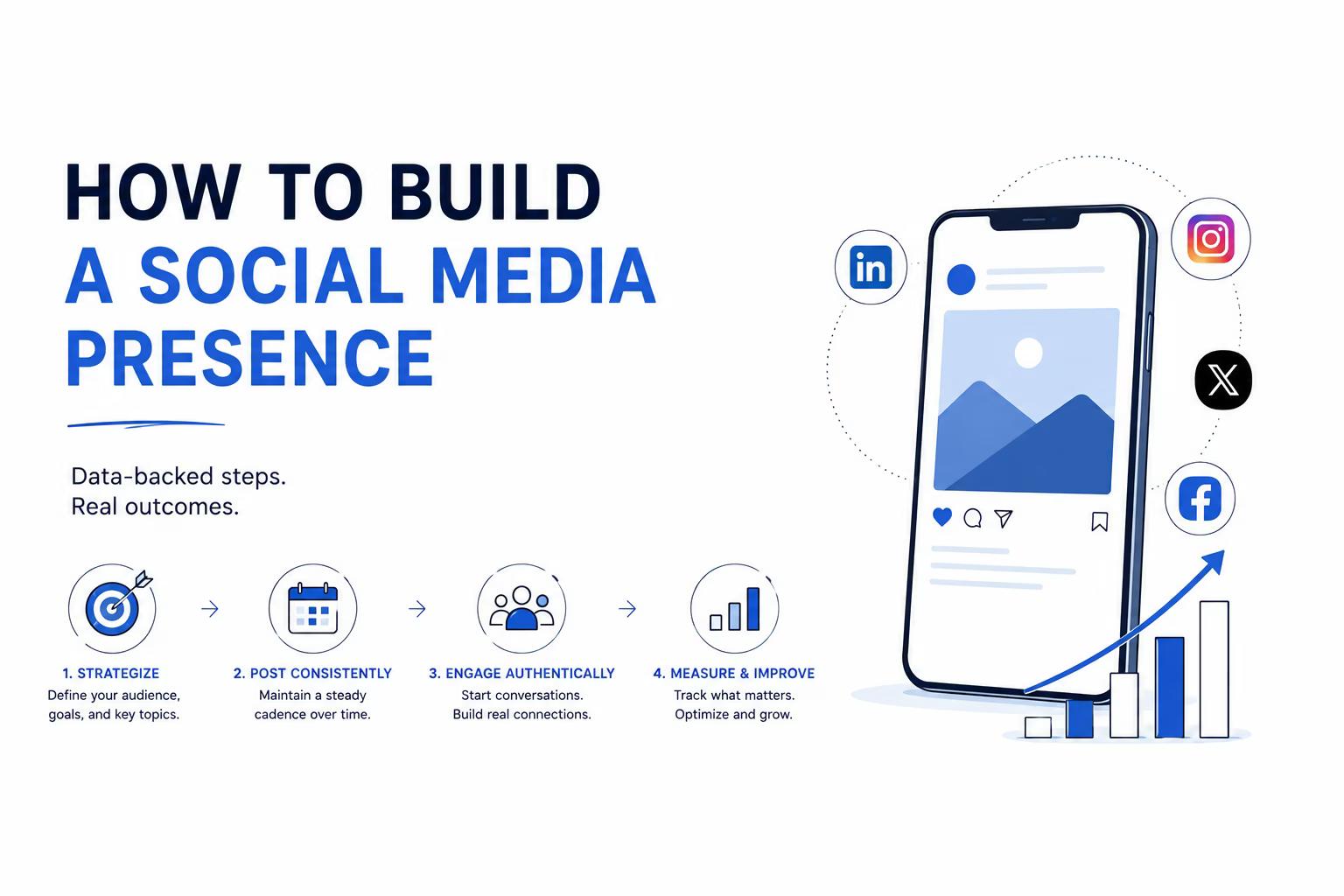
Step 1: Pick Your Anchor Platform Before You Go Multi-Channel
The average user is on 6.5 platforms, but that doesn't mean your team should be producing for all of them at once. For most B2B SaaS companies, LinkedIn is the anchor. Set a posting cadence there first (6-15 posts per month is the range where median monthly impressions cross 11,000) and add channels only once the anchor is running reliably.
Step 2: Build a Team-Driven Engine
Personal profiles dominate the LinkedIn feed. Personal profiles outperform company pages by a wide margin. Company pages now account for just 1-2% of what appears in a typical user's feed. Your founder posting matters more than your brand page.
Building a system where multiple people post consistently, with proper approvals and scheduling, is what separates a real presence from a company page that gets 11 impressions per post.
Step 3: Measure What Drives Pipeline
Track impressions over time, earned media value, and who's engaging. Not just how many people engaged, but who. Are they your ICP? Are they the job titles that show up in your CRM?
The metrics that actually matter are impressions over time, ICP engagement rate, and earned media value. Follower count and raw likes tell you almost nothing about pipeline.
Common Mistakes That Kill Social Presence
Most social presence failures are operational, not strategic.
The most common: quitting at month two. Our data shows per-post impressions drop about 17% between month one and months 3-6. That looks like failure. It's the plateau before compounding. The accounts that stopped posting right there never found out.
Cross-posting identical content across channels without editing for each platform is another common one. LinkedIn and Instagram have different audiences, formats, and context. Copy-pasting signals low effort, and the algorithm treats it accordingly.
Treating engagement rate as the north star is a third mistake. Given that our data shows engagement rate is flat at ~1.9% regardless of frequency, chasing that number misses the point entirely. Total impressions times audience quality is the metric that moves pipeline.
How Ordinal Handles the Operational Layer
The playbook above only works if the operations behind it are solid. Scheduling posts, routing approvals, coordinating team engagement in the first hour after a post goes live. That's where most social programs break down.
Teams like Clay use LinkedIn content management through Ordinal to handle exactly this. Clay grew from 8K to 120K followers in a single year with a one-person social team, using Ordinal for scheduling, auto-engagement, and analytics across a 25-person employee advocacy program. The infrastructure is what made the volume possible.
Building a Presence That Compounds
Social media presence is a measurable, operational discipline with specific inputs and outputs.
Start with a posting frequency audit. Establish your baseline impressions per post. Then build the infrastructure (approvals, scheduling, team engagement) that lets you maintain volume without burning out. That's what a real presence looks like in 2026.
Frequently Asked Questions
What Is a Social Media Presence?
A social media presence is the consistent, measurable footprint a person or brand maintains across the platforms where their audience spends time. Posting cadence, content quality, and engagement define it, not just whether an account exists. For B2B brands, a strong presence typically combines a company page with active personal profiles from founders and employees.
How Do I Build a Social Media Presence From Scratch in 2026?
Pick one anchor platform (LinkedIn for most B2B teams), commit to at least 6-15 posts per month, and measure impressions per post rather than follower count. Our analysis of ~3,900 LinkedIn accounts shows that frequency range delivers median monthly impressions of 11,616, more than 4x what 1-5 posts per month produces. Expect a ~17% drop in per-post performance after the first month. That's normal, not failure.
How Often Should I Post to Maintain a Social Media Presence?
For most B2B teams, 6-15 posts per month is the practical sweet spot. Median monthly impressions at that frequency hit 11,616, while posting 31+ times per month pushes that to 33,136, but engagement rate stays flat at ~1.9% across every frequency bucket. More posts means more total reach, not a better rate per post.
Does Posting More Frequently Hurt My Engagement Rate?
No. Our LinkedIn data shows median engagement rate holds steady at roughly 1.9% whether you post 5 times per month or 31+. The "posting more dilutes engagement" claim doesn't hold up. What you gain from higher frequency is total impressions, which is the actual ceiling on pipeline-relevant reach.
Is Organic Social Media Presence Still Worth Building Given Rising Ad Costs?
Yes. Paid social CPMs are rising ~18% year-over-year according to Digital Applied's 2026 analysis, while organic content compounds over time. Apaya's 2026 research found that 76% of consumers say social content influenced a recent purchase, and most of that influence comes from organic posts, not ads.
How Long Does It Take to Build a Meaningful Social Media Presence?
Plan for 6-12 months of consistent posting before compound growth becomes visible. Our data shows a 17.1% drop in average impressions per post between month 1 and months 3-6, which reflects the loss of a new-account novelty boost, not a sign the strategy isn't working.
Should Founders or Company Pages Drive Social Media Presence?
Both, but personal profiles get significantly more reach on LinkedIn. Company pages now account for just 1-2% of typical feed content, while personal posts dominate. A team-driven presence where founders and employees post consistently will outperform a brand-page-only strategy.
How Do I Measure if My Social Media Presence Is Working?
Track impressions per post, ICP engagement (who's engaging, not just how many), and earned media value rather than follower count or raw likes. If you can't tie social activity to pipeline conversations or revenue influence, you're measuring the wrong things.
Related Posts
Looking to learn more? The below posts may be helpful for you to learn more about social media and content marketing.