

EveryoneSocial built its name on employee advocacy. Employees get a feed of approved posts and share them to their own networks. If you're shopping for an alternative, you probably want something specific: lower cost, a free trial, a cleaner interface, or automation that does more than queue up content for employees to click "share" on.
Those needs point to very different tools. Some of the options below are dedicated advocacy platforms built for companies with hundreds of employees and annual contracts. Others are schedulers that automate engagement across a smaller team of execs and marketers. And one is a YouTube tool that shows up in searches for this category but solves a different problem entirely. We pulled pricing and positioning straight from each vendor's own pages, so you can compare them on the same footing.
At a glance
Ordinal is our own product. Its row uses the same sourced facts as every other tool, and it carries no rating we issued ourselves.
What Makes a Good Everyonesocial Alternative
Automation Depth Beyond Sharing
Some tools just queue approved posts for employees to click 'share,' while others automate the engagement itself, setting up likes, comments and reposts from team accounts without anyone logging in. This is the real functional split in the category, not just a feature checkbox.
CRM and Pipeline Attribution
For b2b teams, the ability to tie shares and clicks back to contacts in salesforce, hubspot or marketo (or at least to earned media value) separates tools built for proving ROI from ones that only report engagement counts.
Gamification and Adoption Mechanics
Leaderboards, competitions and badges show up repeatedly as a way vendors try to keep employees actually participating, and reviewers flag it as both a selling point and sometimes a source of confusion or clutter.
Trial and Contract Flexibility
Free trials, annual versus multi-year terms, and per-seat versus per-employee pricing structures determine how easy it is to test a tool properly before locking into a contract, something several entries call out explicitly as a pain point or a relief.
The EveryoneSocial Alternatives Worth Shortlisting
1. Ordinal
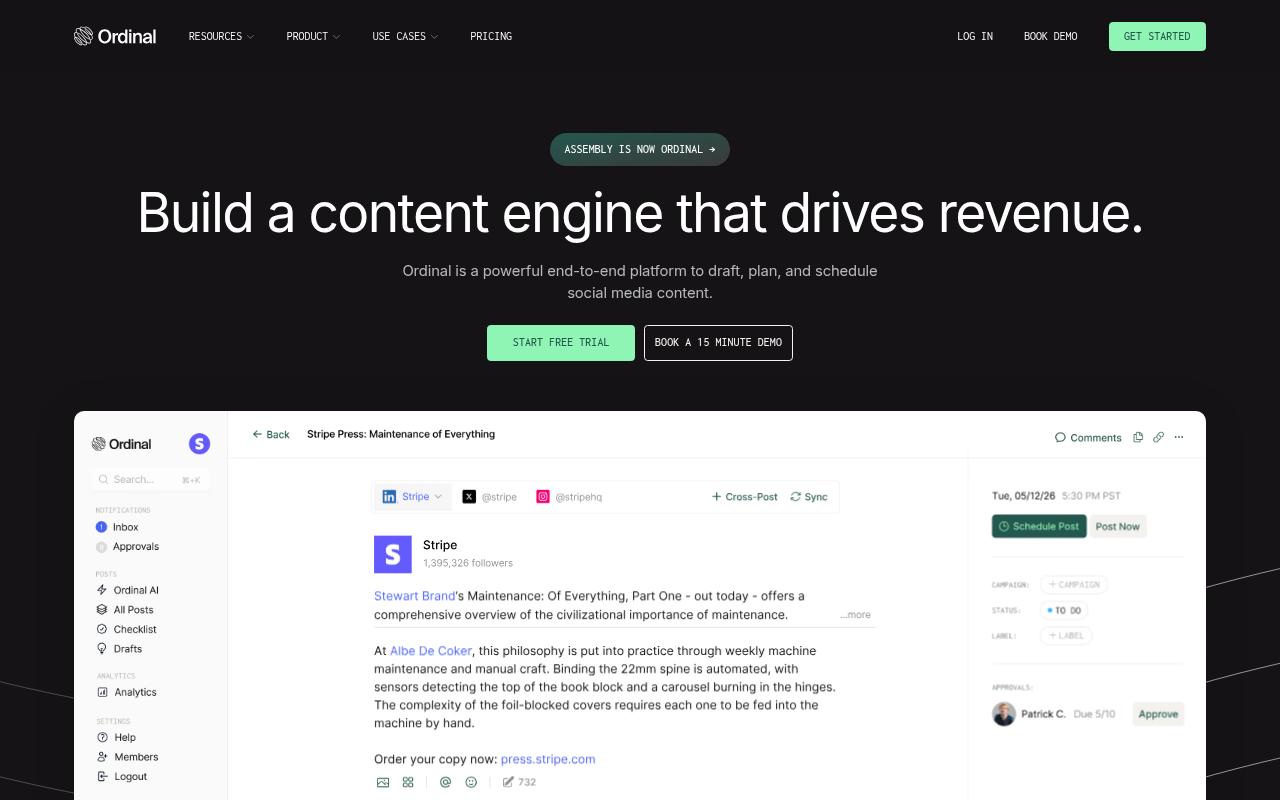
Ordinal is an end-to-end platform to draft, plan and schedule social content, built for content agencies, founders and execs, social media managers, and growth teams. It schedules and cross-posts to LinkedIn, X, Instagram, YouTube Shorts and other major channels, and its team engagement features let colleagues like, comment and repost from their own accounts automatically.
Price: Starts at $95/month for Starter (up to 3 seats, 4 social profiles), with Pro at $265/month, Growth at $695/month and custom Enterprise pricing, according to Ordinal's pricing page. Annual billing drops those to $85, $235 and $625 a month.
If you're leaving EveryoneSocial because "advocacy" still depends on employees remembering to open an app, Ordinal handles that differently. Team likes, comments and reposts are set up inside the post creation flow, and teammates can engage from their own accounts up to 12 hours after a post goes live on LinkedIn and X. Slack Boost Channels ping a channel the moment a post publishes, so people who aren't even logged into Ordinal still see it.
That makes it a strong fit for a head of marketing trying to get 5 to 10 execs posting and engaging regularly without a heavyweight enterprise rollout. The Pro plan adds unlimited seats plus API and MCP access, so you can connect AI tools to draft posts and analyze performance. Enterprise layers on advanced employee advocacy, CRM lead connection and SAML/SSO for larger programs. Our Oktopost alternatives breakdown covers how it compares on the advocacy side.
Verdict: The best pick for B2B teams that want automated engagement and LinkedIn-first scheduling with public pricing and no per-seat creep.
2. GaggleAMP
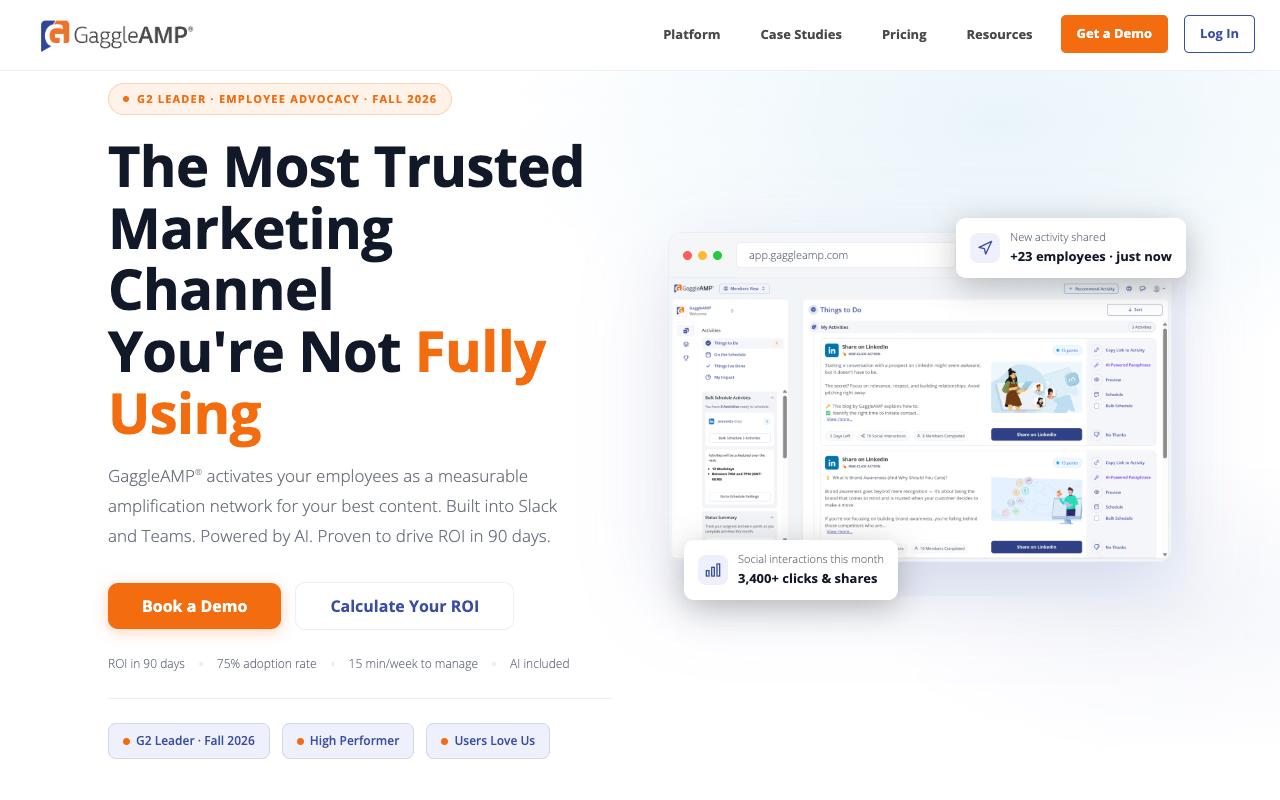
GaggleAMP turns employees into an amplification network for company content, delivering a feed of pre-approved posts inside Slack and Microsoft Teams so nobody needs a new login. It's aimed at marketing, sales enablement, HR/comms and leadership teams, and its AI Suite writes unique copy variations per employee so shares don't look templated. Reporting ties shares to traffic, leads and pipeline through UTM tracking and earned media value.
Price: No public pricing, according to GaggleAMP's pricing page. Quotes are based on company size, and every plan includes unlimited members and the full AI Suite. One-year terms carry a 10% uplift over the two-year base rate, while three-year terms get 5% off.
On Capterra, GaggleAMP holds 4.6/5. Reviewers commonly praise ease of use, content sharing, increased social reach, and helpful customer service and note limited analytics depth, a clunky interface, and minimal administrator features. See the Capterra reviews page.
On G2, GaggleAMP holds 4.4/5 across 382 reviews. Reviewers commonly praise intuitive interface, content amplification, employee engagement, and responsive customer support and note limited analytics depth, customization constraints, incomplete integrations, and occasional bugs. See the G2 reviews and pros and cons pages.
Verdict: A solid choice if your company already lives in Slack or Teams and you want advocacy with pipeline attribution, as long as you're comfortable with multi-year contract math.
3. DSMN8
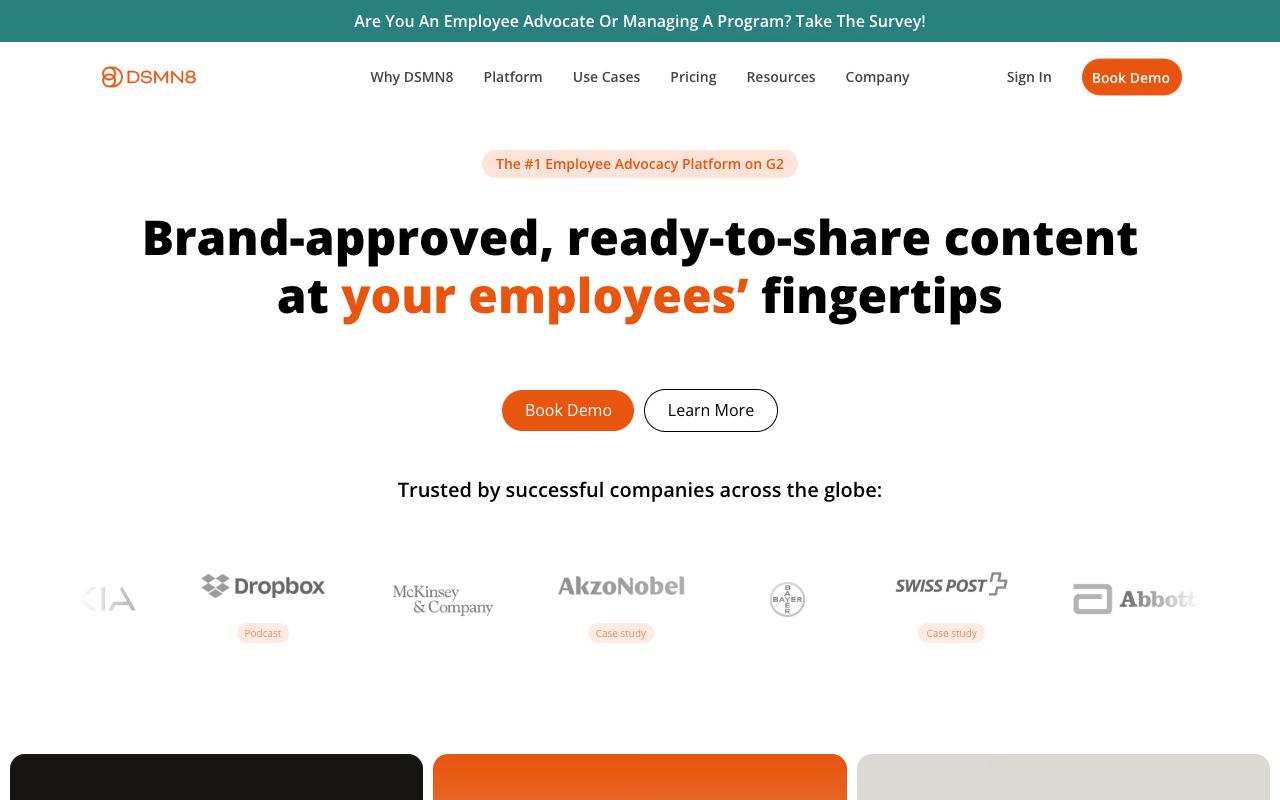
DSMN8 is the closest like-for-like swap for EveryoneSocial. It gathers approved content into a personalized feed that employees edit and share, mostly to LinkedIn, on desktop or mobile. It serves marketing and comms, employer brand and HR, and sales teams, with gamified leaderboards, an AI content assistant, internal newsletters, and ISO-27001-certified security with SSO and audit trails.
Price: Custom quote based on seats, modules and onboarding level. DSMN8's pricing FAQ says pricing "typically starts from a few dollars per employee per month," and contracts are annual.
On Capterra, DSMN8 holds 4.7/5. Reviewers commonly praise ease of use, automated sharing, and engagement analytics and note recurring account reauthentication, sharing limits, and occasional posting errors. See the Capterra reviews page.
On G2, DSMN8 holds 4.6/5 across 1,173 reviews. Reviewers commonly praise ease of use and effortless content sharing and note limited sharing options, personalization, and content variety. See the G2 reviews and pros and cons pages.
Verdict: Pick it if you want a dedicated advocacy platform with gamification and enterprise security, and you're ready for an annual commitment.
4. Sociabble
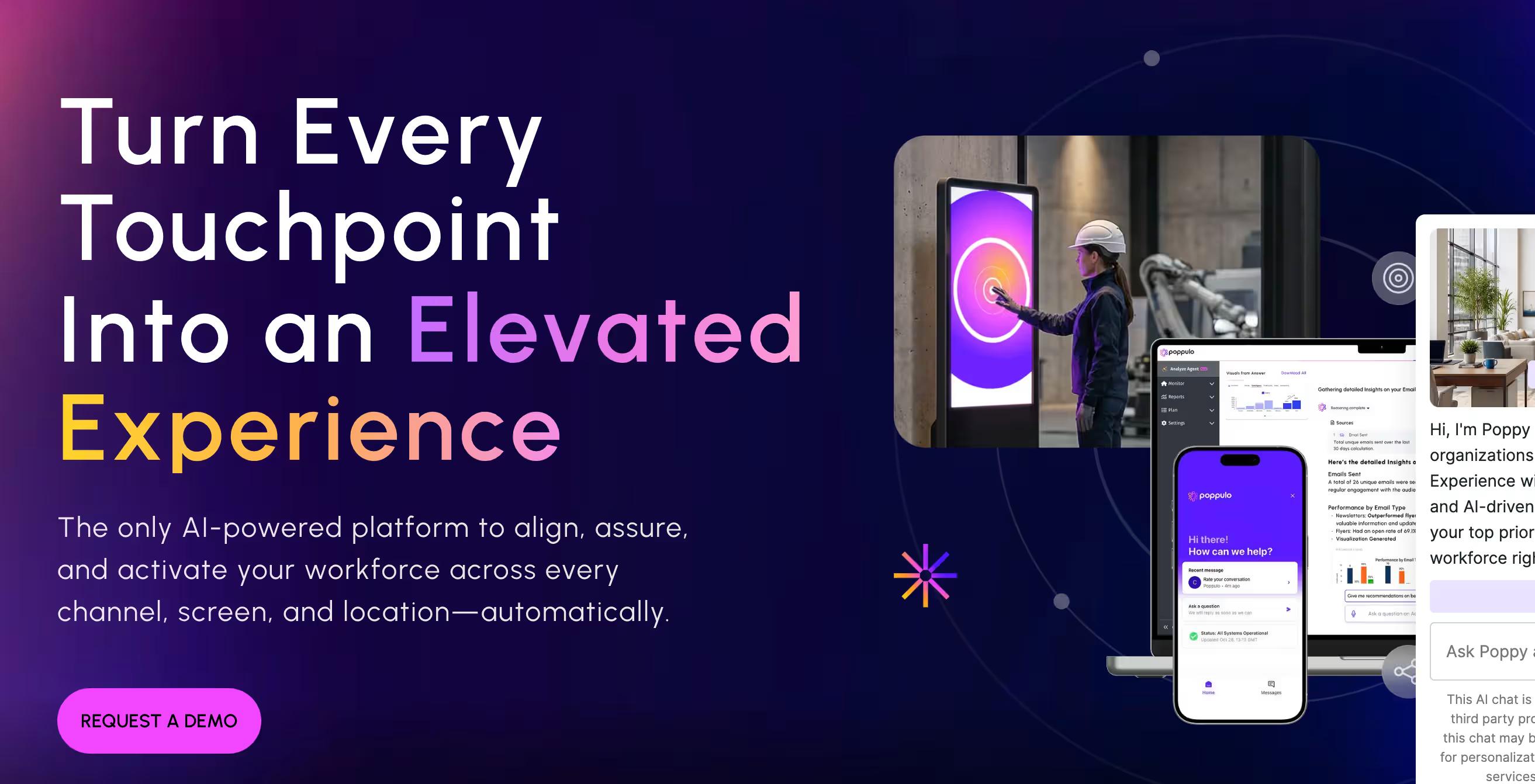
Sociabble has been rebranded as the Poppulo Experience Platform, per its pricing page. It sits closer to internal communications than pure social automation, so it's worth a look if advocacy is one piece of a broader employee comms program.
Price: No public pricing. The pricing page only offers "Request a demo," "Talk to an expert" and "Contact us," with no tier names or prices disclosed.
On Capterra, Sociabble holds 5/5. Reviewers commonly praise employee communication and easy adoption and note difficulty finding prior discussions and missing authentication options. See the Capterra reviews page.
On G2, Sociabble holds 4.7/5 across 412 reviews. Reviewers commonly praise ease of use and customer support and note setup complexity and limited integrations. See the G2 reviews and pros and cons pages.
Verdict: Worth shortlisting only if you need internal comms and advocacy in one product and don't mind sitting through a sales process to find out what it costs.
5. PostBeyond
PostBeyond is an employee advocacy and social selling platform for marketing, sales, HR and channel partner teams. It centralizes pre-approved content in one library, with an approval workflow and compliance guardrails that flag unapproved messages before they publish. An AI Copilot writes network-tailored captions from a URL, and an Influitive rewards integration lets you reward employees for sharing.
Price: A 30-day free trial covers up to 30 enrolled employees. Growth starts at a $1,125/month minimum for 100 employees, and Enterprise is custom for 250+, according to PostBeyond's pricing page.
On Capterra, PostBeyond holds 4.8/5. Reviewers commonly praise ease of use, content scheduling, social-media sharing, and employee engagement and note limited content-sharing controls, leaderboard clarity, occasional LinkedIn glitches, and pricing. See the Capterra reviews page.
On G2, PostBeyond holds 4.6/5 across 401 reviews. Reviewers commonly praise gamification, streamlined social sharing, ease of use, and mobile access and note analytics depth, business intelligence integrations, and social-platform sharing limitations. See the G2 reviews and pros and cons pages.
Verdict: A good fit for regulated or compliance-heavy teams that want to test properly before committing, which EveryoneSocial doesn't make easy.
6. Oktopost
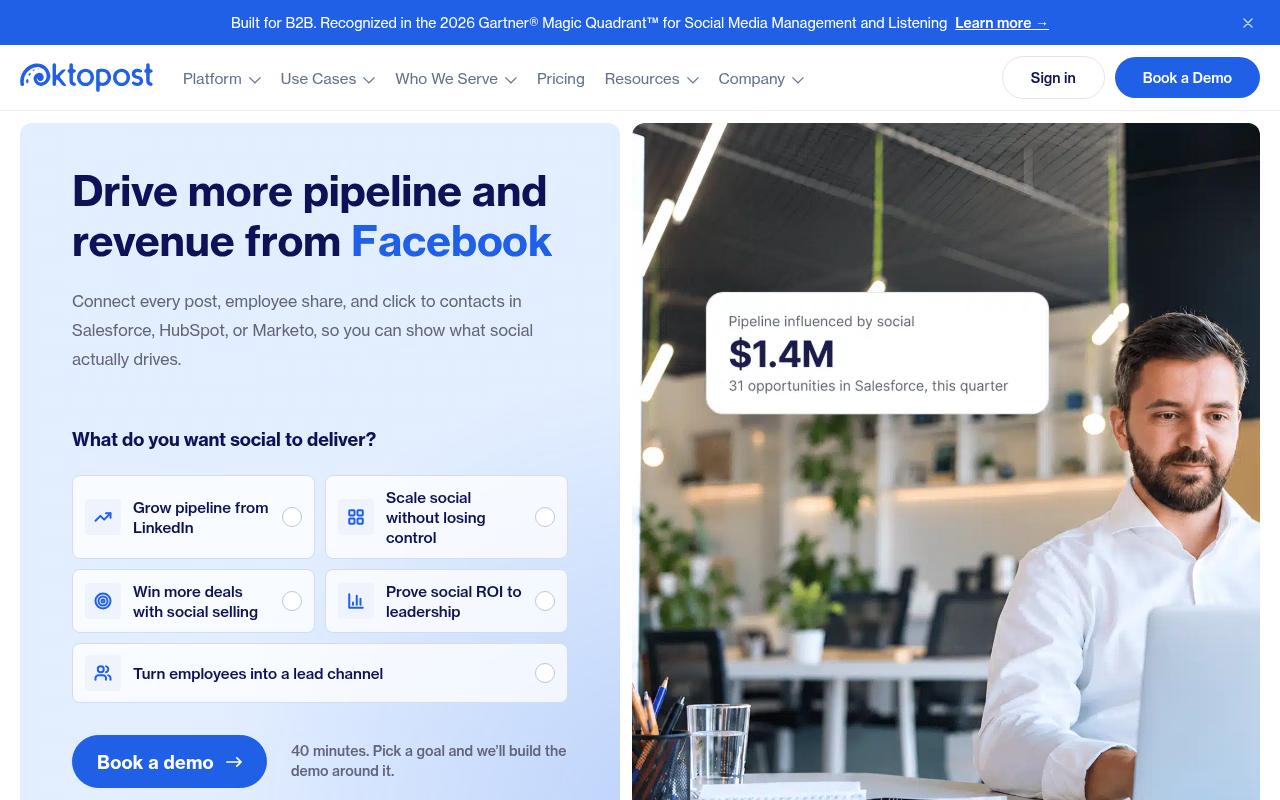
Oktopost connects social posts, employee shares and clicks to contacts in Salesforce, HubSpot or Marketo, so B2B teams can prove what social drives in pipeline. It covers LinkedIn-first publishing, funnel-focused analytics, social listening and employee advocacy through its AI-powered Advocacy Agent. It's built for B2B marketing leaders and sales teams doing social selling.
Price: No public plans. Oktopost's pricing page offers a 40-minute call to build a tailored quote.
On Reddit, one r/marketing user described Oktopost's employee advocacy app as a list of pre-curated posts from marketing that employees pick from and share, sometimes in a single click. The same user also called out the leaderboard, which shows inside the app for everyone involved.
On Capterra, Oktopost holds 4.5/5. Reviewers commonly praise B2B-focused social management, analytics, advocacy, CRM integration, and customer support and note reporting limitations, gaps in advanced functionality, and the need for additional training or integrations. See the Capterra reviews page.
On G2, Oktopost holds 4.4/5 across 204 reviews. Reviewers commonly praise ease of use, intuitive workflows, reporting, integrations, and responsive customer support and note social integration disconnects, platform limitations, and occasional reporting or scheduling issues. See the G2 reviews and pros and cons pages.
Verdict: The strongest option here if CRM attribution and social listening matter more to you than price transparency.
7. Hootsuite Amplify
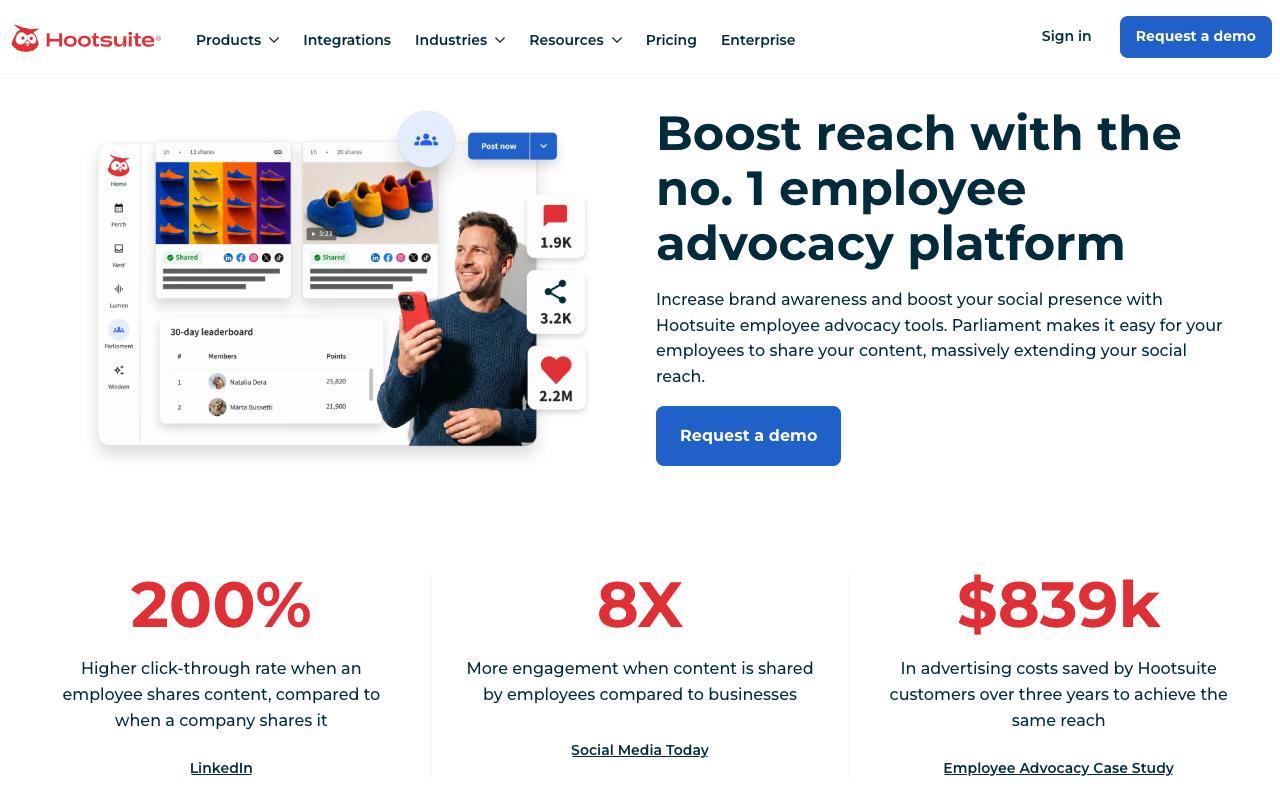
Hootsuite Amplify has evolved into Parliament, Hootsuite's employee advocacy product. Admins build a pre-approved content library in the Hootsuite Dashboard, employees share it in a few taps, and admins track engagement and adoption. Built-in AI writes captions, it integrates with Microsoft Teams, and it's aimed at marketing, HR and sales teams already using Hootsuite.
Cons:
- Frequent billing/subscription complaints, including being charged after cancellation or unauthorized charges
- Poor, slow customer support, often routed through an unhelpful AI chatbot
- Reports of platform bugs and reliability issues (e.g., video upload errors, system errors)
- Considered pricey relative to the experience delivered
- Confusing or hidden renewal/contract terms cited by multiple reviewers
Price: Not sold as a self-serve plan. It isn't included in the Standard ($99/user/month), Professional ($199/user/month) or Advanced ($399/user/month) tiers on Hootsuite's plans page, so you'll need to request a demo.
On Trustpilot, Hootsuite sits at 1.3/5 from 554 reviews. That page covers the whole company rather than Amplify specifically, and recent reviews focus mostly on billing and support. Reviewers describe being charged after cancelling, confusing renewal terms, and slow support that's often routed through an unhelpful AI chatbot. Some also mention bugs like video upload errors.
On Capterra, Hootsuite Amplify holds 3.5/5. Reviewers commonly praise social sharing and employee engagement and note value for money and reliability issues. See the Capterra reviews page.
On G2, Hootsuite Amplify holds 4.4/5 across 203 reviews. Reviewers commonly praise ease of use and simple employee advocacy workflows and note limited content library and posting limitations. See the G2 reviews and pros and cons pages.
Verdict: Only makes sense if you're already deep in Hootsuite, and even then, read the renewal terms twice.
8. vidIQ
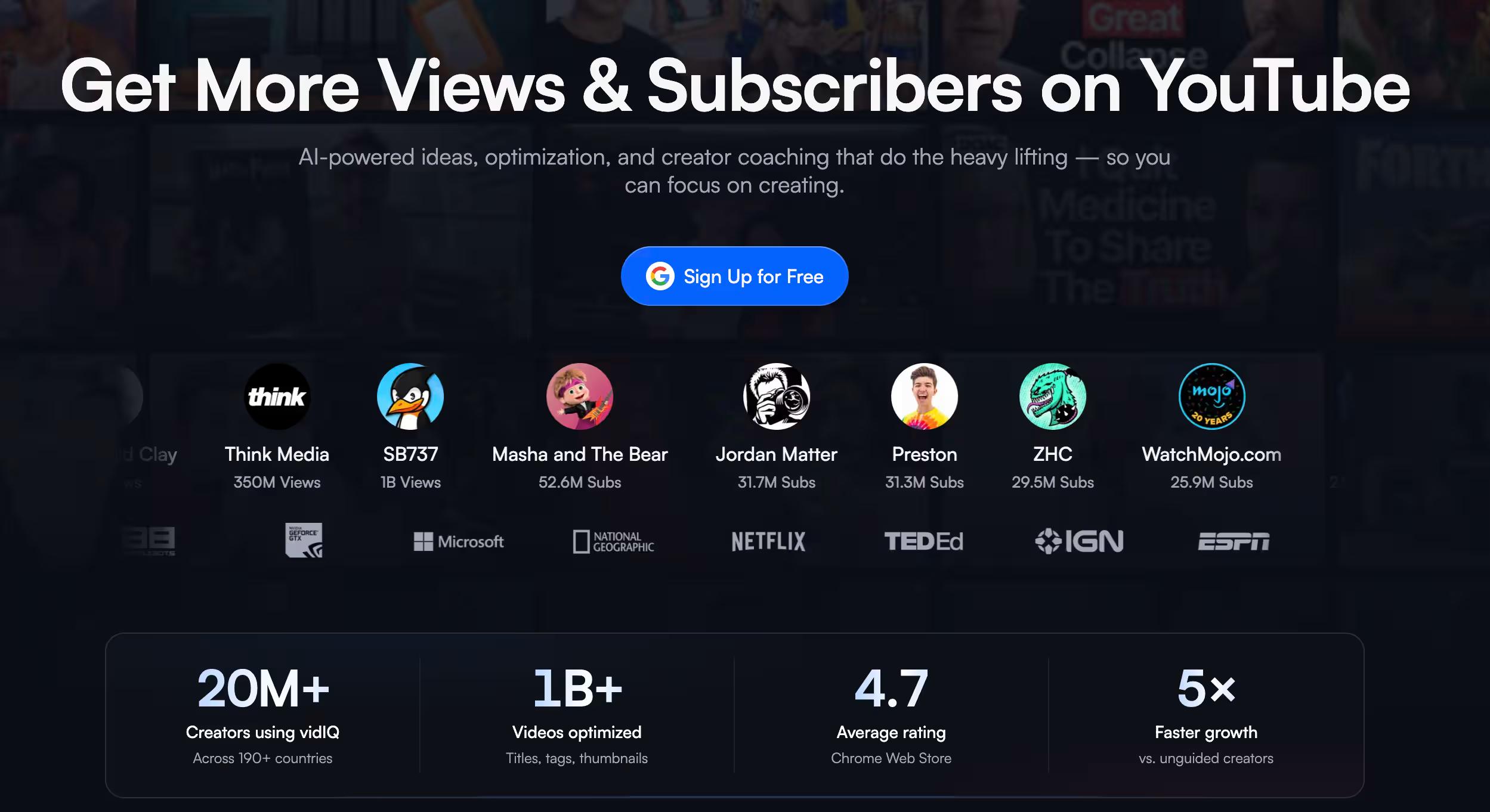
vidIQ is a YouTube growth toolkit with a web app, Chrome extension and mobile app. It helps creators research keywords, audit channels, track competitors and generate thumbnails with AI. It doesn't do employee advocacy or cross-channel scheduling, so treat it as a complement for teams whose social automation needs center on YouTube.
Pros:
- Helps with feedback, clipping, and thumbnail improvement for content creation
- ChatGPT plugin integration helps audit channels and identify improvements
- Coaching program gets positive feedback from users who found their coach helpful and practical
- Option to switch coaches if one isn't the right fit
Cons:
- Many users describe billing/subscription practices as deceptive or scam-like, with cancellation being hard to complete or confirm
- AI-generated video and thumbnail features often produce low-quality output while still consuming paid credits
- Perceived decline in feature quality and value over time ('shrinkflation')
- Keyword tags, titles, and thumbnail ratings described by some as inaccurate or low-value
- Described by some as a 'subscription harvesting platform' with poor customer support and no refunds
Price: Free plan available. Boost costs $16.58/month billed yearly ($19 monthly), Max costs $39/month billed yearly ($49 monthly), and Enterprise is custom, according to vidIQ's plans page.
On Trustpilot, vidIQ holds 3.7/5 from 1,375 reviews, and opinion is sharply split. Long-term users praise the feedback, clipping and thumbnail tools, the ChatGPT plugin for channel audits, and a coaching program that lets you switch coaches. A large share of recent reviews are strongly negative, though, describing cancellation as hard to complete, AI video and thumbnail output as low quality while still consuming paid credits, and a decline in value over time.
On Capterra, vidIQ holds 4.3/5. Reviewers commonly praise keyword research, competitor analysis, SEO suggestions, and ease of use and note expensive paid plans, generic AI suggestions, feature limitations, and a learning curve. See the Capterra reviews page.
On G2, vidIQ holds 4.5/5 across 34 reviews. Reviewers commonly praise keyword research, data insights, ease of use, and YouTube integration and note limited free-version features, premium pricing, and weaker AI thumbnail design. See the G2 reviews and pros and cons pages.
Verdict: Skip it as an EveryoneSocial replacement, but consider the free plan if YouTube is your main channel.
FAQ
What Is the Best EveryoneSocial Alternative for Small B2B Teams?
Ordinal is the most accessible option for small teams. It publishes pricing starting at $95/month and handles team likes, comments and reposts automatically. Dedicated advocacy platforms like GaggleAMP, DSMN8 and Oktopost require a demo to get a quote, and PostBeyond's paid tier starts at $1,125/month for 100 employees.
Which EveryoneSocial Alternatives Offer a Free Trial?
PostBeyond offers a 30-day free trial for up to 30 enrolled employees, and vidIQ has a permanently free plan for YouTube creators. GaggleAMP, DSMN8, Sociabble and Oktopost all require you to book a demo or request a quote.
Which Employee Advocacy Tool Connects Social Activity to the CRM?
Oktopost connects posts, shares and clicks to contacts in Salesforce, HubSpot or Marketo. GaggleAMP attributes shares to traffic, leads and pipeline through UTM tracking, and Ordinal's Enterprise plan includes CRM lead connection.
Related Posts
Looking to learn more? The below posts may be helpful for you to learn more about social media and content marketing.