

Benchmarking a competitor's social performance sounds like a data problem. It's usually a tooling problem. You can see a rival's posts, their follower count, and roughly how many reactions each post pulled. What you can't see is their engagement rate against a stable denominator, their posting cadence over six months, or whether that one post that blew up was quietly boosted with ad spend. That's the gap these tools fill.
The category splits into two camps:
Pure analytics platforms like Rival IQ, Socialinsider, Quintly and Social Status exist to measure and report, so they track competitor profiles deeply but don't publish anything.
Then broader management platforms like Hootsuite bundle competitive tracking into a suite that also handles scheduling and inbox. Which camp you need comes down to whether benchmarking is a quarterly reporting exercise or a daily input to what you post next.
Pricing across this list runs from a free tier to enterprise plans that require a sales call, and the feature sets diverge more than the marketing copy suggests. Here's the shortlist side by side before the detail.
At a glance
What Makes a Good Competitor Benchmarking Tool (Social Media)
Data depth and history
How many months (or years) of historical performance a plan retains, and how many profiles or accounts you can track, determines whether you can do a real year-over-year read or just a quick snapshot. This varies sharply by tier across the tools, from a single month on a free plan to 24 months on higher-end plans.
Boosted post detection
Raw engagement numbers don't tell you whether a competitor's viral post was organic or paid, and only some tools attempt to answer that with machine learning flags on likely-promoted content. This is one of the sharpest feature splits in the category.
Benchmarking vs. publishing
Pure analytics platforms measure and report but don't post, while broader platforms fold competitive tracking into scheduling and inbox tools. Whether you want those two functions in one system or kept separate shapes which camp fits your workflow.
Cross-network coverage
Which platforms are actually tracked, and whether that includes personal profiles, linkedin, or niche channels, varies a lot and some tools carve out explicit gaps or beta-only support.
Custom metrics and export
Teams that need to pipe competitor data into a warehouse or build non-standard metrics care about query languages, API/webhook access, and export formats far more than dashboard polish.
The Best Competitor Benchmarking Tools for Social Media
1. Ordinal
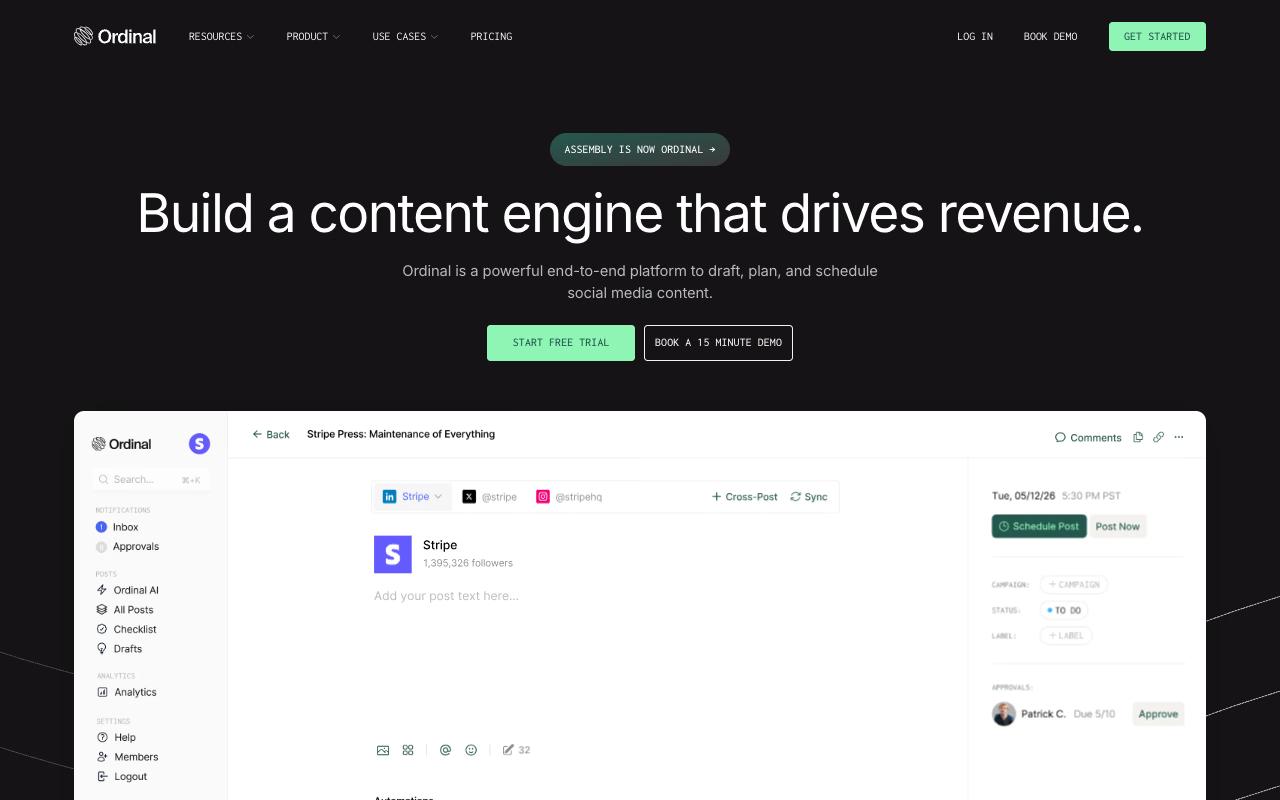
Ordinal is an end-to-end platform for drafting, planning and scheduling social content, with automated engagement and analytics built into the same workflow. It's used by content agencies, founders and execs, social media managers, content marketers and growth teams, and per its homepage, by more than 1,000 modern marketing teams. The pitch for benchmarking work is that the measurement and the publishing live in one system, so what you learn about a competitor's cadence can change your calendar the same afternoon.
Pricing starts at $95/mo for Starter (up to 3 seats, 4 social profiles, 50 scheduled posts and 30 AI content generations per month, 14-day analytics) and $265/mo for Pro, which adds unlimited seats, unlimited scheduled posts, all-time account analytics, automated engagement and API/MCP/webhooks access, according to Ordinal's pricing page. Enterprise is custom and adds leads data, employee advocacy, custom permissions and SAML/SSO. Annual billing drops those to $85 and $235 respectively, and both paid plans include a 14-day trial.
On the benchmarking question specifically, the API, MCP server and webhooks on the Pro plan mean your social data doesn't sit trapped behind a dashboard. Every action available in the UI is available programmatically, and the MCP integration lets an AI tool read your full posting history, analyze performance, and draft in your voice without you opening the app. So if your head of marketing wants pipeline attribution and clean data in the warehouse, that architecture matters more than another chart type. The all-time account analytics on Pro also removes the data-history ceiling that most analytics tools use to tier their plans.
And because Ordinal covers LinkedIn deeply (personal and company tagging, PDF carousels, realistic previews showing the "see more" cutoff, auto-likes, auto-comments and auto-reposts from any connected account), the competitive read on the channel where B2B benchmarking usually happens feeds straight into what you publish next. It replaces the common setup of a scheduler plus a separate analytics tool plus ad-hoc Slack messages asking colleagues to engage.
Verdict: The right pick if you want benchmarking data and the publishing engine in the same place, with an open API so the data can live wherever your team reports from.
2. Quintly
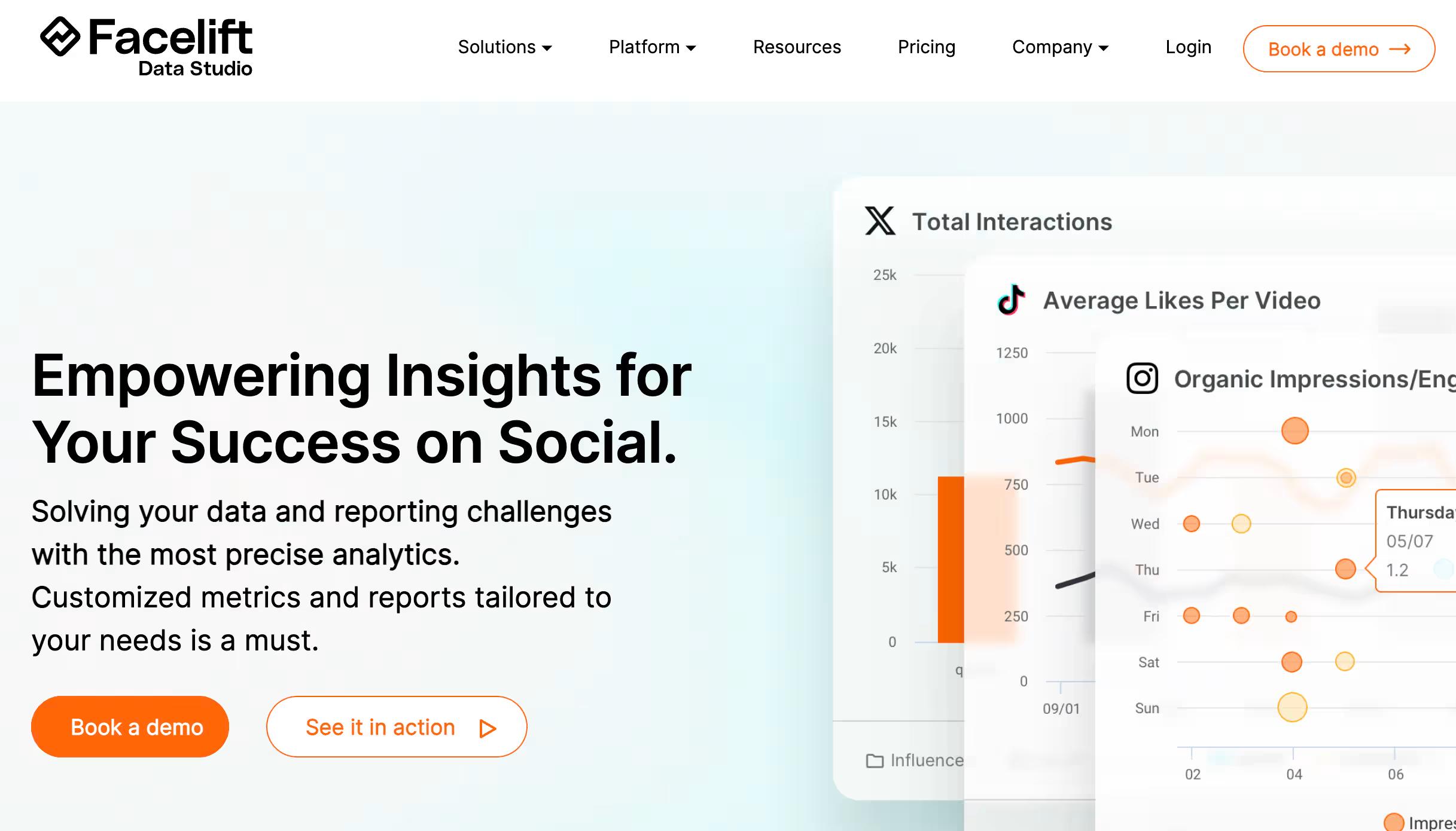
Quintly, now rebranded as Facelift Data Studio, pulls data from social accounts and tracks performance across hundreds of profiles in one place, including competitors, inspiring brands, prospective clients and influencers. It's built for social media managers, data analysts and strategists, and marketing directors, plus the agencies, media companies and organisations they work in. The distinguishing capability is depth of customization: 500+ metrics, hundreds of customizable dashboards, a proprietary quintly Query Language for writing custom metrics, and integrations that push data into external storage like Google BigQuery.
There's no public pricing. Quintly lists three tiers (S, Q and L) as "Plan on request," scaling by profile count (S covers 5 profiles, Q up to 20, L 21 and above), with custom metrics support, QQL access and ad accounts varying by tier, and API access, Data Push and Data Migration reserved for higher tiers. You book a demo to get a quote.
On Capterra, Quintly holds 4.6/5. Reviewers commonly praise accurate multi-network social data with customizable metrics and reporting views and note restricted functionality in the trial version and complexity for non-technical users. See the Capterra reviews page.
On G2, Quintly holds 4.7/5 across 68 reviews. Reviewers commonly praise flexible, customizable social media analytics dashboards and metrics across multiple channels and note steep learning curve and limited capabilities in lower-tier or trial plans. See the G2 reviews and pros and cons pages.
Verdict: The most configurable option here if you have an analyst who'll write custom queries and pipe the output into a warehouse. It's the least suitable if you want a number by Friday.
3. Social Status
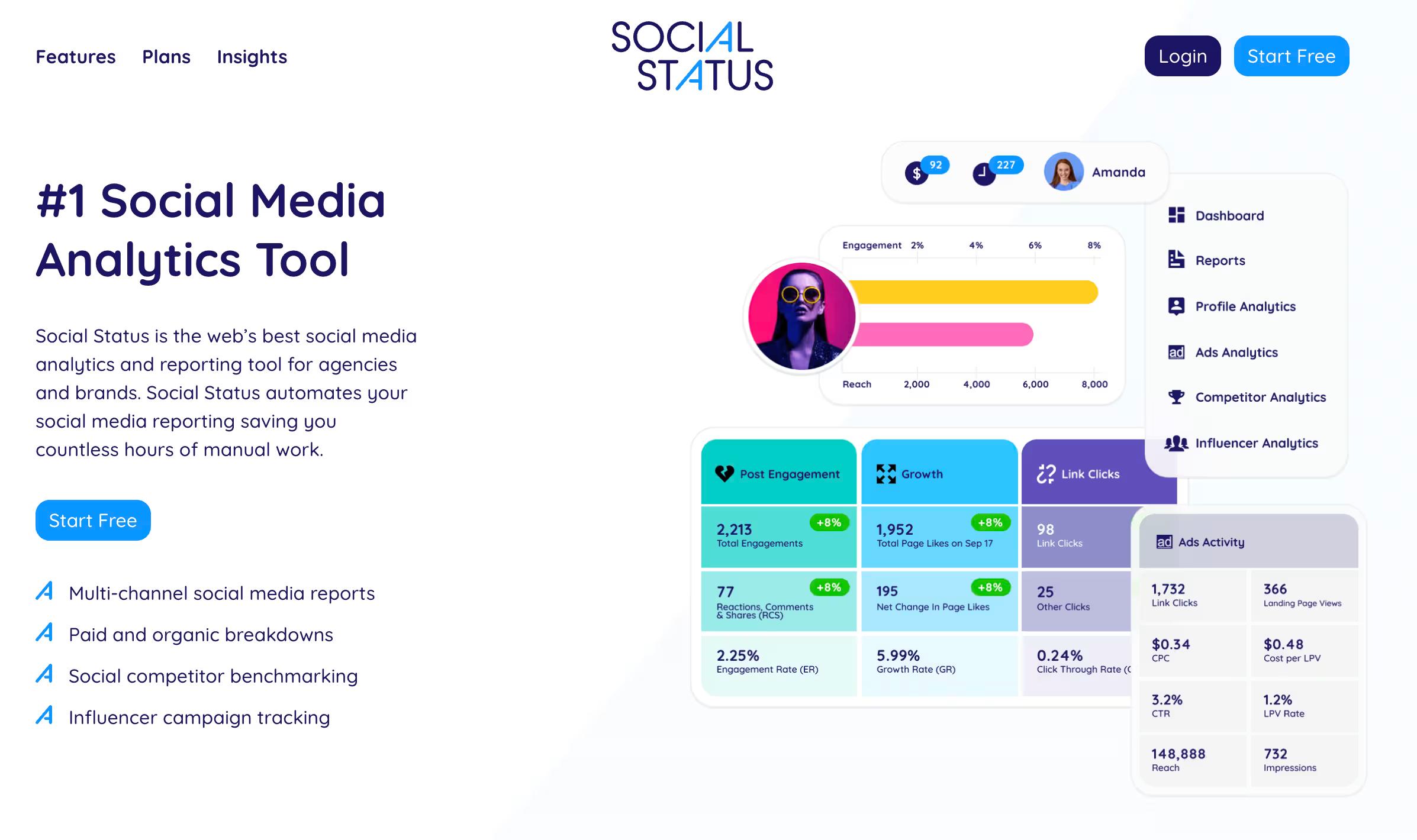
Social Status automates social analytics and reporting across four tools: Profile Analytics, Ads Analytics, Competitor Analytics and Influencer Analytics. The competitor module benchmarks reactions, posting frequency, timing and top-performing posts against public Facebook Pages, Instagram Business/Creator profiles, TikTok profiles, X profiles and YouTube channels. It's aimed at agencies and brands who are currently losing hours to manually compiling reports.
It's the cheapest entry point on this list. Per the Social Status plans page, there's a free tier at $0/month with 1 plan quota and 1 month of data history, then Micro at $9/month, Basic at $29/month (adding CSV/XLSX/PDF/PPTX exports and white-label reports), and Essential at $49/month with 40 plan quota, 6 months of history and support for all channels including TikTok, LinkedIn and X. Professional plans for agencies start at $99/month and scale to $1,499/month. Annual billing saves 25%, there's a 14-day trial on paid Small Business plans, and no mandatory contracts.
Worth noting one gap: competitor tracking doesn't cover personal Instagram profiles, and LinkedIn Campaign Manager support under Ads Analytics is listed as launching soon with beta access on request.
On Capterra, Social Status holds 4.8/5. Reviewers commonly praise clear social media performance insights and time-saving reports and note pricing and feature depth for smaller teams. See the Capterra reviews page.
On G2, Social Status holds 4.6/5 across 90 reviews. Reviewers commonly praise detailed multi-channel analytics and easy automated reporting and note learning curve and limited advanced customization for some reports. See the G2 reviews and pros and cons pages.
Verdict: The best value for agencies that need white-label competitor reports without a four-figure monthly commitment.
4. Rival IQ
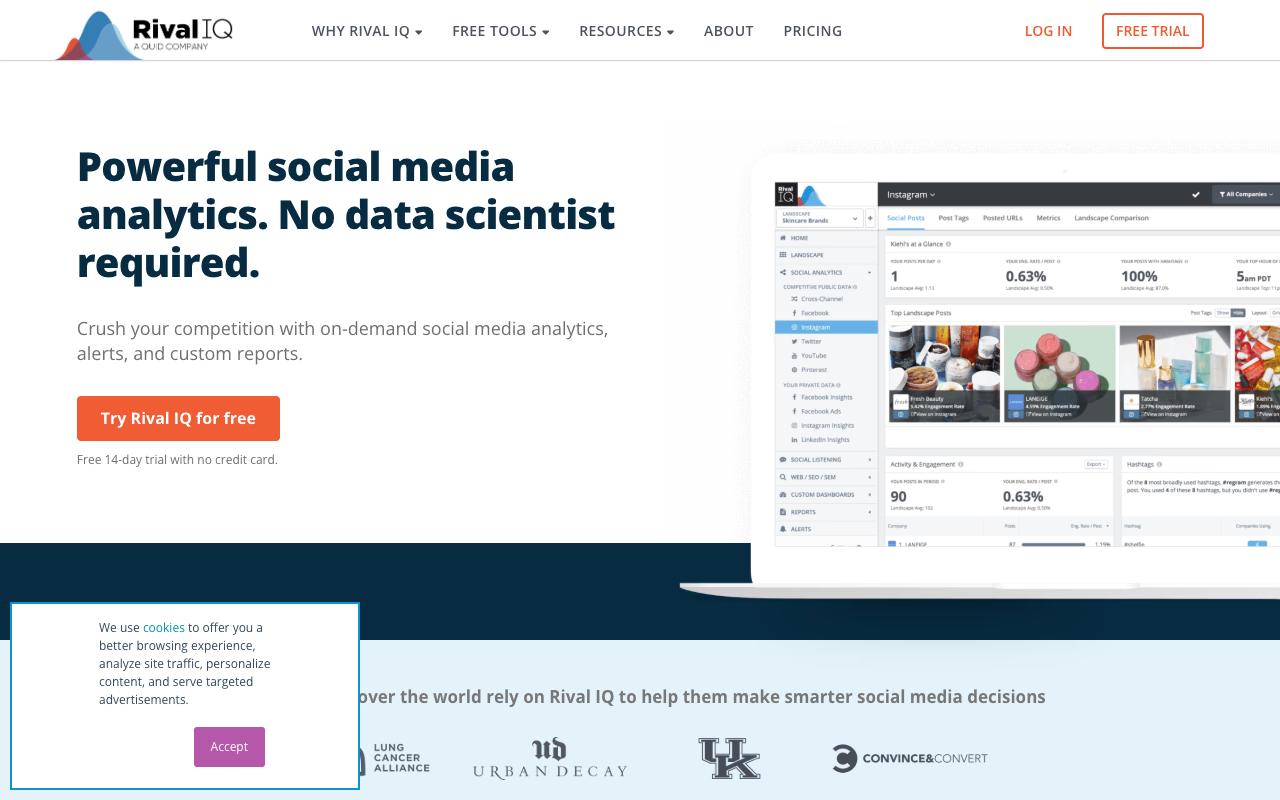
Rival IQ is the most benchmarking-native tool here, built so digital marketers can compare their social performance against competitors without needing a data scientist. It tracks profiles and posts across Instagram, Facebook, Twitter, YouTube and TikTok, with hashtag analytics, popular topics, post timing, media type breakdowns and keyword search. Landscapes and Company Filters let you benchmark against a whole industry or go head-to-head with one rival.
The standout feature is Boosted Post Detection: machine learning flags competitor posts that were likely promoted, which answers the question every benchmarking exercise eventually runs into, namely whether that spike was organic or paid. Always-on alerts monitor competitor posts and profiles, and post tagging lets you measure custom categories like campaigns or influencer mentions.
Pricing is the steepest starting point on this list. Drive is $239/month for 10 tracked companies, 6 months of history and 1 user; Engage is $349/month for 20 companies, 12 months of history, 2 users and 2 social listening saved searches; Engage Pro is $559/month for 40 companies, 24 months of history, 5 users and 10 saved searches, according to Rival IQ's pricing page. Extra tracked companies run $50/month per 5 and extra users $10/month each, annual billing saves 15%, and there's a 14-day trial with no credit card. Enterprise packages are available through sales.
On Capterra, Rival IQ holds 4.4/5. Reviewers commonly praise user-friendly social analytics and competitor tracking and note high pricing and limited lower-tier users. See the Capterra reviews page.
On G2, Rival IQ holds 4.5/5 across 49 reviews. Reviewers commonly praise ease of use and clear reporting and note price and limited support. See the G2 reviews and pros and cons pages.
Verdict: Buy it if competitive benchmarking is the core job and you can justify $239/month before you've published a single post.
5. Socialinsider
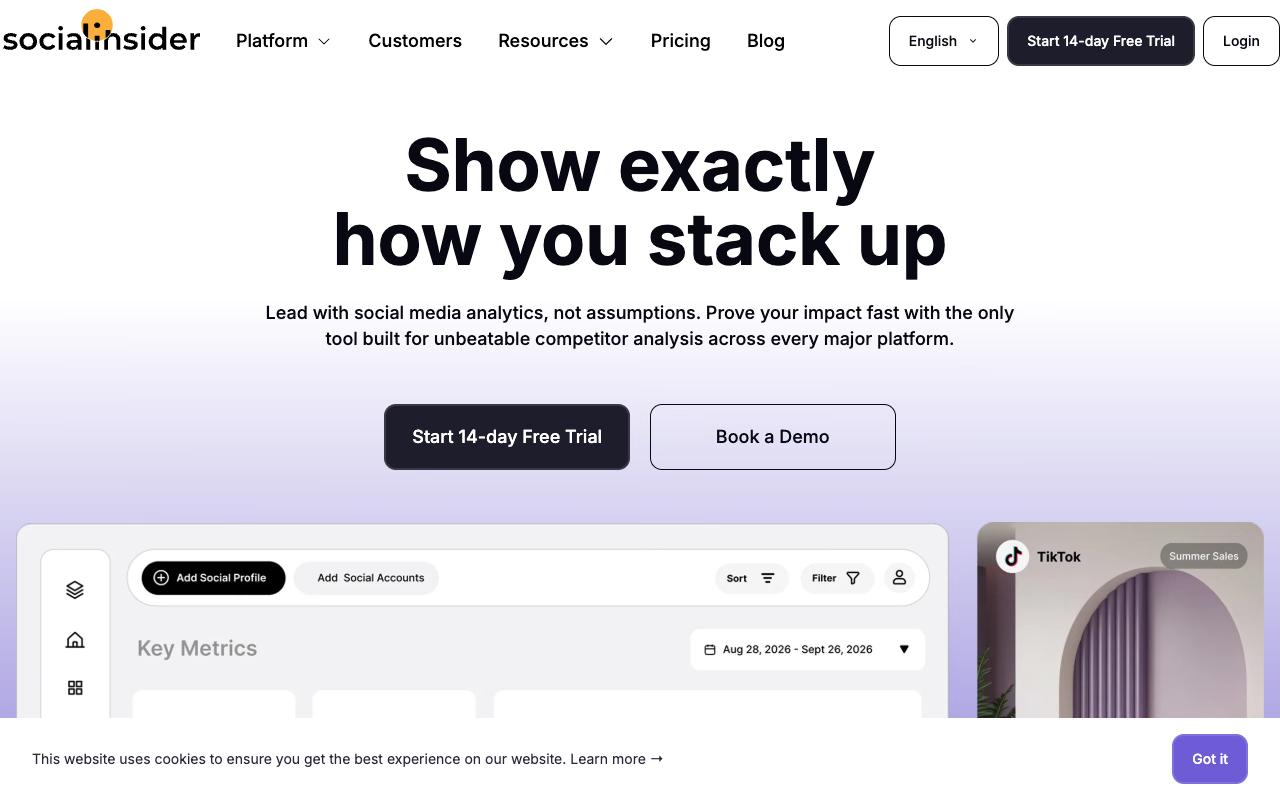
Socialinsider positions itself, in its own words, as "the only tool built for unbeatable competitor analysis across every major platform." It handles analytics, benchmarking and historical comparison so you're reading trends over time, and it's aimed at brands, agencies and marketing teams who need to prove how they stack up. The AI companion lets you ask for benchmarks, insights or reports through chat, and AI-powered content pillars surface what's working for competitors and across the industry, including top posts and rising content patterns.
Plans run $82/month for Adapt (20 social accounts, 3 months of historical data, 1 seat), $124/month for Optimize (30 accounts, 6 months, 2 seats), and $199/month for Predict (40 accounts, 12 months, 5 seats), with custom Enterprise pricing above that. Every plan includes cross-network analytics, competitor benchmarking, automated reports, unlimited exports, an MCP connector and priority support, per Socialinsider's pricing page. Additional profiles are $6/month each, yearly billing saves roughly 16%, and there's a 14-day trial.
One structural note: the seat and historical-data limits are what separate the tiers, so a team of five needs the $199 plan regardless of how many competitors they're tracking.
On Capterra, Socialinsider holds 4.9/5. Reviewers commonly praise easy-to-use interface, accurate analytics data, and time-saving automated reporting for social media performance and benchmarking and note occasional criticism of pricing and a few users noting feature limitations compared to broader social media management suites. See the Capterra reviews page.
On G2, Socialinsider holds 4.7/5 across 142 reviews. Reviewers commonly praise user-friendly interface, detailed social media analytics and competitor benchmarking, and responsive customer support and note limited customization options for reporting and some constraints around specific platform integrations. See the G2 reviews and pros and cons pages.
Verdict: A good middle option, with an MCP connector on every plan and enough historical depth on the top tier to run year-over-year comparisons.
6. Hootsuite
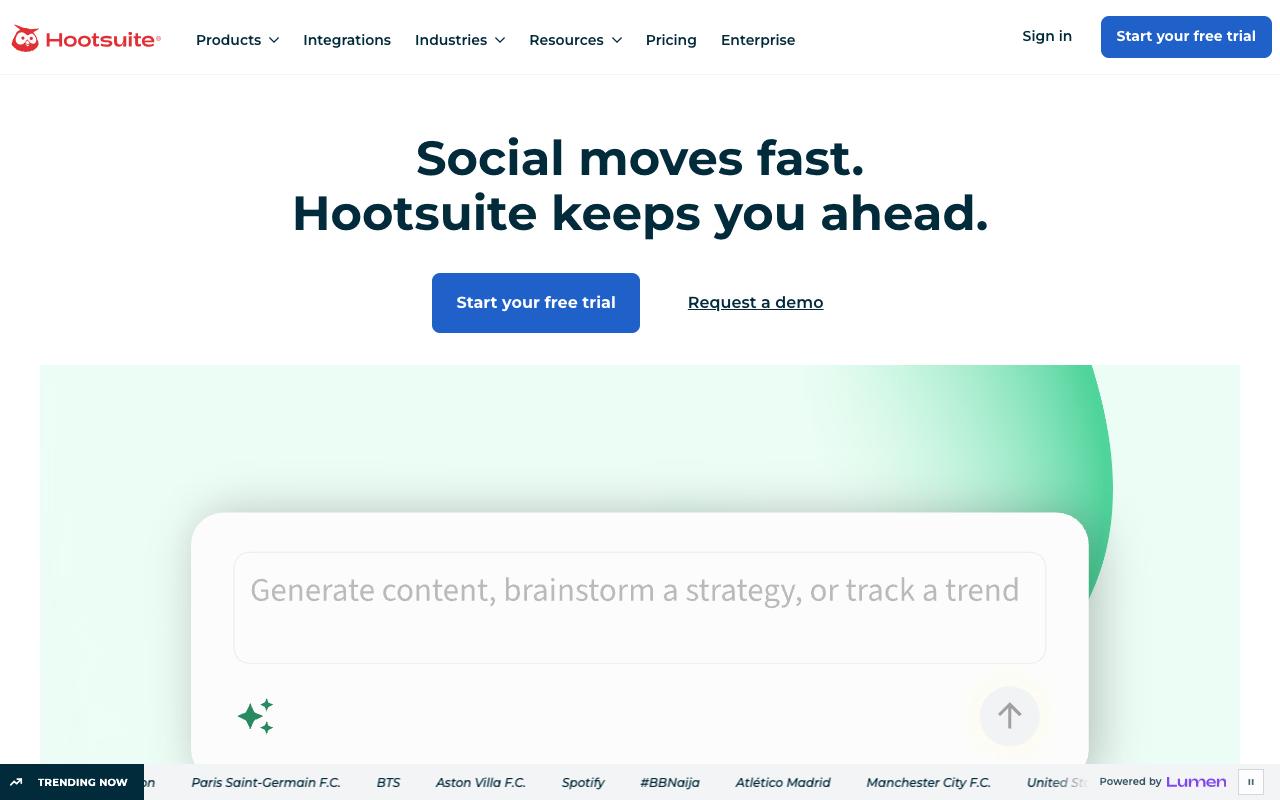
Hootsuite is the broadest platform here, combining publishing, a unified inbox, analytics and social listening in one dashboard. Its competitive analysis module tracks competitors' posting frequency, strategies, mentions, follower growth, average engagement, share of voice and sentiment, and pulls from social media, websites, forums, LLMs, podcasts and visuals. The listening layer covers 30+ social networks, 300+ review sites and 150+ million websites, a wider net than any pure analytics tool on this list casts.
Pros:
- Unified Inbox consolidates comments/messages from multiple platforms into one stream, saving significant time
- Bulk composer allows scheduling a month's worth of content quickly
- OwlyWriter AI helps draft social captions
- Fast and easy to use, with clean short (Owly) links for posts
- Best Time to Publish feature can improve engagement using audience-specific data
Cons:
- Customer support is slow and often unhelpful, with long email response times
- Billing/overcharging problems, including being charged after cancellation or after a trial period
- Platform reliability issues and bugs (e.g., video upload/frame-rate errors)
- Some users report lost or disconnected social account connections
- Owly short links stop working if the subscription is cancelled, even if the original post is still live
- UI can feel dated in places
Pricing is per user. Standard starts at $99/month per user for up to 10 social accounts with brand and competitor monitoring, Professional at $199/month per user adds unlimited accounts and 90-day trend forecasting, and Advanced at $399/month per user adds approval workflows, message auto-routing and team performance measurement, per Hootsuite's plans page. Enterprise is custom. Those are annual-billing rates, and monthly billing costs more. There's a 14-day trial with no credit card.
On Reddit, a thread in r/SocialMediaMarketing with 69 comments produced a consistent read: Hootsuite works for larger budgets but strains smaller ones. One commenter, who runs a competing tool, wrote that "the price tag is big and they are a bit behind in terms of some important features, like scheduling stories for example." Others in the thread pointed small agencies and startups toward cheaper alternatives offering comparable features.
Trustpilot tells a harsher story, with Hootsuite sitting at 1.3/5 from 555 reviews. The complaints cluster around billing and support more than the product itself. One reviewer described being charged after cancelling: "still got charged $150 after the trial period, immediately reached out to their customer service, zero responses, tried to get a refund the right way, zero support, still to this day zero reply." Another described email responses taking days and arriving cold and impersonal. If you're evaluating Hootsuite, the contract and cancellation terms deserve as much scrutiny as the feature list.
On Capterra, Hootsuite holds 4.4/5. Reviewers commonly praise reliable social media management with secure, fast performance and helpful scheduling and analytics tools and note cost and learning curve compared to simpler or cheaper alternatives, with some users wanting more intuitive workflows. See the Capterra reviews page.
On G2, Hootsuite holds 4.3/5 across 7,422 reviews. Reviewers commonly praise centralized, easy-to-use management of multiple social media accounts and streamlined post scheduling and note high pricing and limited or missing features, especially around instagram capabilities, integrations, and posting reliability. See the G2 reviews and pros and cons pages.
Verdict: The most complete platform if you want listening, publishing and competitive tracking under one login, with per-seat pricing and a support reputation that should factor into the decision.
FAQ
What's the Cheapest Competitor Benchmarking Tool for Social Media?
Social Status has a free tier at $0/month with 1 plan quota and 1 month of data history, and its Micro plan starts at $9/month. Among the paid-only options, Socialinsider's Adapt plan at $82/month is the lowest entry point, and Rival IQ is the highest at $239/month for its Drive plan.
Which Tool Can Tell Me If a Competitor Boosted a Post?
Rival IQ has Boosted Post Detection, which uses machine learning to flag competitor posts that were likely promoted. That's useful for explaining sudden engagement spikes in a competitor's feed before you try to replicate whatever they did organically.
Do I Need a Separate Tool for Benchmarking and Scheduling?
Not necessarily. Quintly, Social Status, Rival IQ and Socialinsider are analytics and reporting platforms, so they measure but don't publish. Ordinal and Hootsuite both combine publishing with analytics, which means what you learn from competitor data can feed directly into your content calendar instead of sitting in a separate report.
Related Posts
Looking to learn more? The below posts may be helpful for you to learn more about social media and content marketing.