Why LinkedIn Posts Show Up in AI Answers

Full Transcript
Jeffrey: For the last decade, if you wanted to be found, you optimized for Google search. That's changing fast. Now, people ask ChatGPT, Claude, Perplexity, and more for answers to their biggest problems. My name's Jeffrey, and I've spent years obsessing over how companies use LinkedIn to grow revenue.
In this video, I'll unpack what I've been seeing with AEO, or answer engine optimization. First, we'll cover what it is and how it actually works. Second, we'll talk about how posting on LinkedIn really affects your ranking. And third, the system and strategy behind winning companies using AEO today. Let's get into it.
What Is AEO, and Does LinkedIn Content Get Cited by AI Search Tools?
Nathan: All right. I'm here with Jeffrey, the co-founder of Ordinal. Excited to talk about today. It's near and dear to my heart around SEO and AEO. But really then where your expertise comes in, because whenever people think about SEO or AEO, rarely do people think about LinkedIn, and they probably should, LinkedIn and Reddit, but today we'll just focus on LinkedIn.
So I wanted to ask you a couple of questions around that because you brought up some cool stuff. So before we even get started, would you mind just defining what is AEO and does LinkedIn content actually get cited by AI search tools like ChatGPT and Perplexity?
Jeffrey: Yeah. So AEO, I believe it stands for answer engine optimization. But yes, AEO is basically, I think, this new concept or newish concept, right? So instead of traditional SEO where you're trying to rank on Google, AEO is maybe just the practice of ranking, or like Google and other search engines, AEO is the practice of trying to rank on AI tools, right?
So think AI searches. Whether that's like a local tool like, you know, ChatGPT or Claude that someone might be asking you for recommendations about. It could be, you know, even startups like Perplexity. Or it could even be Google's native AI overview section.
But in the whole I think AEO is the practice of how do we adjust very tactical things and concepts that used to apply to traditional SEO and optimize them more for this AI first world where people are searching more and more on AI engines and trying to get recommendations and answers there.
Do You Go to AI Search Tools Before Google?
Nathan: Let me ask you personally, have you found yourself going to AI search tools before Google or are you still primarily Google? Is Google still the ingrained habit for finding information that you want?
Jeffrey: For me personally, it's a mix, but I would say AEO plays a much, much bigger role than it used to. I think there's a few things. One is we run a lot of agents internally at Ordinal. So, agents will often surface tools proactively. So, it's not even necessarily a user search on my side.
I'm not necessarily asking it to pick a new provider for this or, you know, XYZ. It often just surfaces recommendations. And I think that's the result of some of these companies doing a really good job with AEO where the agents, you know, make it the default option. So I would say that's the first aspect that probably AEO plays in a personal choice.
The second is AEO is, you know, really useful for summarizing large amounts of information. So I think that everyone's probably felt this as a user, but in some respects you're a little tired of going to SEO, reading a listicle and realizing it's, you know, written by the company that wants you to buy their product.
Obviously, you know, I think that's still valuable and there's real insights there. And, you know, it's helpful to a more traditional buyer as well, but I think in many ways with tools like Claude or ChatGPT or Codex and Perplexity, it's way easier to just ask them to do the comparison for you.
But then hence the question, what source materials is it going to pull? Who's it going to rank higher than the other? Does it really have a full comprehensive understanding of your product? And I think that's really where AEO kind of comes in, is making sure that you're set up for success when a user does ask.
How Do Enterprise B2B Companies Get Recommended by AI?
Nathan: And based on your experience and knowledge, how do enterprise B2B companies get recommended when someone asks an AI which tool to buy? Is it just good SEO or is it also pulling from, like we chat about, social channels like LinkedIn, Reddit, different things from there?
Jeffrey: Yeah, I think a lot of it is definitely just good classic traditional SEO, right? You want to build authority for these engines, and these AI engines are different in a lot of ways in Google traditionally, but they're also similar in other ways too, right? I think that, you know, they care about the keywords that you're ranking for, whether you're a trusted voice in the space, and a lot of that is built from kind of more traditional SEO practices.
So in some ways I do think a little bit of this, like, AEO side is overblown, in that if you have a really great ranking domain then you're probably going to do okay on LLMs as well. However, there is this, like, remaining half of optimization that I think isn't talked about enough, and that's where this whole new wave of tactics come in.
Is your website easily crawlable by agents, right? Have you set up your pricing page and info to be easily understandable? We've seen companies that have even put up markdown versions of their pricing pages, right? So that agents can easily understand it and LLM can easily crawl it.
In addition to that, I'm sure we'll get to it, but there are a lot of, I think, really powerful but underleveraged tactics that mattered less for SEO, but more for AEO. And LinkedIn, for example, is one of them, right? So how do you actually create authority as an individual voice or company? And how can you leverage social channels to do that for you?
Because a lot of these LLMs will actually care a lot more about what LinkedIn and Reddit and some of these social channels have to say than they do about your own blog posts and media. So I think distributing on third-party networks like LinkedIn is also incredibly important.
Does Aiming for AI Citations Change What You Post About?
Nathan: Well, and so if I was listening to this and let's say I was in charge of social, and I typically think of, you know, social media, I'm going for engagement or I'm, you know, going for follower increase, but then if I'm maybe a little more serious and at enterprise I'm going for pipeline. If my goal though becomes to also get cited by these AI search engines, does that change how I should approach the topics that I'm posting about?
Should I just try to do it organically? Should I concentrate on one specific niche for longer? What would be your recommendation on how this would change posting cadence and topics, if at all?
Jeffrey: Yeah, I think this is a great question. I feel like maybe what it's getting at is the fact that social is no longer just a one-dimensional platform, right? And there are different objectives that you need to think about. Our recommendation is typically think about social as like an actual funnel as well, right?
So you have your typical top of funnel content, right? That might be personal stories from your life. It might be like memes. It might be, you know, just stuff that gets impressions and views and builds your follower base.
You have middle of funnel content where you're building a lot more authority and credibility around competitors, your domain space, insights there, and then you have bottom of funnel content that's meant to convert. That middle and bottom of funnel content is what's actually going to rank for relevant searches, obviously. Though at the same time, you know, top of funnel content is still important to establish some credibility and make sure that the middle and bottom of funnel content is getting views.
So I hate that this is a little bit of a non-answer, but I would say my answer is that you need to kind of focus on all of them, because it kind of works as a system, and that's probably how you end up doing well.
How Should Larger Teams Run LinkedIn Approvals and Governance?
Nathan: And we're talking about all these, you know, different pieces in the funnel. It can be a lot of posting. How would larger teams run LinkedIn approvals and governance so that they can get those AI citations without killing the velocity that they need to do so? How can they handle those approvals?
Jeffrey: We think it's really important to use a centralized system. So I think there's two points here, right? Number one, the best way to do this is to use a centralized software, right? You are going to have a disaster trying to run a bunch of LinkedIn voices manually through spreadsheets and Notion and manual posting. You're not going to get the consistency that you need for AEO to run like an engine.
The analogy I like to give is like think about AEO just like SEO, right? Would you like tell a blog writer that they can just, you know, sort of log into your account every once in a while when they have an idea, write a whole post and publish it, or do you want a system that consistently turns out five high-value articles a week, right? And I think for most companies, the answer is the latter.
It's the same thing for LinkedIn content in AEO. If your goal is to rank and your goal is to get picked up by search engines, you need to be consistent. You need to have a system. You need to take as many shots on goal as possible to both build credibility but also start ranking for the right things.
I think the second side to this that I think is a nuanced point but an important one as well is it's important to have more voices in AEO, right? Like if you're doing LinkedIn content, the great thing is unlike a company blog, you can have as many blogs as you have employees essentially. You can have as many distribution channels for AEO as you have people that work at your business.
And so if you're running a really good employee advocacy or executive advocacy program, you can start to compound and scale out your AEO efforts in a way that wasn't possible before, right? In many ways, traditional SEO is constraining because you can only publish so many blog posts per week. But you have a 100 people posting, if each one posts three to five times a week, that's a lot of content that's getting out there and indexed.
Nathan: I never thought about that. Having a blog posting network by your employees and executives rather than just like a tweet thread. That's really interesting. Sorry, that's very cool.
Yeah, and I imagine those complement each other. If you have somebody posting on LinkedIn about something and they have a parallel blog post article and a link back to it, I imagine that only helps in the long run. That's so cool.
Jeffrey: Exactly. Exactly.
Nathan: But like you said, only possible with a system or a very exhausted ghostwriter who's 24/7.
Jeffrey: Yeah.
How Often Should Enterprise Teams Post on LinkedIn?
Nathan: How often do you think enterprise teams should be posting on LinkedIn if they, let's say, if they're just starting out versus they're a little more mature and they want to start getting aggressive?
Jeffrey: Yeah. I think that in general what we've seen from our customers is, you know, when you're just starting out, the honest answer is whatever you can get out of it, right? I can give you the ideal answer, like every day, right? But I think that in reality maybe it's like two, three times a week, maybe it's even just once a week.
There's a lot of factors that are hard to decide because it is, just starting out, a little bit dependent on internal politics, how willing execs are to post, how okay they are with content, how long it takes to align on approvals and voice in those first few cycles.
But once you get in a rhythm, I think it's important to scale to at least 3 to 5x per week. I think that's really a good sweet spot where you're doing enough volume, you can start to see things work. You can start to see trends and patterns. And, you know, on the AEO side as well, right, you can start to actually build some ranking.
Is There a Point of Diminishing Returns on Posting Frequency?
Nathan: Yeah. And in traditional content marketing, there's been a thought that as long as the articles are quality, more is actually more. And if I'm thinking of like, let's say, somebody who really wants to be aggressive, is there a part of limiting diminishing returns, excuse me, if I'm posting let's say twice or three times a day, do my posts start to compete with each other in terms of reach and so I should try to stick to that 3 to five or even two to three per week?
Jeffrey: Past the 3 to 5x, there's probably a falloff for sure. But I think if you're sticking within 3 to 5x per week, you're probably okay. Nothing too significant.
Nathan: That's actually a big relief. That's good. I imagine a lot of people, that takes the pressure off where it gives them time to do it right.
How Will AI Agents Change Enterprise Social Media Operations?
Nathan: Okay. My last question for you. Obviously, nobody knows the future, but let's say that you have your crystal ball out. How do you think AI agents will change enterprise social media operations over the next year or two?
Jeffrey: Oh, wow. That's a big question. I think for us, and, you know, maybe this ties into the AEO question, the really important thing as AI continues to evolve is that the level of quality of your content that you're putting out doesn't dip. So, if you're doing a lot of AEO volume, for example, it's important that AI plays a role and it's an undeniable role in helping you draft your content, but it's important to keep the content quality high.
I think where AI agents are really going to change the game of social is the scale and the distribution methods in which how things are going to happen. So if you have really sophisticated social teams and you look at them today, the way they're using AI and getting the most value out of it doesn't tend to be, hey ChatGPT, draft me 100 posts to post on LinkedIn and here's like three random topics.
It tends to be much more like, hey, we've set up swim lanes for each individual exec. We've set up swim lanes for the employee departments. We've set up tiering systems to figure out who posts about what. We've tuned our AI models to understand unique insights and perspectives and tone of voice, partially with the Ordinal MCP. We've also tied it to context that gives it real context about the business and thoughts.
And we use all of that to coordinate this massive posting system that would never have been possible manually. And so that's the automation that I think AI allows you to bring. Not necessarily just blasting out more posts.
How Does Ordinal Help Teams Keep Quality High?
Nathan: Yeah. Okay, then that's great. And now just in the last few seconds, how does Ordinal specifically help teams do that in a way without letting the quality dip?
Jeffrey: Yeah. So, Ordinal is an end-to-end social management platform built for B2B teams. We help coordinate a lot of executive advocacy flows as well as employee advocacy flows. I think in short, you know, that's everything from the coordination of posts, of like getting them approved, getting everything loaded up correctly, getting it scheduled, helping to manage multiple execs accounts without logging in and out or having to kind of share across spreadsheets and Slack and all of that stuff.
Ordinal is just a centralized orchestration layer that allows this whole push content to run through it. On top of that, Ordinal is very AI native, right? So we connect to Claude, Cursor, Codex, any AI tool that you use locally.
We can connect all your LinkedIn data to, as well as kind of other social data, and you can use that to obviously help draft posts, but you can also kind of look at analytics on how things are performing and really create this loop that starts to work.
Nathan: And like you said, a lot of people think that most of the strategy around social media is in the crafting of the content, but you're actually a believer that there's a second half that's arguably just as big, if not bigger, which is the scheduled distribution and coordination of those posts. Okay. Just want to make sure I got that right.
Awesome. Well, Jeffrey, thank you so much for taking the time. I really appreciate it. And if anyone has questions, where can they find you? What's the best way? Email, LinkedIn?
Jeffrey: Yeah, you can find our website at tryordinal.com. You can email me at jeffrey@tryordinal.com. But yeah, that's pretty much it.
Nathan: All right. Thank you so much. Appreciate it.
Jeffrey: Awesome. Thank you.
Chapters
- 0:00Intro
- 0:18Definition of AEO (Answer Engine Optimization)
- 1:40Personal use of AI search tools vs. Google
- 3:14How to get recommended by AI
- 5:38Adjusting content for AEO
- 6:37Content approvals for larger teams
- 8:53Recommended posting cadence on LinkedIn
- 10:32How AI agents change future social media
- 12:09How Ordinal helps teams manage social content
- 14:10Outro
Key Takeaways
- A lot of answer engine optimization (AEO) is good, classic SEO. If you have a really great ranking domain, you're probably going to do okay on LLMs as well.
- The remaining half is newer: making your website and pricing page easy for agents to crawl, and distributing on third-party networks such as LinkedIn, which a lot of LLMs care about more than your own blog posts.
- Middle- and bottom-of-funnel LinkedIn posts are what rank for relevant searches. Top-of-funnel posts earn the credibility and the views that carry them.
- You can have as many distribution channels for AEO as you have employees, and that only works when posting runs through one centralized system.
- Start at whatever cadence you can sustain, then scale each voice to at least three to five posts a week. Past that range there's probably a falloff.
Everyone has probably felt this as a user: you search for a tool, read a listicle, and realize it was written by the company that wants you to buy its product. It's way easier to ask Claude, ChatGPT, or Perplexity to do the comparison for you, which moves the question to what source material the model pulls and who it ranks higher.
Here's my position: a lot of these LLMs care more about what LinkedIn and Reddit have to say than about your own blog, so the companies that get recommended will be the ones that run LinkedIn as a system, with many voices posting consistently.
What Is AEO, and How Much Is Just Good SEO?
AEO stands for answer engine optimization. Traditional SEO is about ranking on Google, and AEO is the practice of trying to rank on AI tools: ChatGPT or Claude when someone asks for a recommendation, startups like Perplexity, and Google's native AI overview section.
Much of AEO is good, classic, traditional SEO. These AI engines care about the keywords you rank for and how trusted a voice you are in your space, and that authority is built through traditional SEO practices. So I do think the AEO conversation is a little overblown, in that if you have a really great ranking domain, you're probably going to do okay on LLMs as well.
There's a remaining half of optimization that I think is talked about too little. One part is technical: making your website easily crawlable by agents and your pricing page easy to understand. We've seen companies put up markdown versions of their pricing pages so an LLM can crawl them.
I see the effect in my own habits. We run a lot of agents internally, and they often surface tools proactively, so a recommendation arrives without me asking for a new provider at all. I think that's the result of some companies doing a really good job with AEO, to the point where the agent makes them the default option.
Why Do LinkedIn Posts Show Up in AI Answers?
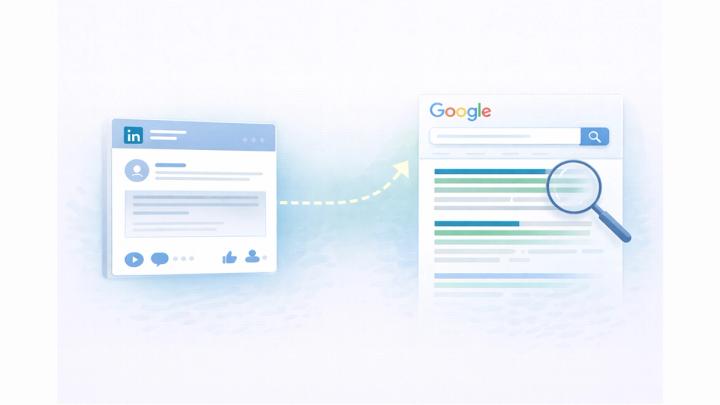
The other part is a set of powerful, underused tactics that mattered less for SEO and matter more for AEO, and LinkedIn is one of them. The work is creating authority as an individual voice or as a company, and letting social channels do that for you.
"A lot of these LLMs will actually care a lot more about what LinkedIn and Reddit and some of these social channels have to say than they do about your own blog posts and media."
That's why I think distributing on third-party networks like LinkedIn is incredibly important. Our guide to social media SEO covers the search side of that.
Which LinkedIn Content Ranks for AI Searches?
Our recommendation is to think about social as a funnel.
- Top of funnel: personal stories from your life, memes, and the posts that get impressions and views and build your follower base.
- Middle of funnel: posts that build authority and credibility around your competitors and your domain, with insights from that space.
- Bottom of funnel: content that's meant to convert.
The middle- and bottom-of-funnel content is what's going to rank for relevant searches. Top-of-funnel content is still important, though, because it establishes some credibility and makes sure the middle and bottom of the funnel get views. I hate that this is a bit of a non-answer, but you need to focus on all of them, because it works as a system.
Why Does AEO on LinkedIn Need a System?
Think about AEO just like SEO. A blog writer who logs into your account every once in a while when they have an idea and publishes a whole post is a poor way to run a blog. The better answer is (usually) a system that consistently turns out five high-value articles a week, and it's the same thing for LinkedIn content.
Consistency Comes From One Centralized System
If your goal is to rank and get picked up by search engines, you need to be consistent. Running a bunch of LinkedIn voices manually through spreadsheets, Notion, and manual posting is going to be a disaster, so my first recommendation for larger teams is one centralized piece of software.
"You need to take as many shots on goal as possible to both build credibility but also start ranking for the right things."
More Voices Mean More Channels
The second point is more nuanced and just as important: it helps to have more voices. Unlike a company blog, LinkedIn gives you as many blogs as you have employees.
"You can have as many distribution channels for AEO as you have people that work at your business."
Traditional SEO is constraining, because you can only publish so many blog posts per week. But if you have 100 people posting three to five times a week each, that's a lot of content getting out there and indexed. A really good employee advocacy or executive advocacy program lets you compound your AEO efforts in a way that was never possible before.
How Often Should Each Person Post?
In general, what we've seen from our customers is that when you're just starting out, the honest answer is whatever you can get. The ideal is every day, and the reality is maybe two or three times a week, or even once. A lot of that depends on internal politics: how willing execs are to post, how okay they feel about the content, and how long it takes to align on approvals and voice in the first few cycles.
Once you're in a rhythm, I think it's important to scale to at least three to five posts a week, the same range we recommend in our guide to LinkedIn posting frequency. That's the sweet spot where you're doing enough volume to see trends and patterns and start to build some ranking on the AEO side. Past that range there's probably a falloff.
Where Does AI Fit in a High-Volume Posting Program?
If you're doing a lot of AEO volume, AI has an undeniable role in helping you draft, and the really important thing is that the quality of what you put out stays high. Where I think AI agents will change social is in scale and distribution. Asking ChatGPT to draft 100 LinkedIn posts from three random topics is the low-value way to use it.
The really sophisticated social teams I look at today have set up swim lanes for each individual exec and for the employee departments, and tiering systems to figure out who posts about what. They've tuned their AI models to understand unique insights, perspectives, and tone of voice, and tied them to real context about the business. All of that coordinates a massive posting system that would never have been possible manually.
How We Run This at Ordinal
Ordinal is an end-to-end social management platform built for B2B teams, and we help coordinate a lot of executive advocacy and employee advocacy flows. That's everything from getting posts approved, loaded up correctly, and scheduled, to managing multiple execs' accounts without logging in and out or sharing things across spreadsheets and Slack. It's the centralized orchestration layer the content runs through.
Ordinal is also very AI native. We connect to Claude, Cursor, Codex, or any AI tool you use locally, and we can connect your LinkedIn data and other social data to it. You can use that to help draft posts and to look at analytics on how things are performing, which creates a loop that starts to work. The tone-of-voice tuning I described above is partially done with the Ordinal MCP.
Final Thoughts
Count how many people at your company posted about your domain last week, and how many of those posts were middle or bottom of funnel. Then put the people who are willing into one centralized system, start at whatever cadence they can sustain, and build each voice toward three to five posts a week. While that ramps up, check whether an agent can easily crawl your website and understand your pricing page.
Frequently Asked Questions
What Is Answer Engine Optimization (AEO)?
AEO is the practice of trying to rank on AI tools such as ChatGPT, Claude, Perplexity, and Google's AI overview section. I think of it as taking the tactics and concepts that applied to traditional SEO and adjusting them for a world where people search more and more on AI engines for recommendations and answers.
Does LinkedIn Content Show Up in AI Search Answers?
A lot of LLMs care more about what LinkedIn, Reddit, and other social channels have to say than about your own blog posts and media. That's why I think distributing on third-party networks like LinkedIn is incredibly important if you want to be recommended.
Is AEO Different From SEO?
A lot of AEO is good, classic SEO: building authority, ranking for the right keywords, and being a trusted voice in your space. If you have a really great ranking domain, you're probably going to do okay on LLMs too. The remaining half is newer tactics, such as making your site and pricing page easy for agents to crawl and building authority on social channels.
What Kind of LinkedIn Content Ranks in AI Search?
Middle- and bottom-of-funnel content is what's going to rank for relevant searches, because that's where you build authority around your domain and your competitors. Top-of-funnel posts still matter, since they establish credibility and get views for everything else. I'd focus on all three, because they work as a system.
How Often Should You Post on LinkedIn for AEO?
When you're just starting out, the honest answer is whatever you can get, which is (usually) two or three times a week or even once. Once you're in a rhythm, I'd scale each person to at least three to five posts a week. Past that range there's probably a falloff.
How Does Employee Advocacy Help With AEO?
You can have as many distribution channels for AEO as you have people who work at your business. A company blog can only publish so many posts per week, while 100 employees posting three to five times a week puts a lot of content out there to be indexed. That only works with a centralized system, because running that many voices through spreadsheets and manual posting is a disaster.