

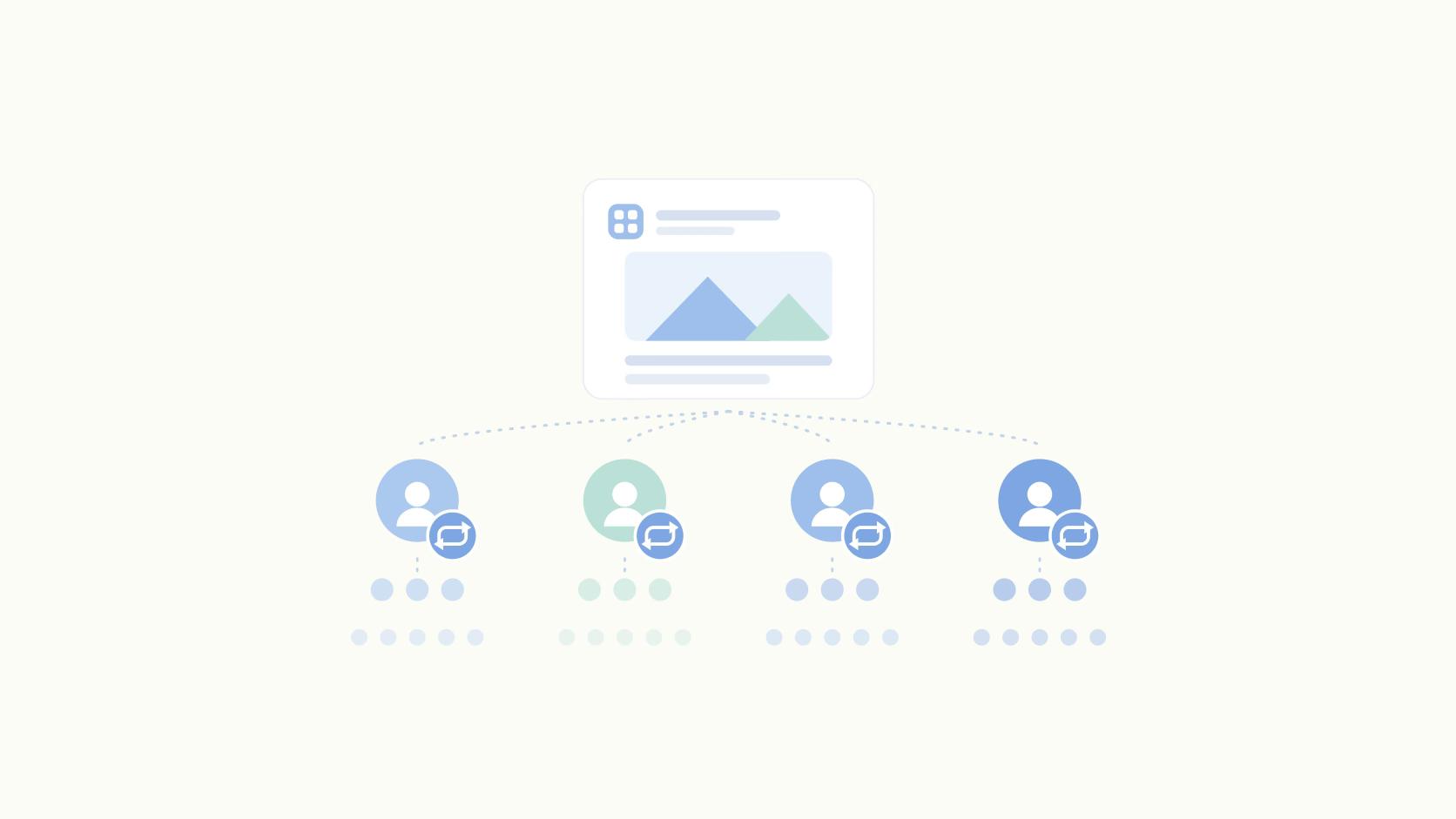
Employee advocacy tools split into two camps, and that split matters more than any feature list. One camp is built around a content library where employees log in, pick an approved post, and hit share. The other is built around drafting and scheduling content on behalf of specific people, then coordinating team engagement around it.
Both call themselves employee advocacy while solving different problems.
The table below lines up pricing, standout features and ratings so you can see where each tool sits before reading the full entries.
What Makes a Good Best Employee Advocacy Software to Improve Social Strategy
1. Content model: library vs. drafted: The core split in this category is whether employees choose from a pre-approved content library and reshare it, or whether marketing drafts and schedules posts on behalf of specific people like execs. This distinction shapes almost everything else about fit, so it's worth deciding which problem you actually have before comparing feature lists.
2. Platform scope vs. point solution: Some tools are narrowly built for advocacy alone, while others bundle it as one module inside a broader intranet or employee-experience suite. A narrow tool can go deeper on the actual sharing workflow, while a bundled platform may mean paying for overlap if you already own adjacent systems.
3. Attribution and reporting depth: Tools vary widely in how far they take measurement from basic share counts to reach broken out by department, UTM-tracked pipeline attribution, and earned media value versus paid ad equivalents. If you need to prove ROI to leadership, check what's actually exportable and tied to CRM or pipeline data.
4. Enterprise trust and compliance: For regulated or security-conscious buyers, features like SSO, audit trails, role-based permissions, ISO certification, or named SEC/FINRA/FCA coverage separate vendors that can pass a security review from those that can't.
5. Gamification and adoption mechanics: Several tools lean on leaderboards, points, badges, and rewards to keep employees participating, plus features like duplicate-copy paraphrasing to avoid the obvious 'everyone posted the same thing' look. Whether a program sustains itself often comes down to these adoption mechanics rather than the sharing feature itself.
6. Pricing transparency and structure: Published starting prices versus custom quotes, and per-seat versus per-employee-count pricing, materially affect how easy a tool is to evaluate and budget for before you ever talk to sales.
Best Employee Advocacy Software
1. Ordinal
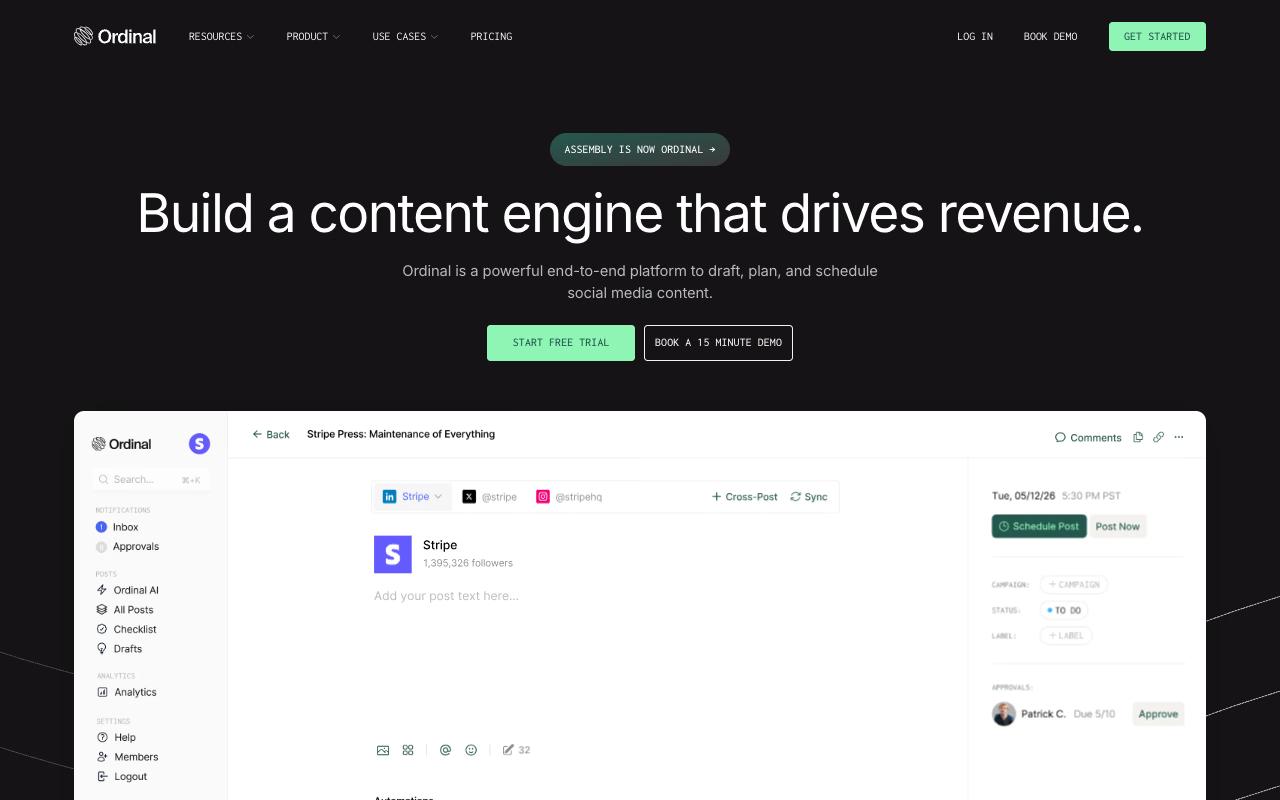
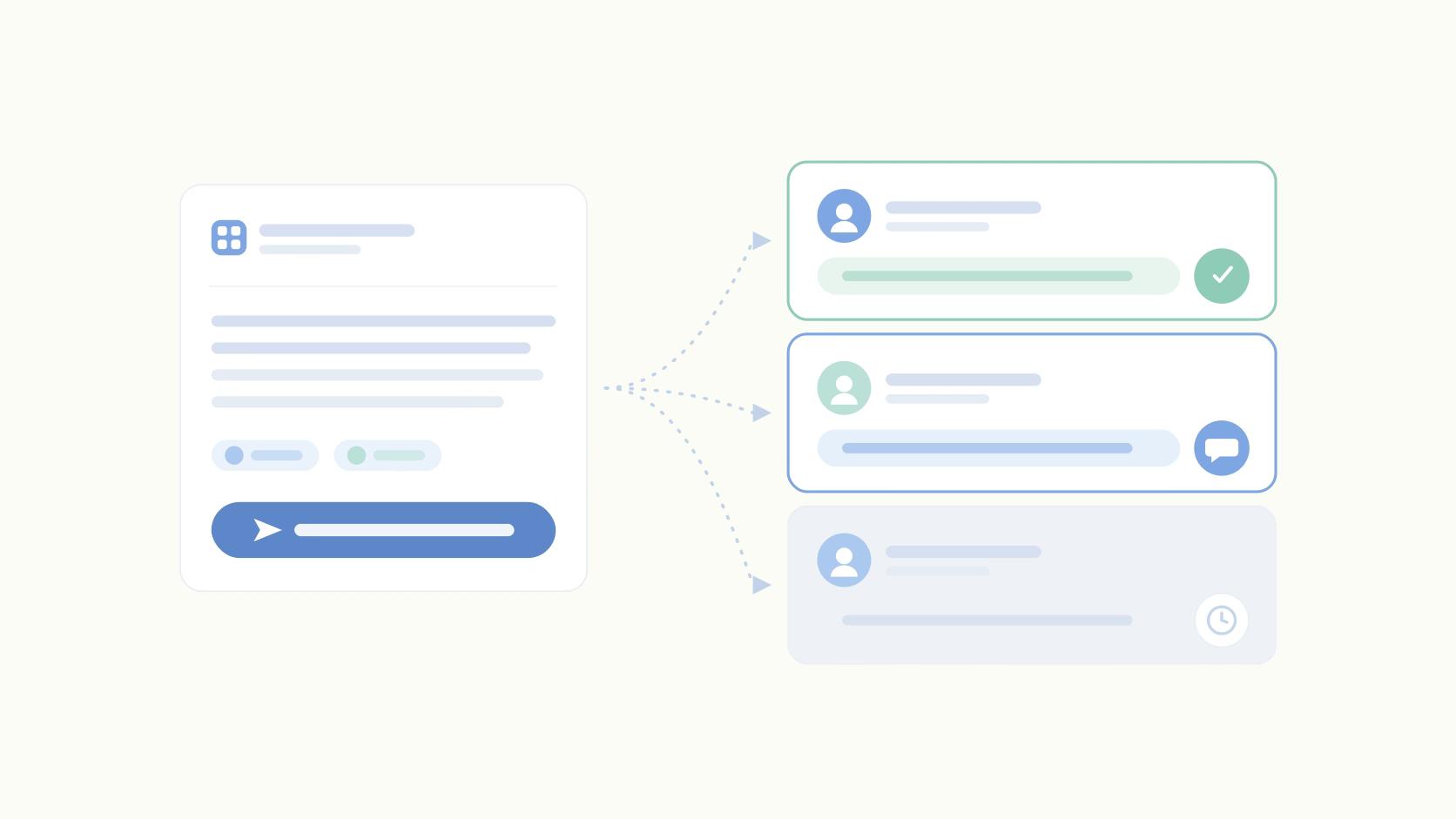
Ordinal is an end-to-end platform for drafting, planning, and scheduling social content, and it comes at advocacy from the creation side rather than the resharing side. Instead of asking employees to pick from a library, marketing teams draft and schedule posts for founders, execs, and company accounts directly, then use automated engagement to coordinate likes, comments, and reposts from any connected LinkedIn account. So the fit is social media managers, content marketers, and growth teams at companies where a handful of executives need to post consistently and someone else is doing the actual writing.
The LinkedIn feature depth is where it pulls away from general schedulers. You get personal profile and company tagging, PDF carousel uploads, video, and a realistic preview that shows exactly where your hook cuts off before "see more." According to Ordinal's product pages, every action available in the UI is also available through the API, MCP server, and webhooks, which is the part that matters if you're trying to connect social data to your CRM or run reporting outside the tool. Pro also includes approval workflows and all-time account analytics.
Pricing: Starter is $95/mo (or $85/mo billed annually) for up to 3 seats and 4 social profiles, with 50 scheduled posts per month. Pro is $265/mo (or $235/mo annually) and adds unlimited seats, unlimited posts, automated engagement, approval workflows, and API/MCP/webhook access. Enterprise is custom and adds employee advocacy, leads data, SAML/SSO, and dedicated onboarding. Both paid plans include a 14-day free trial, according to Ordinal's pricing page.
Verdict: The strongest pick if your advocacy problem is really a ghostwriting and coordination problem, and the only tool here with published prices and an API you can build on.
2. Sociabble
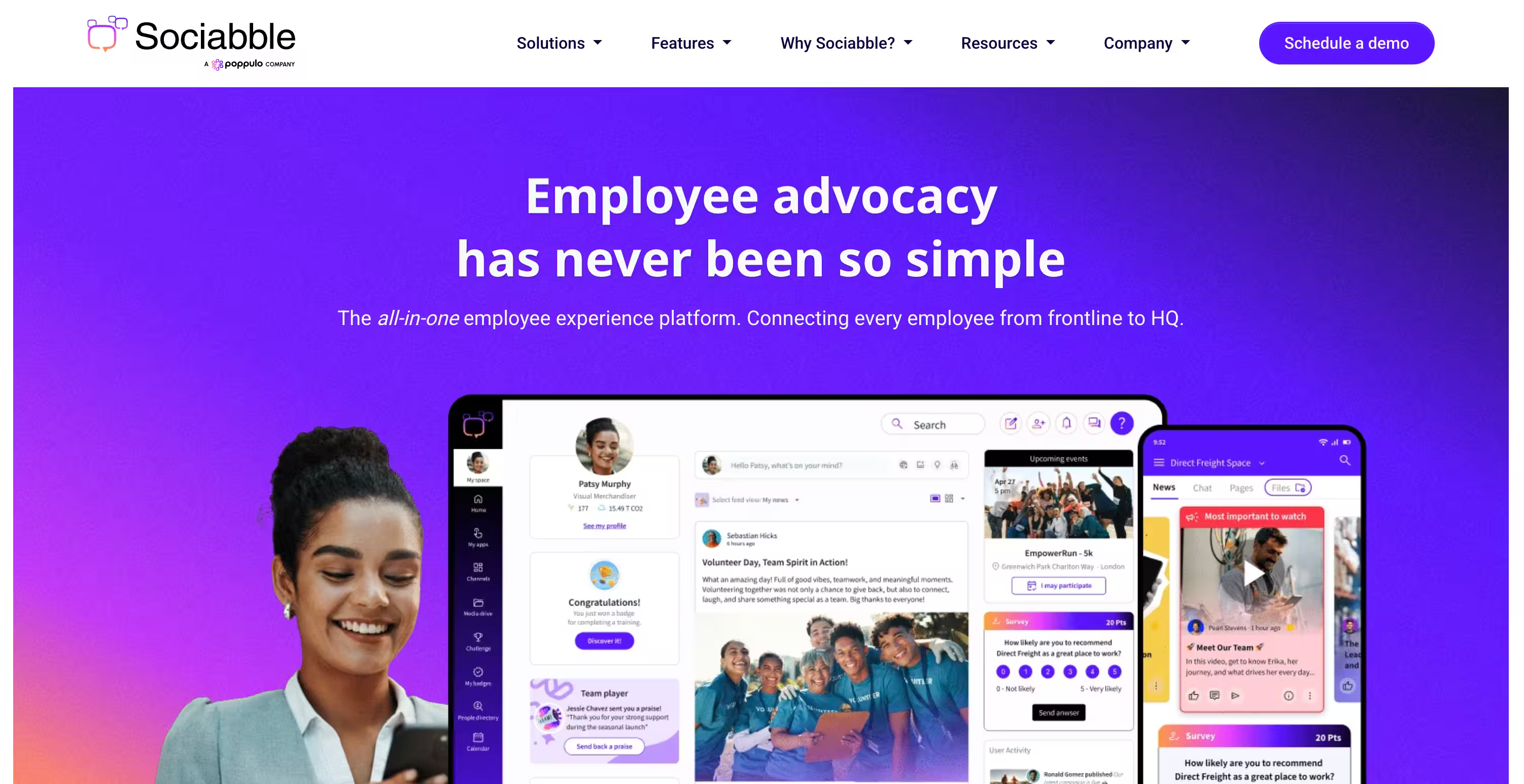
Sociabble is an employee experience platform that bundles internal communication, employee engagement, advocacy, and social selling into one product. The advocacy piece sits alongside targeted internal messaging, "must-read" content that guarantees visibility for compulsory information like security procedures, anonymous surveys, and a fairly deep gamification layer with challenges, badges, leaderboards, and rewards that connect to stores like Bonusly and Panopli. It fits organizations with a large frontline or non-desk workforce where advocacy is one goal among several.
Pricing: No public pricing. Sociabble sells tiered packs by user count, per its pricing page: Bronze up to 500 users with 4 days of consulting, Silver up to 1,000 users adding Teams and Slack integrations, SSO, and a translation pack, then Gold and Enterprise for 1,000+ and 50,000+ users with API access and advanced SLAs. You need a quote.
On G2, Sociabble holds 4.7/5 across 405 reviews. Reviewers commonly praise ease of use, support quality, and employee engagement capabilities and note platform complexity, implementation effort, and occasional feature gaps. See the G2 reviews and pros and cons pages.
Verdict: Best when advocacy is one line item in a broader internal comms overhaul rather than the whole reason you're buying.
3. Haiilo
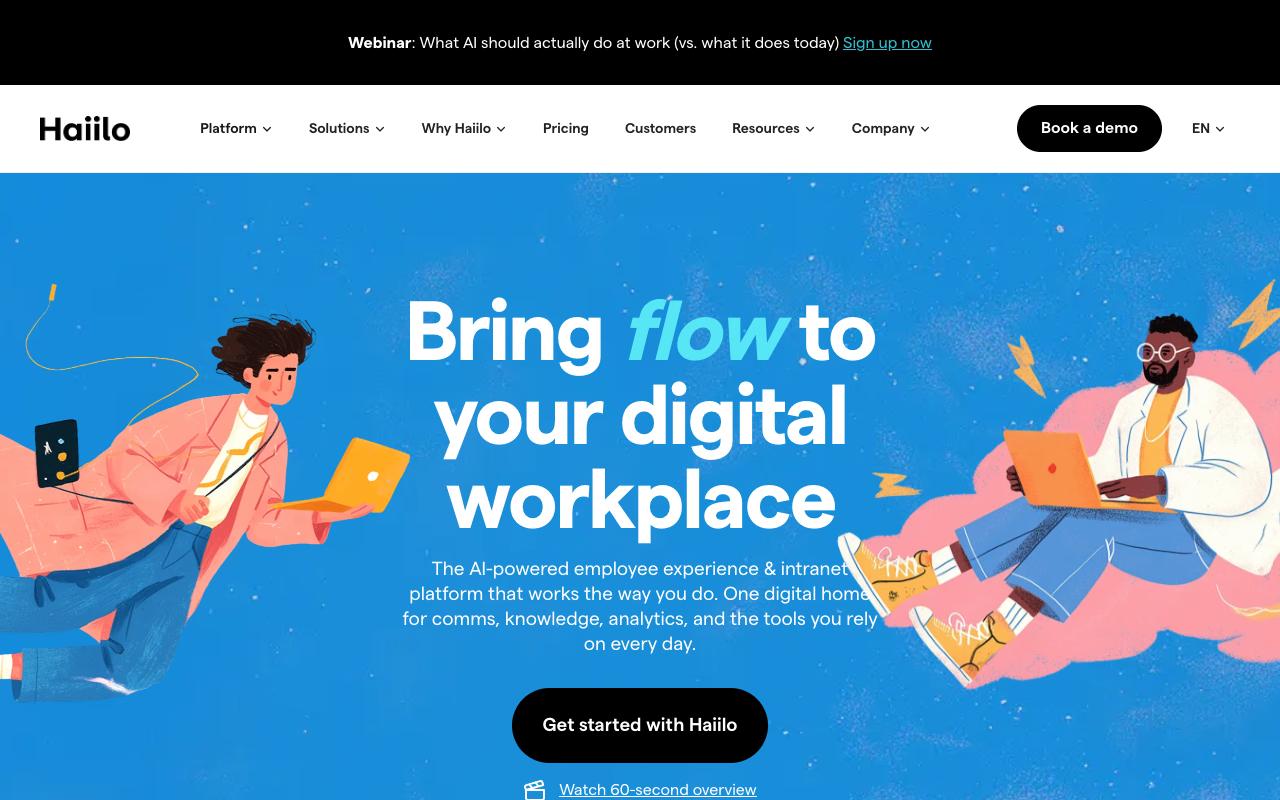
Haiilo is closer to a social intranet than an advocacy tool, and it says so plainly. The pitch is one digital home that replaces scattered documents and message overload with communication, knowledge, and engagement measurement in one place, and advocacy is a module inside that. It's aimed at internal comms, HR, IT, and leadership at organizations with both desk-based and frontline employees, including retail, hospital, and warehouse staff who mostly interact with the company through a phone.
The strongest parts are the AI Content Studio for planning and publishing internal content, real-time sentiment analysis, and a mobile app that delivers audio summaries of company content for people who don't have time to read. On the ratings side, Haiilo shows G2 4.6/5 from 291 reviews and Capterra 4.3/5. The gap between those two is worth a closer look.
Pricing: No public pricing. Haiilo's pricing page states that cost depends on organization size, setup, and required features, with three base plans (Core, Business, Enterprise) plus optional modules including Employee Advocacy and Engagement Surveys. A Connecteam review confirmed there's no published figure and no free plan or trial.
On Capterra, Haiilo holds 4.3/5. Reviewers commonly praise ease of use and employee communication tools and note limited flexibility, pricing concerns, and occasional support issues. See the Capterra reviews page.
On G2, Haiilo holds 4.6/5 across 291 reviews. Reviewers commonly praise intuitive interface and easy employee communication and note technical issues, inflexible design, and uneven support. See the G2 reviews and pros and cons pages.
Verdict: Buy this if you need an intranet first and advocacy second. If you already have an intranet, you're paying for overlap.
4. Sharebee
Sharebee is a focused advocacy and social selling platform built around a curated content library that ambassadors draw from, mainly for LinkedIn. Ambassadors can customize approved posts in their own voice, add graphics, schedule them, or write from scratch, and the tool supports text, image galleries, polls, videos, and PDFs. It's the most narrowly scoped tool in this list, which is a feature if advocacy is the only thing you're solving.
Analytics look genuinely useful for program managers: reach broken out by company, department, or individual user over time, sortable by metric, exportable to Excel, and pulled directly through the official LinkedIn API since Sharebee is a LinkedIn partner. There's also a points-and-rankings gamification algorithm. Sharebee shows G2 4.8/5 from 76 reviews and Capterra 4.8/5, the highest aggregates here, though 76 reviews is a smaller base than the enterprise tools carry.
Pricing: No public pricing. Sharebee's platform FAQ says cost depends on the number of ambassadors, how content gets created, and which features you pick, and that the minimum instance is 20 users including admins.
On Capterra, Sharebee holds 4.8/5. Reviewers commonly praise ease of use, customer support, and overall value and note some feature limitations and room for broader functionality. See the Capterra reviews page.
On G2, Sharebee holds 4.8/5 across 76 reviews. Reviewers commonly praise ease of use, intuitive workflows, and responsive support and note limited customization and occasional feature gaps. See the G2 reviews and pros and cons pages.
Verdict: A clean, LinkedIn-first advocacy tool with real reporting, best for teams with at least 20 people ready to share.
5. DSMN8
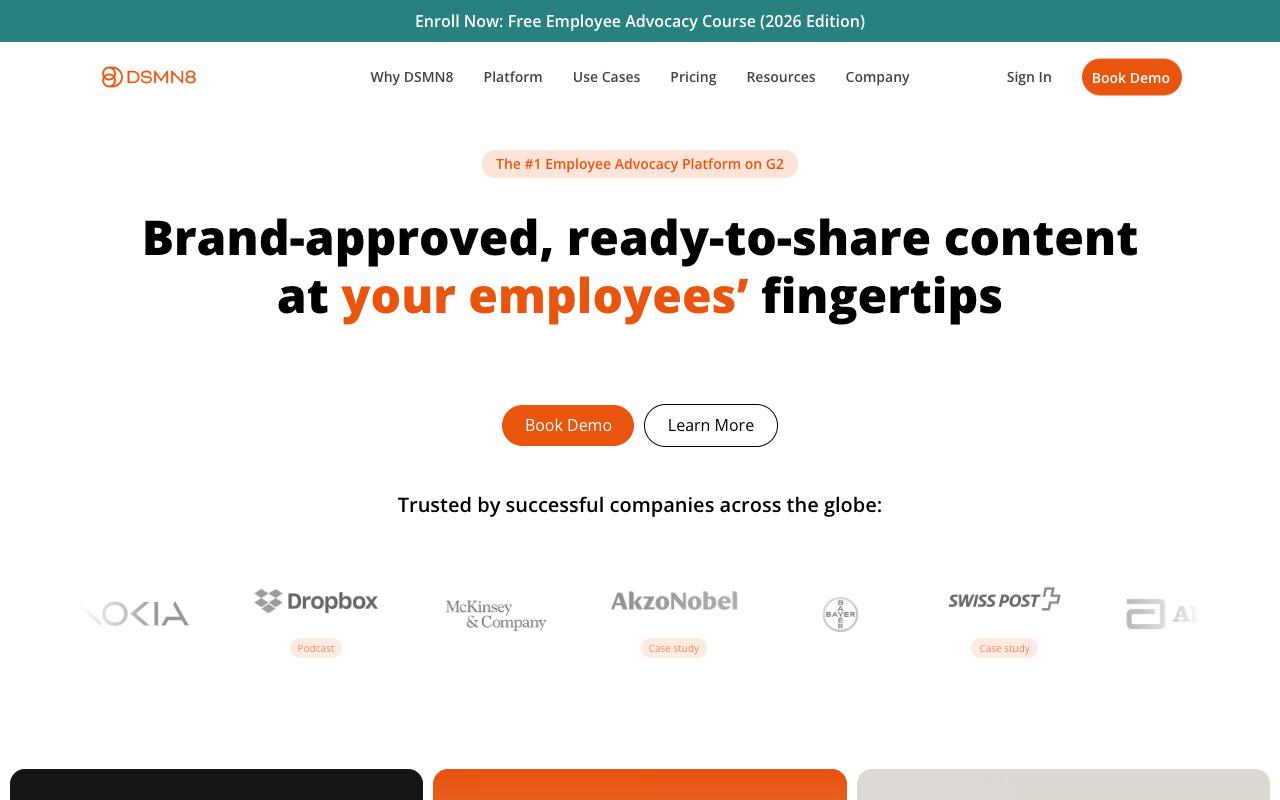
DSMN8 gathers company content into one personalized feed, gives employees a desktop dashboard and mobile app to share it, then tracks the results. The audience spans marketing and comms, employer brand and talent acquisition, and sales and leadership, which shows up in the feature set: content segmented by role or department, delegate access so an assistant can post for a senior exec, and both Company Voice AI and Personal Voice AI for generating posts that don't read like everyone copied the same template.
The enterprise trust signals are the differentiator: SSO, audit trails, role-based permissions, and ISO-27001 certification, per DSMN8's platform features page. There's also a gamification engine with leaderboards and high-fives, plus internal newsletters with impact analytics. Ratings come in at G2 4.6/5 from 1,154 reviews and Capterra 4.7/5, and that G2 sample is by far the largest in this comparison, which makes the score harder to dismiss.
Pricing: No public pricing. DSMN8's pricing page says cost "typically starts from a few dollars per employee per month, depending on the number of users and selected modules," with annual contracts and pricing driven by seat count, modules like Executive Influence and Newsletters, and onboarding level.
On Capterra, DSMN8 holds 4.7/5. Reviewers commonly praise content sharing and employee advocacy workflow and note pricing concerns and feature limitations. See the Capterra reviews page.
On G2, DSMN8 holds 4.6/5 across 1,154 reviews. Reviewers commonly praise ease of use and content sharing and note limited customization and occasional setup complexity. See the G2 reviews and pros and cons pages.
Verdict: The safest enterprise choice, especially if security review is going to be part of the buying process.
6. GaggleAMP
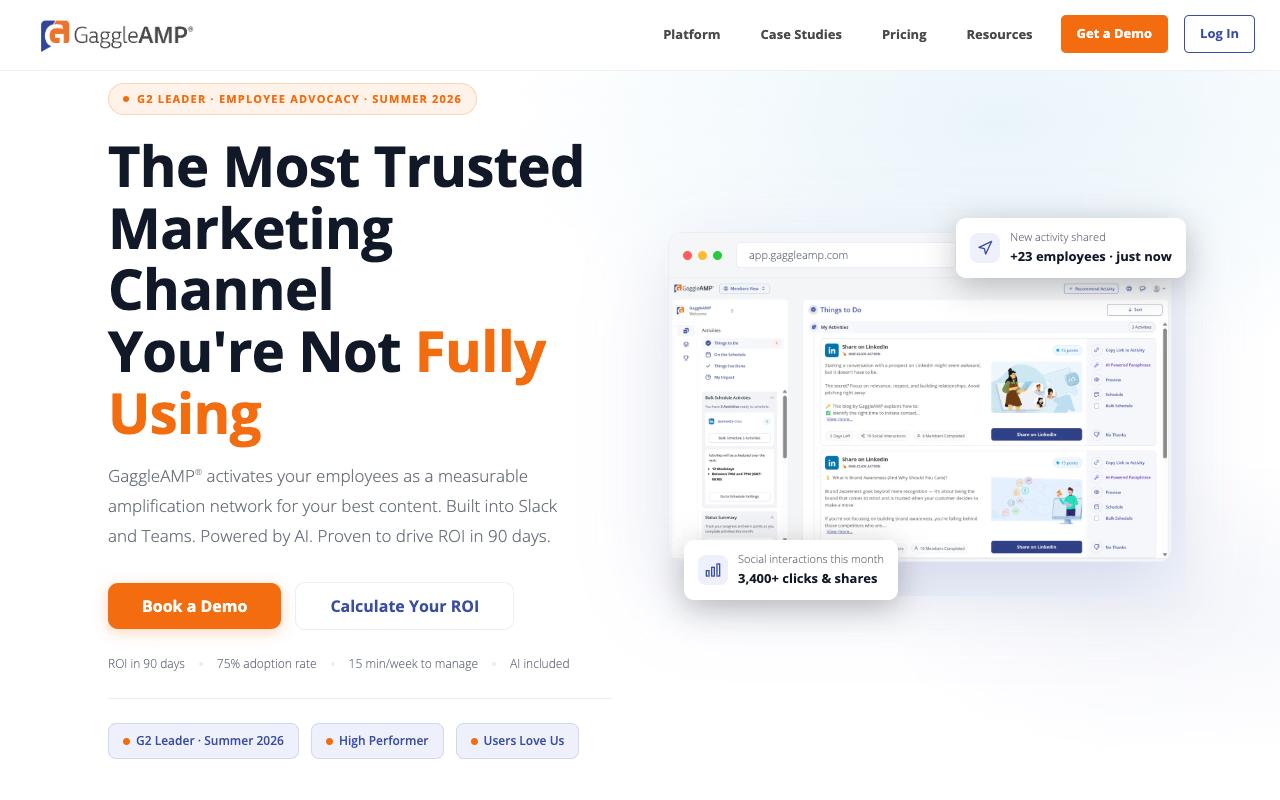
GaggleAMP's core insight is that employees won't leave Slack or Teams to go share something, so it puts one-click sharing directly inside both as native apps with no browser redirect or extra login. Employees get a personal feed of pre-approved activities, and "autoAMP" pushes the right content to the right people at the right time with segmentation by team, region, or role. Aimed at marketing, sales enablement, HR and comms, and leadership at mid-market and larger companies.
Attribution gets more attention here than in most of these tools. Real-time reporting ties employee shares to traffic, leads, and pipeline, with UTM tracking, earned media value against paid ad equivalents, and one-click exportable reports for leadership. The AI Suite is included in every plan and includes manager-side paraphrasing that generates unique copy variations per employee, which addresses the duplicate-post problem that makes advocacy programs obvious.
Pricing: No public pricing. GaggleAMP prices by employee count rather than seats, with one tier that includes unlimited members, the full AI Suite, and Slack/Teams integration. Per its pricing page, contracts are annual: 1-year runs 10% above the 2-year base rate, 3-year runs 5% below it, and a dedicated CSM is included for teams of 100+.
On Capterra, GaggleAMP holds 4.6/5. Reviewers commonly praise ease of use and customer service and note dated layout and limited mobile administration. See the Capterra reviews page.
On G2, GaggleAMP holds 4.4/5 across 382 reviews. Reviewers commonly praise ease of use and customer support and note dated user interface and limited integrations. See the G2 reviews and pros and cons pages.
Verdict: The pick if your team lives in Slack and your CMO wants earned media value in the quarterly deck.
7. EveryoneSocial
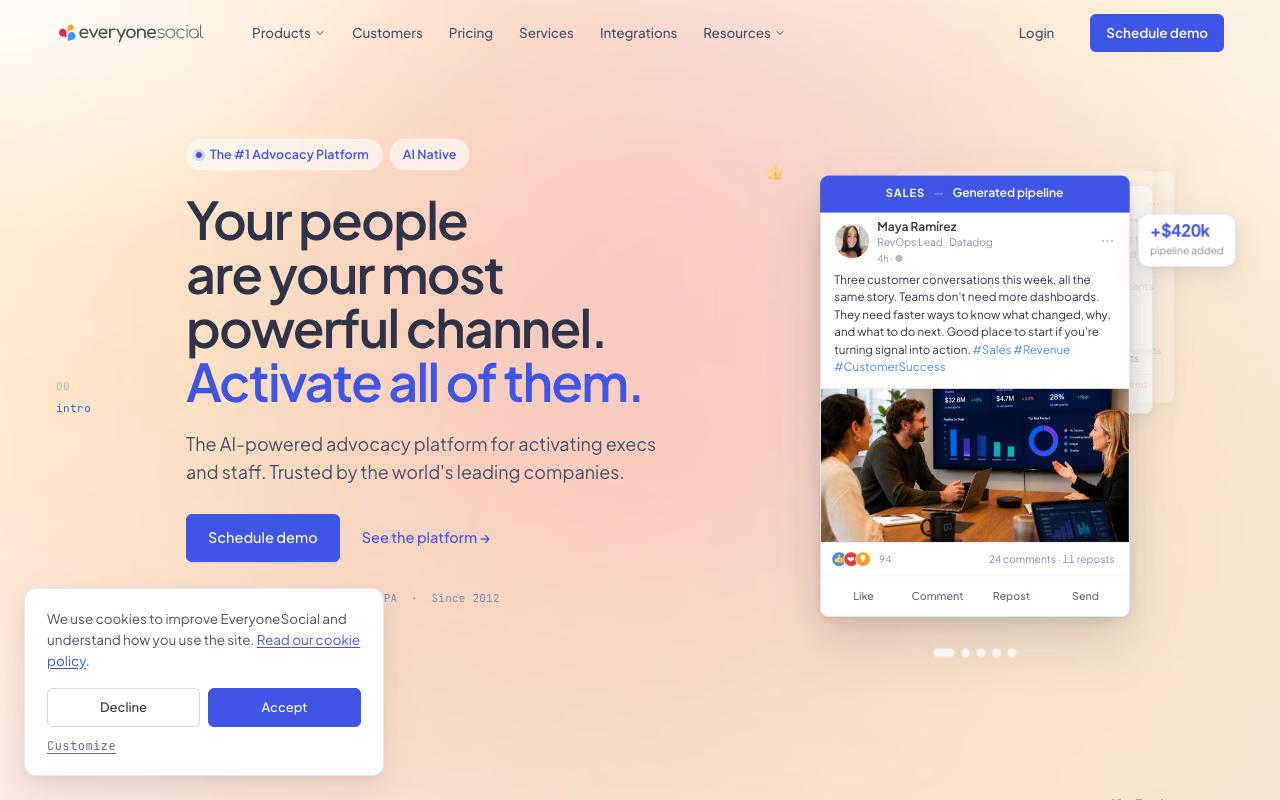
EveryoneSocial activates employees, executives, and company pages as one distribution channel, using AI to handle the friction that usually kills these programs: drafting content, personalizing share copy, and tracking ROI. It's built for enterprise, and the compliance angle is explicit. Financial services firms needing SEC, FINRA, or FCA coverage are named as a target, which is a short list of vendors that can say that.
The buyer is usually a comms, marketing, or advocacy program admin activating employees across sales, marketing, recruiting, and ABM. Ratings sit at G2 4.5/5 from 267 reviews and Capterra 4.2/5. That Capterra number is the lowest in this group, so it's worth digging into on a demo call.
Pricing: No public pricing. EveryoneSocial uses a single custom-quoted plan priced by user count, covering pilots of 500 to 900 users and enterprise rollouts past 50,000. Its pricing page says all plans include the Modern Advocacy platform, API, SSO, and SCIM integrations, implementation, and a dedicated CSM, on annual terms with multi-year discounts.
On Capterra, EveryoneSocial holds 4.2/5. Reviewers commonly praise ease of use and employee advocacy features and note customer support and value for money. See the Capterra reviews page.
On G2, EveryoneSocial holds 4.5/5 across 267 reviews. Reviewers commonly praise ease of use and quick content sharing and note limited individual tagging and engagement controls. See the G2 reviews and pros and cons pages.
Verdict: Strong fit for regulated industries running advocacy at real scale, less compelling if you're under a few hundred users.
8. Oktopost
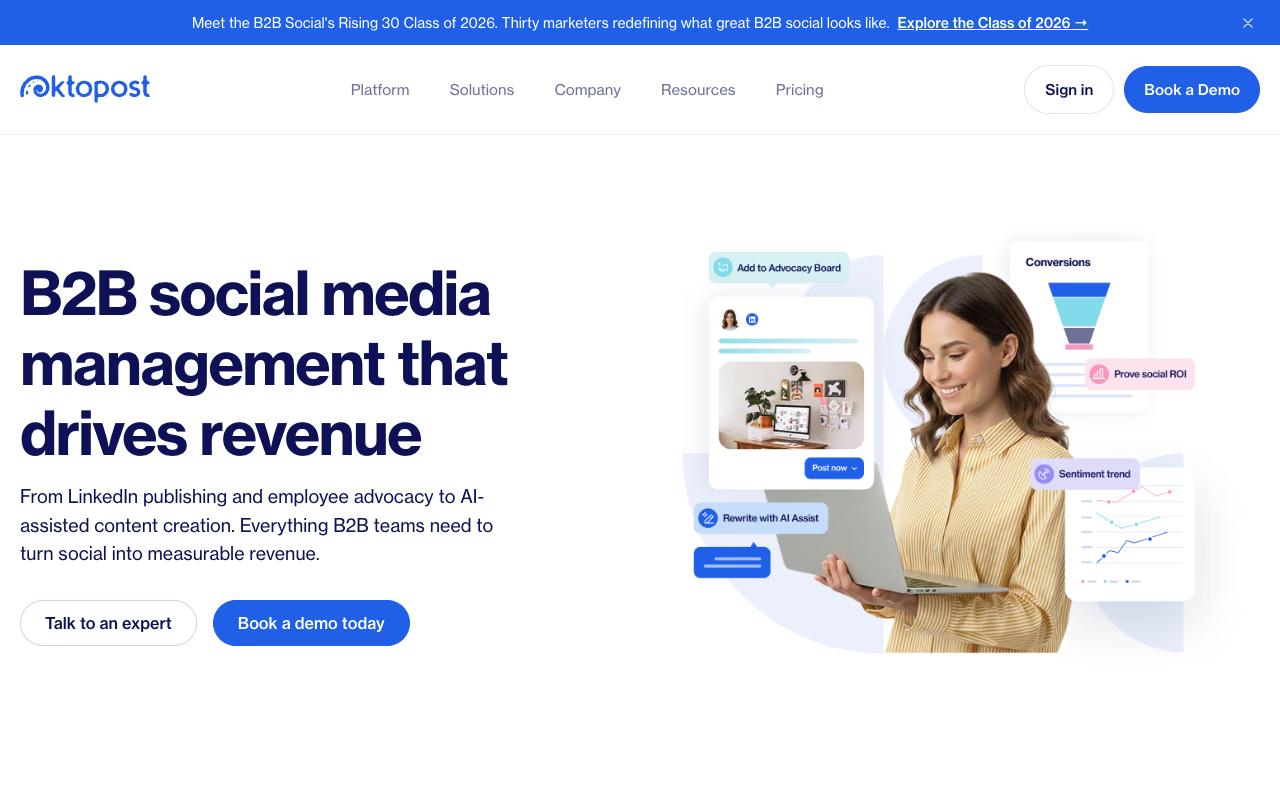
Oktopost is a full B2B social media management platform where advocacy is one of six integrated modules, sitting next to publishing, social listening, analytics, customer engagement, and marketing intelligence. The whole thing is built around tying social to pipeline: campaign-based publishing with UTM tracking so every post maps to a campaign and then to leads and opportunities in the CRM. LinkedIn-first by design, with role-based access and approval workflows across marketing, sales, and HR.
On the advocacy side specifically, a user in r/marketing described the experience clearly. Their team runs Oktopost's employee advocacy app, which populates a list of pre-curated posts created by marketing that anyone involved can pick from and share, sometimes with a single click. They also noted the leaderboard is visible to everyone in the app. Ratings land at G2 4.5/5 from 194 reviews and Capterra 4.5/5, unusually consistent across both platforms.
Pricing: Quote-based, but Oktopost's pricing FAQ does disclose two annual tiers. The Professional package starts at $8,000/year and includes one marketing user, social calendar, social BI, social inbox, AI Assist, approvals, dynamic UTMs, and MAP/CRM integrations. Advanced starts at $12,000/year and adds SAML SSO, SCIM provisioning, compliance, multiple workflows, and API access.
On Capterra, Oktopost holds 4.5/5. Reviewers commonly praise comprehensive social media management tailored to b2b needs with reliable scheduling, advocacy tools, and customer support and note user interface usability issues and limited advanced customization or feature depth for some workflows. See the Capterra reviews page.
On G2, Oktopost holds 4.5/5 across 194 reviews. Reviewers commonly praise robust b2b-focused social media management and employee advocacy features with strong integrations and analytics and note learning curve and interface complexity along with occasional limitations in customization and reporting flexibility. See the G2 reviews and pros and cons pages.
Verdict: Best if you want to replace your whole social stack rather than bolt advocacy onto it, and you can justify $8,000 a year minimum.
FAQ
Which Employee Advocacy Tools Publish Their Pricing?
Only two. Ordinal lists Starter at $95/mo and Pro at $265/mo on its pricing page, with annual rates of $85 and $235. Oktopost discloses starting annual figures of $8,000 for Professional and $12,000 for Advanced. Sociabble, Haiilo, Sharebee, DSMN8, GaggleAMP, and EveryoneSocial all require a demo or quote request. DSMN8 gives the most useful directional hint, saying pricing "typically starts from a few dollars per employee per month."
What's The Difference Between A Content Library And Ghostwriting Approach?
Content library tools like Sharebee, DSMN8, GaggleAMP, and EveryoneSocial give employees a feed of pre-approved posts to pick from and share. The work sits with the employee, and gamification exists to get them to do it. Ordinal comes at it differently: marketing drafts and schedules content directly for founder, exec, and company accounts, so the employee doesn't have to log in and choose anything. If your problem is that five executives need to post weekly and none of them write their own posts, the second model matches better.
Do Any Of These Tools Offer An API For Reporting Outside The Platform?
Several do. Ordinal includes API, MCP server, and webhook access on its Pro plan at $265/mo. Oktopost includes API access in its Advanced package at $12,000/year. EveryoneSocial includes API, SSO, and SCIM in its single custom-quoted plan. Sociabble includes API access at the Gold and Enterprise pack levels for organizations over 1,000 users. GaggleAMP emphasizes UTM tracking and lead attribution reporting inside the platform rather than API access.
Related Posts
Looking to learn more? The below posts may be helpful for you to learn more about social media and content marketing.