

Three LinkedIn link penalty studies published in the last 18 months put the reach cost at, 26.5%, and 36%. All three looked at real posts, and all three get quoted with total confidence by people telling you what to do with your content.
Why the discrepancy? The studies are measuring different account types, different sample compositions, and different years, and once you sort that out the picture gets a lot clearer. The advice B2B teams have internalized (never post a link, always put it in the first comment) turns out to be calibrated for the wrong account type for about half the people following it.
TLDR:
- Public analyses range from to reach loss on linked posts, and the two largest samples land closest together
- In our experience, we've seen reach loss on linked posts grow substantially from 2023 to 2025
- The biggest variable is whether the post comes from a company page or a personal profile
- In our experience, link posts tend to earn higher engagement per impression, which partially offsets the reach hit
- Richard van der Blom's 2026 data suggests two or three links carry a smaller penalty than one, which contradicts nearly all conventional advice
What Is the LinkedIn Link Penalty?
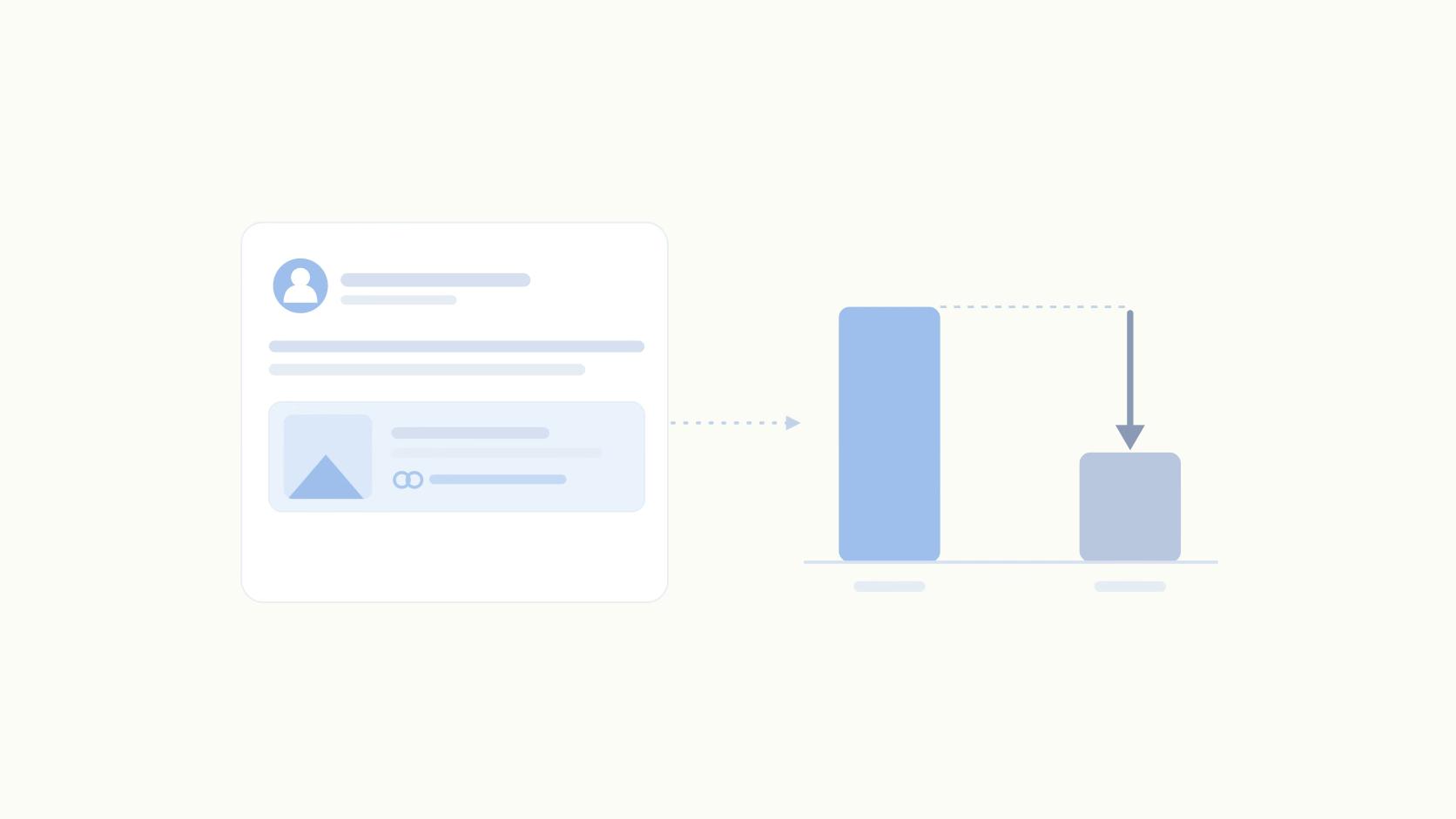
The LinkedIn link penalty is the reduction in reach that posts containing an external URL tend to receive compared with otherwise similar posts that keep readers on the platform. LinkedIn has never confirmed a deliberate downranking mechanism for outbound links, so this is an observed correlation across large samples.
The mechanism most researchers point to is dwell time, because a post that sends someone to another site cuts short the on-platform behavior LinkedIn's ranking system rewards. The reach loss shows up as a downstream effect of that scoring.
One thing no public study has cleanly separated: whether the penalty attaches to the URL string itself or to the auto-generated preview card LinkedIn renders underneath it. That distinction matters for anyone deciding between a raw link and a link with a stripped preview, and right now nobody has the data to answer it.
Every LinkedIn Link Penalty Study, Compared
Across four public analyses, the measured reach loss for linked posts falls between and. Here's what each one looked at:
- In our own experience reviewing a large volume of posts spanning early 2023 through early 2026, we've consistently seen lower reach on linked posts compared to non-linked ones. It's also the only view in this set that we were able to break out by account type.
- LinkPost's research covered a large volume of posts published in 2026. Linked posts hit a median of 448 impressions versus 705 for non-linked posts, a 36% gap (358,000 post study). Mixed account types.
- Richard van der Blom's ongoing practitioner algorithm analysis, updated in 2026, puts the cost of a single external link at roughly of reach, down from 18.8% in April 2025 (link penalty analysis).
- Botdog's 2025 algorithm guide synthesis states external links reduce reach by 25% to (Botdog, 2025), varying by account type and post format.
Three things drive the variance: the first is account type mix, because samples weighted toward company pages report bigger penalties than samples weighted toward personal profiles.
The second is the year, and this one does most of the work: in our own experience, the penalty has grown substantially between 2023 and 2025, so a sample pulling heavily from earlier posts reads low while a sample weighted toward more recent posts reads high. Any study that averages across the full window, as Ordinal's does, lands somewhere in the middle by construction.
The third is metric choice. Impression data is heavily right-skewed because a handful of viral posts drag the mean upward, so a study reporting means and a study reporting medians can describe the same dataset and publish different numbers. Ordinal and LinkPost both use median, which is why their figures (26.5% and 36%) are the two most comparable in the set. They're also the two largest samples, and their convergence is the strongest signal here.
Company Pages Take the Hit and Personal Profiles Mostly Don't
This is the finding that should change what you do tomorrow, and it's the one every competing article buries. Ordinal's segmentation shows company pages absorbing the reach penalty from external links while personal profiles show almost none.
The likely reason is that company page content is already suppressed before a link enters the picture. AuthoredUp's 2025 algorithm data put text-only company page posts at a 0.42x reach multiplier, meaning those posts were reaching under half the baseline with no URL involved at all. A link compounds an existing disadvantage rather than creating a new one.
So the universal advice, the one everybody repeats, is tuned for the account type B2B teams post from least often. Founders, executives, and employees publishing from personal profiles have spent two years stripping links out of their posts to dodge a penalty that barely applies to them, then dropping the link in a comment where roughly nobody clicks it.
That's a self-inflicted conversion loss dressed up as algorithm strategy.
The obvious objection is fair: personal profiles are penalty-light rather than penalty-free, and the gap widens as follower count grows, because bigger accounts sit in more crowded feeds where any ranking drag costs more absolute impressions.
But penalty-light is a very different planning input from a substantial reach cut.
Our position is that if you're posting from a personal profile and the link genuinely helps the reader, put it in the post. If you're posting from a company page, treat the reach cost as real and decide whether the click is worth paying for.
The Multi-Link Finding That Breaks Conventional Advice
Van der Blom's 2026 numbers contain something odd. A single external link costs about of reach, but adding a second or third link cuts the penalty to roughly 7% below baseline, while four or more links pushes it back out to about 24% below baseline.
The most plausible read is a classifier distinction. One link looks promotional, a small cluster of links looks like a resource post, and resource posts are a different content category with different engagement patterns. That's an interpretation rather than a documented mechanism.
Treat it accordingly.
This is one practitioner analysis, the sample composition isn't public, and no large-N study has replicated it. It's a hypothesis worth testing on your own account rather than a rule to roll out across a content calendar.
The more durable finding in that same analysis is the direction of travel, because the single-link penalty fell from 18.8% in April 2025 to about in 2026. Advice written in 2023 is measurably out of date.
How to Decide Whether a Link Is Worth the Reach Loss
Run this sequence on any post where a link is in question.
- Identify the account. Company page: assume a real penalty and plan around it. Personal profile: assume it's small enough to ignore on most posts.
- Name one goal. Clicks or reach, because you don't get to optimize for both. A post built to drive signups can absorb a meaningful reach cut and still beat a post everyone sees and nobody acts on.
- Do the arithmetic before you assume. In our experience, link posts tend to earn higher engagement per impression, so the smaller audience that sees a linked post is often more invested in it. Multiply expected impressions by your historical click rate both ways rather than trusting the reflex.
- Choose the placement deliberately. The link in first comment workaround still helps on company pages, but it stopped being free somewhere around 2024 and it costs you a large share of clicks. If clicks are the point, the link belongs in the body where people can see it.
- Test on your own account. Publish five linked and five unlinked posts of comparable format and topic in the same period, then compare median impressions rather than averages. Ordinal's analytics filter performance by post format and label, so teams can run this comparison against their own data instead of borrowing someone else's average.
What to Do With This in Your Next Planning Cycle
The number that matters is your account type's number, not the industry average. Company pages should treat every outbound link as a purchase, routing evergreen traffic through the featured section and the page's website field, and reserving in-post links for content that converts well enough to justify the reach.
Personal profiles should stop rearranging their content around a penalty that costs them less than the clicks they're giving up.
And the trajectory argues against locking in a policy at all, because van der Blom's single-link figure has already dropped by nearly three points in under a year while Ordinal's year-over-year data moved in the opposite direction over a longer window. Two credible sources pointing different directions is a reason to keep measuring instead of a reason to pick a side.
Run the five-and-five test this month. Ten posts, one account, median impressions, same topic mix. It'll take you a quarter of an hour to set up and it'll settle the argument for your team better than any of the studies above.
Frequently Asked Questions
Does LinkedIn Penalize Posts With Links?
LinkedIn has never confirmed a deliberate downranking rule for external links, but every large public study finds linked posts get less reach than unlinked ones. In our own experience, we've consistently found meaningfully lower reach on linked posts, and other research we've seen points in the same direction. Whether it's a built-in penalty or a side effect of lower dwell time, the reach gap shows up consistently across independent samples.
How Much Reach Do You Lose By Posting a Link on LinkedIn?
Somewhere between and, depending on your account type and which year the data covers. The two largest samples land close to each other, which is a useful anchor when you're planning around a figure. Company pages sit at the high end of that range, while personal profiles show close to no penalty in Ordinal's segmented data.
Does the LinkedIn Link Penalty Apply to Company Pages and Personal Profiles Equally?
No, and this is the variable that changes the whole conversation. Ordinal's study found company pages face a real reach penalty from external links while personal profiles show almost none. Company pages already start from a weaker position too. AuthoredUp's 2025 data found text-only company page posts carrying just a 0.42x reach multiplier before any link enters the picture.
Does Putting the Link in the First Comment Still Work in 2026?
It still helps on company pages, but it's not the free workaround it was in 2023. The tradeoff is that a link buried in the comments gets far fewer clicks than one in the post body, so you're trading conversion for reach. If clicks are the actual goal, the reach loss from an in-body link is usually the better deal.
Do Multiple Links Hurt LinkedIn Reach More Than One Link?
Not according to Richard van der Blom's 2026 analysis. Two or three links dropped the penalty to roughly 7% below baseline, compared to about for a single link. Four or more links reversed that pattern and landed at roughly 24% below baseline. That's one practitioner's data set rather than a replicated study, so treat it as worth testing on your own account.
Why Do Different LinkedIn Link Penalty Studies Report Different Numbers?
Three reasons: account type mix, sample year, and metric choice. Samples weighted toward company pages report bigger penalties than samples weighted toward personal profiles. Ordinal's data also shows the penalty grew from 5% in 2023 to 42% in 2025, so a study built on older data reads much lower than one built on 2025 posts. Median versus mean matters too, since impression data is heavily skewed by the occasional viral post.
Is It Ever Worth Posting a Link on LinkedIn Despite the Reach Penalty?
Often, yes. In our experience, link posts tend to get higher engagement per impression, meaning the smaller audience that does see them engages more. If the post exists to drive signups or send traffic somewhere specific, a reach cut on a post that converts beats full reach on one nobody acts on.
Does the Link Penalty Apply to LinkedIn Documents, Polls, and Newsletters?
Native formats like documents, polls, and newsletters don't carry the external link penalty because they keep people on the platform instead of sending them elsewhere. No public study has isolated newsletter or document performance against linked posts directly, so treat this as an inference from how the platform handles off-site links generally, not a measured finding.
Related Posts
Looking to learn more? The below posts may be helpful for you to learn more about social media and content marketing.