

Introduction
You're creating solid TikTok content, but your views stay frustratingly low. The problem might not be what you're posting but when you're posting it. Most creators ignore timing and wonder why their engagement stays flat. Learning the best times to post on TikTok gives your content the best shot at catching your audience when they're actually scrolling. We looked at October 2025 data to identify the windows where engagement peaks.
The algorithm decides your video's fate in the first hour after you post. If your target audience isn't online during that window, you're starting with a major disadvantage. Get the timing right and you give your content the early traction it needs to reach more people.
TLDR:
- Post on TikTok between 10 AM-6 PM on Tuesdays and Thursdays for highest engagement rates
- Wednesday drives 4x better performance for business accounts compared to other weekdays
- Use TikTok Analytics' Follower Activity tab to find when your specific audience scrolls
- Post 15-30 minutes before peak times so early engagement triggers algorithm distribution
- Ordinal provides data-driven posting time recommendations across TikTok and all major social networks
General Optimal TikTok Posting Times
Data shows that posting between 10 AM and 6 PM on Tuesdays and Thursdays typically generates higher engagement. These midweek days capture users during breaks when they're actively scrolling.
TikTok sees activity spikes during two windows: early mornings from 6 AM to 10 AM, and evenings between 7 PM and 11 PM, when users are starting their day or winding down.
Your specific audience might behave differently based on demographics, location, and habits. A beauty brand targeting Gen Z will see different patterns than a B2B tech company reaching professionals.
Use these time frames as your testing baseline. Post during these windows initially, then let your performance data guide your next moves.
Day-by-Day TikTok Posting Schedule
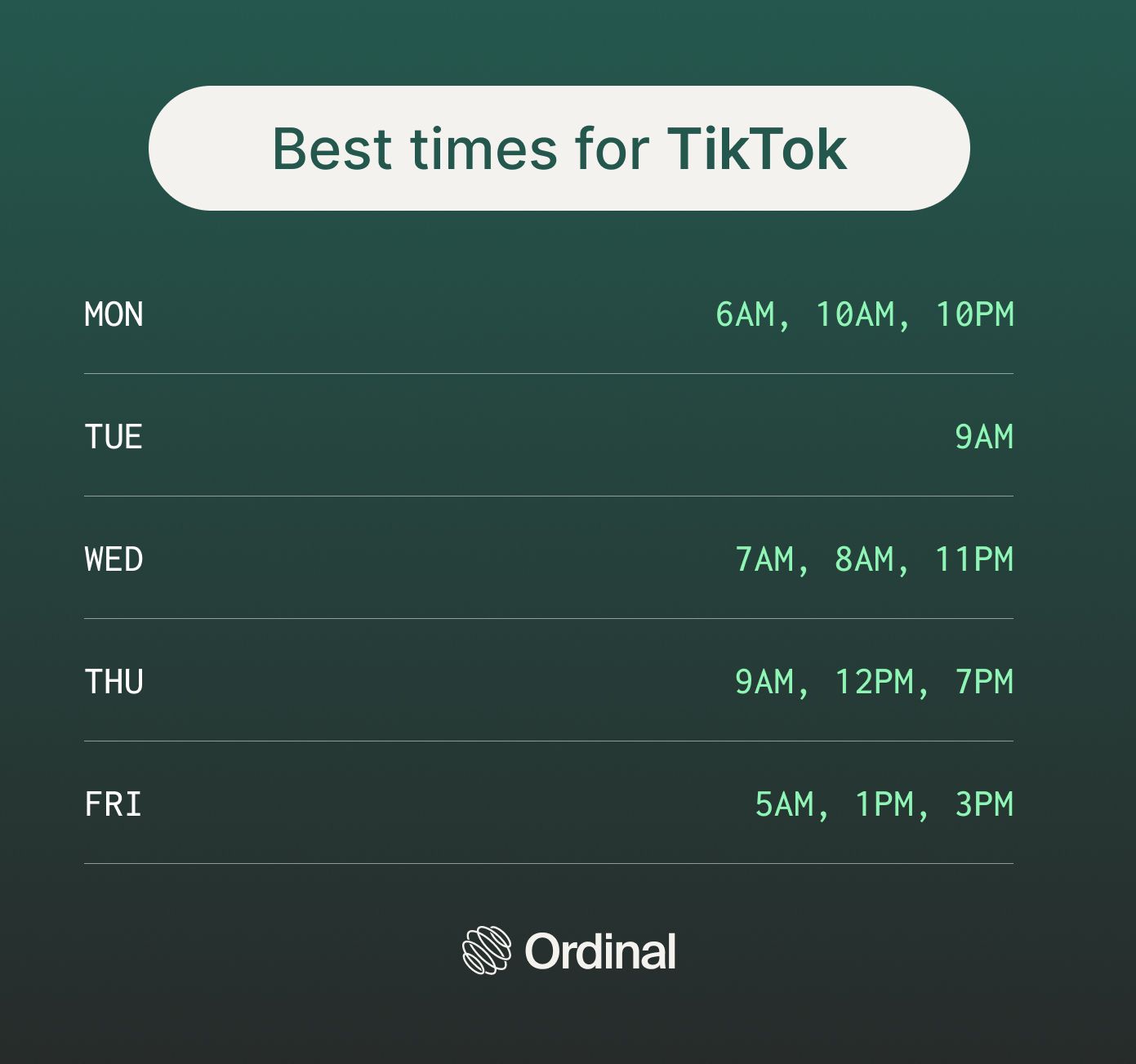
Wednesday performs best for business accounts, with engagement rates up to four times higher than other weekdays. Users hit peak boredom midweek and actively seek distraction.
Weekend timing shifts later as users sleep in and browse casually.
Saturdays favor evening posts and show the highest average watch time at 62 minutes per day, while Sundays see strong morning engagement from people planning their week ahead.
Industry-Specific TikTok Posting Times
Your audience's daily routine dictates when they'll see your content. A fashion brand targeting college students operates on a completely different schedule than a healthcare provider reaching working parents.
E-commerce businesses see peak engagement from 1 PM to 3 PM on weekdays when users browse during lunch breaks, with strong secondary windows from 7 PM to 9 PM as shoppers unwind and explore purchase options. Fashion and beauty brands perform best around 3 PM to 5 PM when users plan evening looks, plus 9 PM to 11 PM during nighttime skincare routines.
Food and beverage content thrives at mealtimes: 11 AM to 1 PM catches lunch inspiration seekers, while 5 PM to 7 PM targets dinner planning.
Entertainment accounts benefit from late-night engagement, especially 9 PM to midnight when users want distraction before bed. AI tools for marketers can help analyze these patterns and automate content scheduling across multiple platforms.
Healthcare and wellness creators reach audiences during morning routines from 6 AM to 8 AM, and evening self-care windows around 8 PM to 10 PM. Test these windows against your own analytics, as your specific audience behavior matters most.
Global Time Zone Considerations
The USA leads TikTok with more than 150 million active accounts as of January 2025. Eastern Time audiences engage most between 9 AM to 12 PM and 7 PM to 9 PM, while Pacific Time users scroll from 6 AM to 9 AM and 4 PM to 6 PM.
European users show distinct patterns. UK and Western European audiences engage during lunch hours from 12 PM to 2 PM GMT and evenings from 7 PM to 10 PM. Central European Time shifts these windows one hour later.
Asian markets vary by country. Japanese users peak during morning commutes around 7 AM to 9 AM JST and late evening after 10 PM. Southeast Asian countries see strong engagement from 8 PM to 11 PM local time on weekdays.
For multi-region accounts, prioritize your primary market's peak hours first. Schedule posts for your core audience, then add secondary posts for other time zones rather than diluting your main demographic's timing.
Understanding TikTok's Algorithm and Timing Impact
TikTok evaluates content performance within the first 30 to 60 minutes after publishing. The system tracks completion rate, likes, comments, and shares during this window to determine distribution potential. Strong early signals move videos into larger audience pools.
Post 15 to 30 minutes before identified peak times. This strategy lets early viewers build initial traction, so your content reaches maximum distribution when your core audience comes online. The algorithm detects this momentum and expands reach.
TikTok's 2025 algorithm now considers 500+ behavioral signals when making recommendations, including scroll speed, pauses, and replays, with over 70% of user watch time coming from the For You Page. The platform shifted focus toward search intent and watch time over raw view counts, with videos maintaining viewer attention receiving better distribution.
Content optimized for search queries gets surfaced when users look for specific topics, increasing the value of relevant keywords in captions.
Timing affects this system because early engagement from target audiences signals content relevance. This matters especially for smaller creators, as accounts with fewer than 100K followers achieve 7.50% engagement rates, more than double the 2.88% rate of mega-accounts with over 10M followers.
Active engagement during peak scrolling hours tells the algorithm your content deserves to be showing to similar profiles. Missing that first hour limits algorithmic lift regardless of content quality.
How to Use TikTok Analytics to Find Your Optimal Posting Times
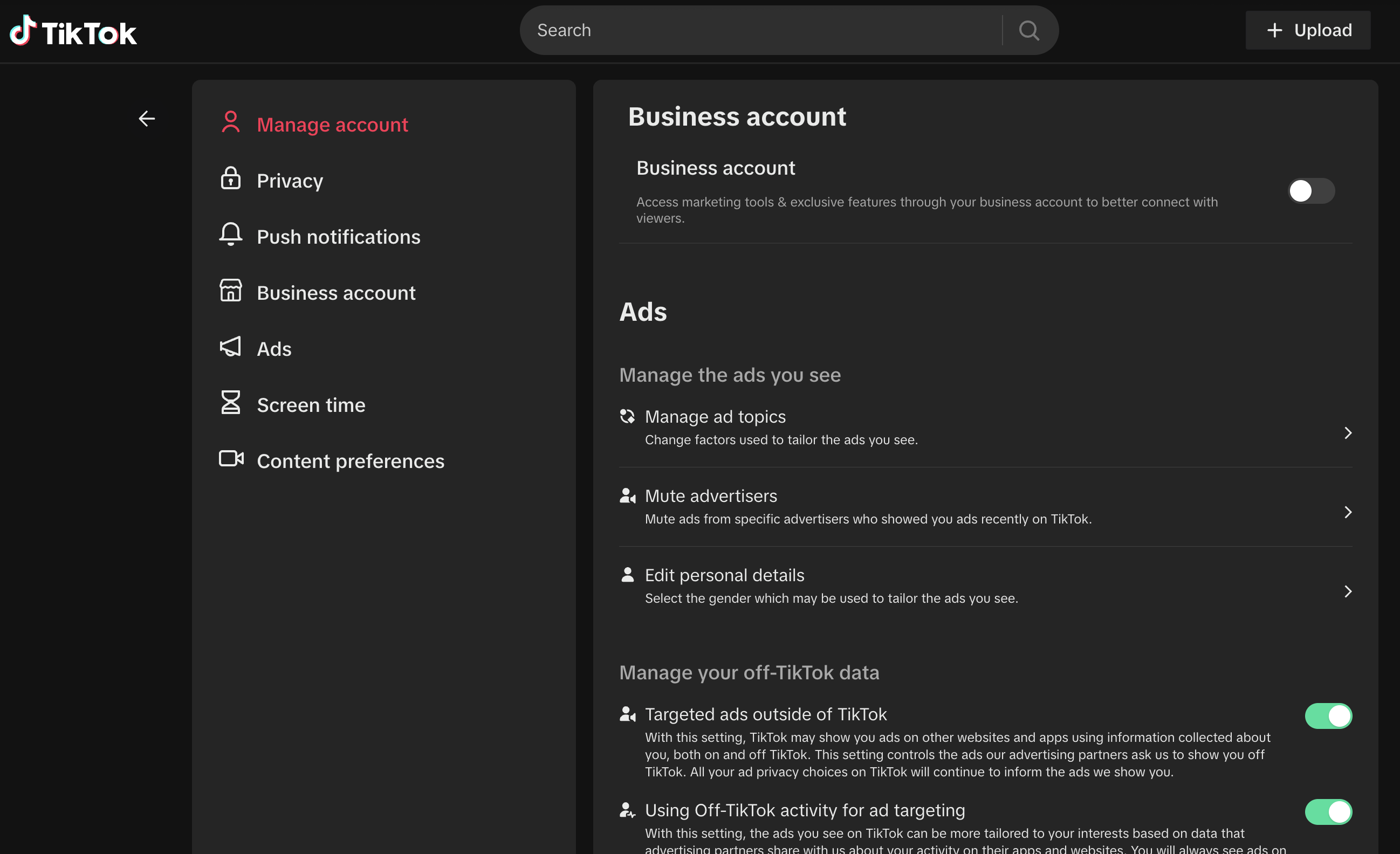
Switch to a TikTok business account to access analytics. Tap your profile icon, select the three-line menu, go to Settings and Privacy, then Account, and choose Switch to Business Account. This free upgrade provides performance data without affecting content reach.
Navigate to your profile and tap the menu icon, then select Analytics. The Follower Activity tab shows when your audience is online, broken down by day and hour. This data reveals your followers' actual scrolling patterns rather than generic industry averages.
Check the activity graph for peaks in follower activity throughout the week. Look for consistent patterns across multiple weeks to identify reliable posting windows. A spike every Tuesday at 2 PM signals a strong posting opportunity.
Compare your posting times against video performance in the Content tab. Sort by views and engagement to see which upload times generated the best results. If videos posted at 8 PM consistently outperform 2 PM posts, adjust your schedule.
Review these metrics weekly as audience behavior shifts.
Test new time slots quarterly to catch emerging patterns, especially after gaining followers from different demographics or locations. A marketing calendar tool like Ordinal can help you organize and track these posting experiments across multiple platforms.
Testing and Optimizing Your TikTok Posting Schedule
Run A/B tests by posting similar content at different times over two weeks. Keep the video format, topic, and caption style consistent while varying only the posting hour. Track which time slot generates better completion rates and engagement within the first hour.
Monitor three core metrics: engagement rate (likes, comments, shares relative to views), reach expansion (how quickly views grow after posting), and follower conversion. Videos with 5% or higher engagement rates indicate optimal timing for your audience.
Test one new time slot per week against your current best performer. If the new slot outperforms your baseline twice consecutively, shift it into your regular rotation. Drop time slots that underperform for three consecutive weeks.
Adjusting for Seasonal Behavior Shifts
Summer weekends see later evening activity, while winter drives earlier engagement. Back-to-school and holiday periods alter scrolling patterns significantly. Review your analytics quarterly to catch these behavioral changes.
Balancing Scheduled vs. Reactive Content
Jump on trending sounds and challenges when they emerge, even outside your normal schedule. Trending content benefits from immediate posting regardless of your optimized times. Balance 80% scheduled content with 20% reactive trend posts for maximum reach.
Final thoughts on optimizing your TikTok schedule
Understanding optimal TikTok posting times helps you start strong, but testing reveals what actually works for your audience. Your followers' scrolling habits will shift over time, so keep checking your analytics and trying new windows. The best schedule is one that matches when your specific audience is online and ready to watch.
FAQ
What time should I post on TikTok if I'm targeting a US audience?
For US audiences, post between 9 AM to 12 PM EST and 7 PM to 9 PM EST on weekdays. These windows capture both lunch break scrolling and evening relaxation periods when engagement peaks across Eastern, Central, Mountain, and Pacific time zones.
How do I find my account's specific best posting times?
Switch to a TikTok business account (free) and check the Follower Activity tab in Analytics. This shows exactly when your followers are online by day and hour, giving you personalized data instead of generic recommendations.
Does posting time really affect TikTok's algorithm?
Yes. TikTok evaluates your content's performance in the first 30 to 60 minutes after posting. Strong early engagement signals quality to the algorithm, which then pushes your video to larger audiences. Post 15 to 30 minutes before your peak times to build momentum.
Should I post at different times for different industries?
Yes. Ecommerce performs best from 1 PM to 3 PM during lunch browsing, while food content thrives at mealtimes (11 AM to 1 PM and 5 PM to 7 PM). Check your own analytics to confirm these patterns match your specific audience behavior.
How often should I test new posting times?
Test one new time slot per week against your current best performer. If it outperforms your baseline twice in a row, add it to your regular schedule. Review your analytics quarterly to catch seasonal behavior shifts that change when your audience scrolls
Related Posts
Looking to learn more? The below posts may be helpful for you to learn more about social media and content marketing.