


If you're weighing alternatives to Agropulse, the question isn't which tool has the longest feature list. It's which one fits how your team really works, whether you're an agency juggling client approvals, a B2B marketing lead trying to tie social to pipeline, or a founder who wants execs posting without a full-time operator babysitting the calendar.
The eleven tools below split cleanly along those lines. Here's where each one lands, what people say about them, and what you'll pay.
Agropulse Alternatives
1. Ordinal
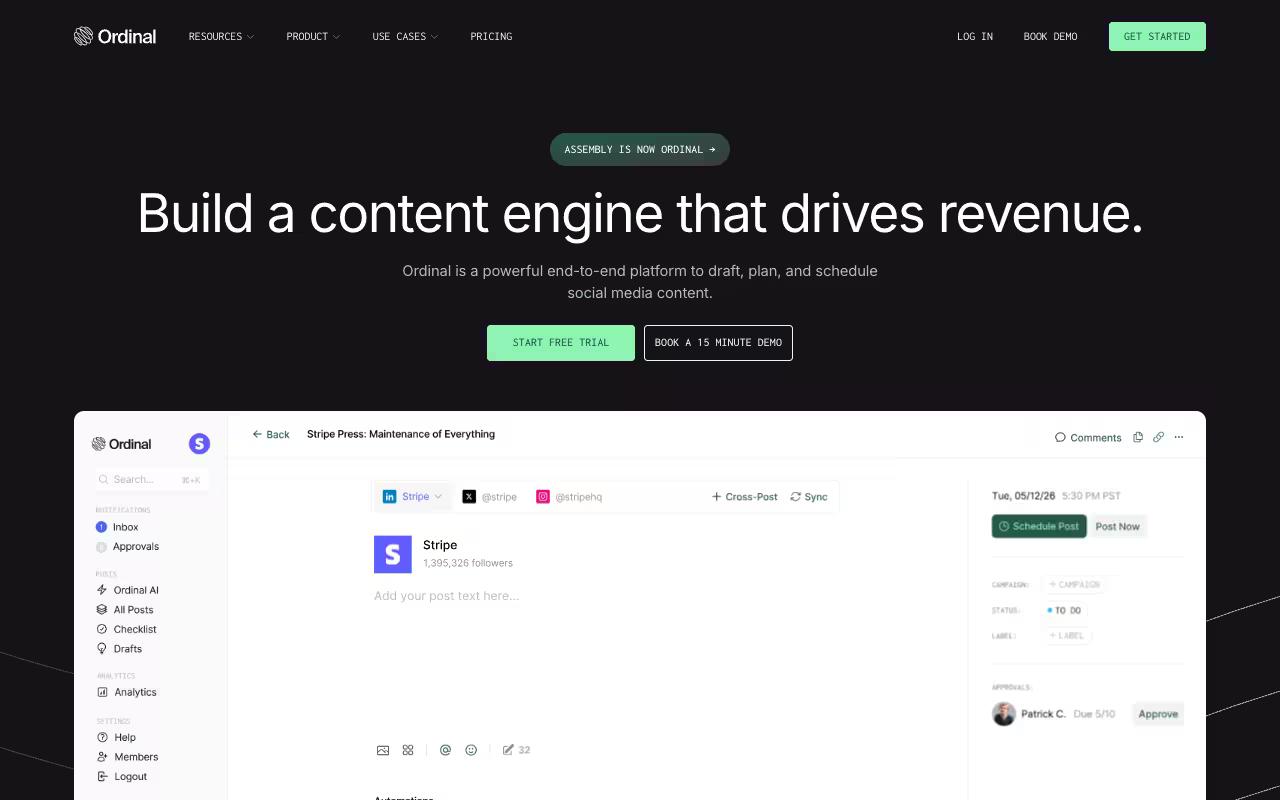
Ordinal is an end-to-end platform for drafting, planning, and scheduling social content, built for modern marketing teams who take social seriously and used by more than 1,000 of them, according to Ordinal's site. It leans hard into LinkedIn: a Notion-style editor with inline comments, realistic previews that show exactly where the hook cuts off before "see more," personal and company tagging, PDF and carousel support, and an auto-engagement suite that can leave likes, comments, and reposts from connected accounts. For a demand gen or VP Marketing role trying to run an executive thought leadership program across 5 to 10 people, that combination matters more than a generic scheduler. And the API/MCP/webhook access means you can wire social data into your CRM or point an AI agent at your posting history.
Reddit sentiment is worth reading before you buy. In an r/SocialMediaManagers thread about Hootsuite alternatives, one user argued that connecting multiple LinkedIn accounts as engagement-only profiles to auto-like and comment could run afoul of LinkedIn's policies on inauthentic engagement, and other users debated whether scheduling alone carries the same risk. That's a real consideration if compliance is on your radar. Beyond that thread, independent third-party ratings weren't available from verified sources at the time of research.
Pricing: Starter is $95/mo ($85/mo billed annually), Pro is $265/mo ($235/mo billed annually), and Enterprise is custom, per Ordinal's pricing page. Auto-engagement and API/MCP/webhooks start at the Pro tier.
Verdict: The strongest pick for B2B teams running LinkedIn-first thought leadership and employee advocacy, as long as you're comfortable with how the auto-engagement features work.
2. Sprinklr
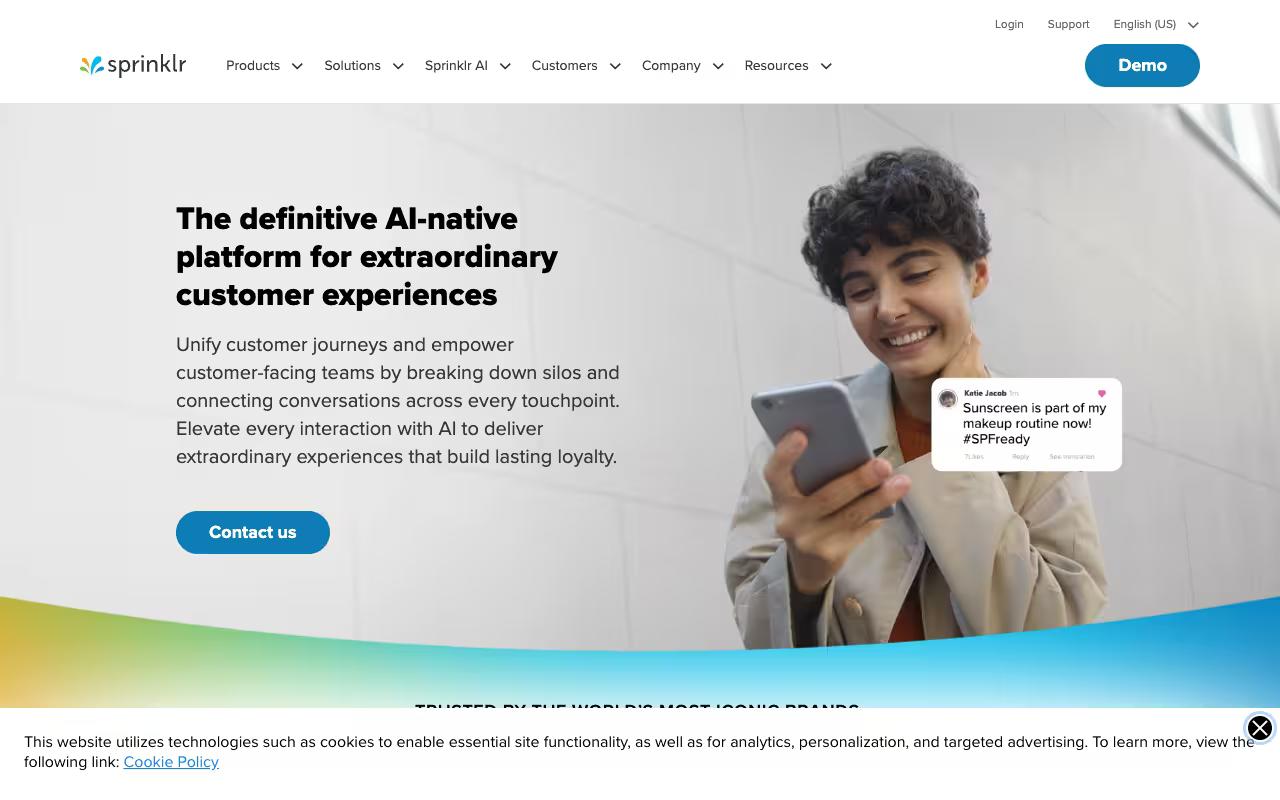
Sprinklr is a Unified Customer Experience Management platform spanning 33 products across service, social, marketing, and contact center suites, aimed at enterprise CX and marketing teams at large brands. It handles social management across 30-plus channels alongside voice, live chat, and conversational AI. This is a tool for a global organization that needs centralized governance across dozens of handles, not a small team that wants to schedule posts.
Pros:
- Very in-depth/powerful platform, especially for large content volumes across many channels and accounts (Reddit)
- Highly customizable and built for enterprise scale (Reddit, LinkedIn)
- Strong global/non-English channel coverage (e.g. Xing, Weibo/Xiaohongshu) that few competitors match (LinkedIn)
- Good fit for large organizations needing centralized governance/compliance across dozens of handles (Reddit, LinkedIn)
Cons:
- Steep learning curve and not very intuitive out of the box (Reddit)
- Clunky, complex UX/UI requiring extensive training to use well (Reddit, LinkedIn)
- Very expensive, with costs scaling quickly as more modules are added (six to seven figure enterprise contracts reported (Reddit, LinkedIn))
- Slow to implement, sometimes with junior/uncoordinated implementation teams post-sale (Reddit)
- Poor post-sale support in some cases, with generic/overseas support and little real human contact (Trustpilot)
- Disputed sentiment-scoring accuracy raised as a serious concern by at least one user (Trustpilot)
Reviews are polarized. On Reddit, users called it "one of the most powerful solutions in the market" and "amazing if you have a lot of content for different platforms," but the same threads describe "a deep learning curve" and a UX that's "clunky AF."
A widely-shared LinkedIn Pulse article titled it "the worst social media tool ever," citing base pricing around $200 per user that scales into six and seven-figure contracts as modules stack up. TrustPilot sits at 2.8/5 from just 3 reviews, all 1-star, driven by post-sale support complaints and a disputed sentiment-scoring feature.
Pricing: No public pricing. Sprinklr's site only invites you to book a demo for tailored pricing.
On Capterra, Sprinklr holds 4.3/5. Reviewers commonly praise omnichannel management, customization, and collaboration and note complex setup, pricing opacity, and difficult onboarding. See the Capterra reviews page.
On G2, Sprinklr holds 4.1/5 across 2,179 reviews. Reviewers commonly praise centralized social media management, analytics, and reporting and note steep learning curve and interface complexity. See the G2 reviews and pros and cons pages.
Verdict: Right for large enterprises that need centralized, multi-channel CX governance and can absorb the implementation lift and cost. Overkill for everyone else.
3. Loomly
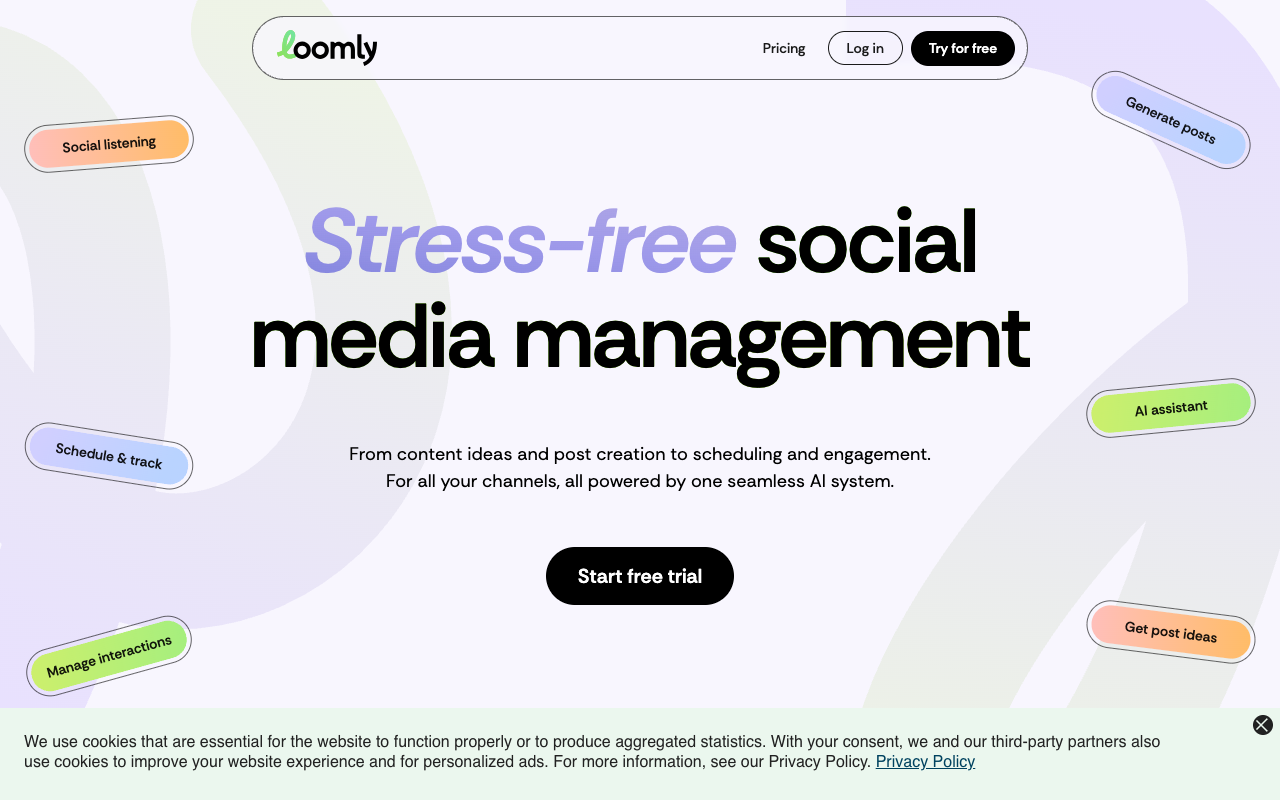
Loomly covers the full publishing process from post ideas and mockups through approval and analytics, with a workflow built for marketing teams that need to route content past teammates and clients. Custom approval workflows, a unified inbox, campaign labels, and per-brand calendars are the core. It's a solid fit for social managers and small agencies who want clean approvals without enterprise complexity.
Pros:
- Easy to use with an intuitive, clean interface for scheduling and publishing across multiple social channels
- Helpful AI assistant for generating post ideas and captions
- Responsive, hands-on customer support (e.g. helping troubleshoot TikTok connection issues)
- Simple, client-friendly approval workflow praised by long-time users and agencies
- Good value/affordability historically, especially for small agencies and freelancers (prior to 2025 price changes)
Cons:
- Major, sudden price increases in 2025 (reported as high as 300-400%) that pushed many small agencies and freelancers to switch to alternatives like SocialPilot or Recur Post
- Recent interface redesign criticized as buggy (posts not loading or scheduled posts failing to publish)
- Some feature gaps: difficulty tagging LinkedIn handles, can't insert links in stories, limited custom channel/API options after Twitter support was removed
- Occasional reports of slow or unhelpful customer support response for troubleshooting
- A few users describe the platform as glitchy or dated feeling
The 2025 pricing story dominates recent reviews. In r/SocialMediaMarketing, one user reported "like a 400% price increase," and an agency user said they switched to SocialPilot after being on the Advanced plan at $180/mo. On the positive side, a LinkedIn testimonial praised the calendar and AI post ideas, and TrustPilot reviewers call it "easy to use" with helpful support, including a five-year user who loves the simplicity.
Pricing: Starter is $65/mo ($49/mo billed yearly), Beyond is $332/mo ($249/mo billed yearly), and Enterprise is custom, per Loomly's pricing page. There's a 14-day free trial and a 50% nonprofit discount.
On Capterra, Loomly holds 4.7/5. Reviewers commonly praise user-friendly social media scheduling and organized content calendar and note constraints in advanced analytics and occasional issues with certain social platforms integration. See the Capterra reviews page.
On G2, Loomly holds 4.6/5 across 1,795 reviews. Reviewers commonly praise ease of use, intuitive calendar, and collaborative approval workflows and note limited or basic analytics and frustrations with pricing tiers and changes. See the G2 reviews and pros and cons pages.
Verdict: A capable approval-workflow tool for small teams and agencies, but confirm the current price before committing given the 2025 increases.
4. Planable
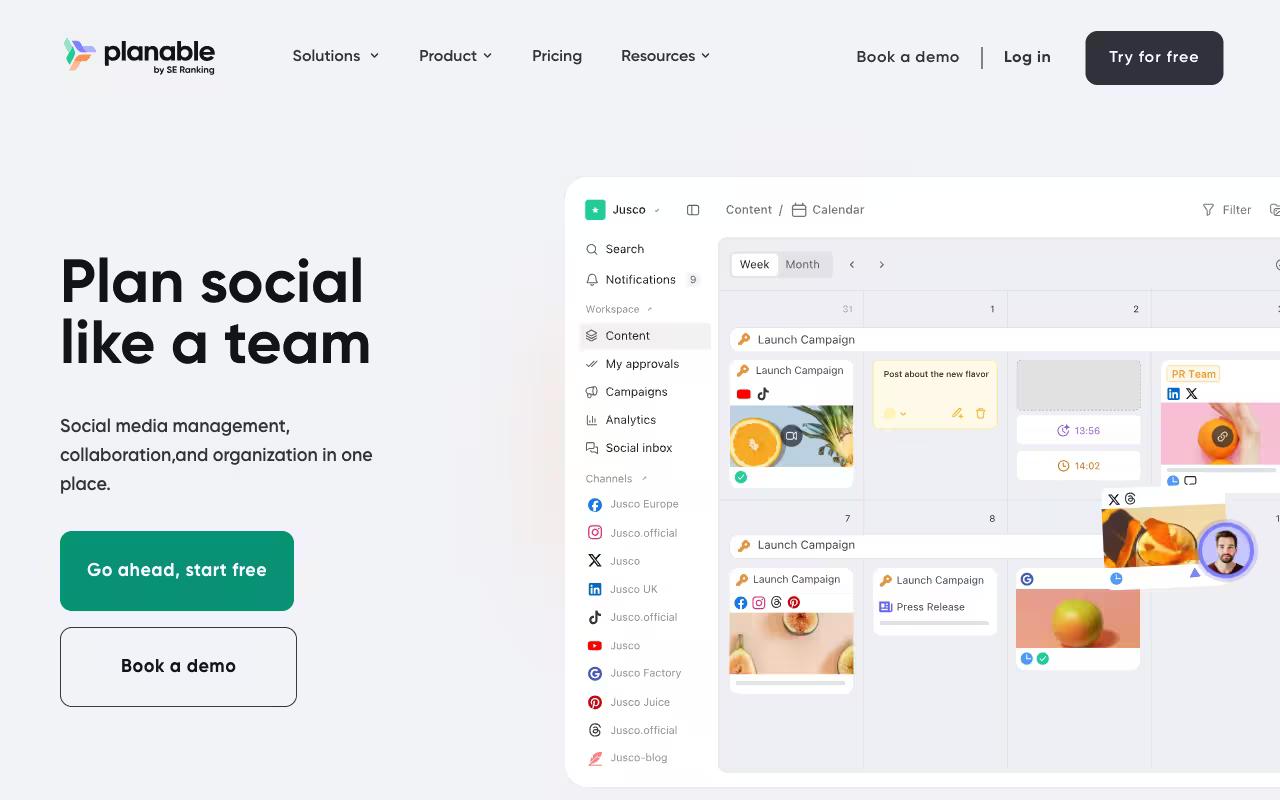
Planable is a collaboration-first content planning tool that brings creation, feedback, and approvals into one workspace across nine social networks plus blogs, newsletters, and briefs. Its standout is the visual approval workflow: drag-and-drop calendar, comment-and-annotate feedback, multi-level approvals, and previews of exactly how a post looks on each platform. It's aimed at agencies and multi-brand teams who live in the review-and-approve cycle.
Pros:
- Intuitive, easy-to-use interface for scheduling and planning posts
- Strong collaboration and client approval workflow that reduces email back-and-forth
- Visual calendar with drag-and-drop makes rescheduling easy
- Lets teams preview exactly how posts will look on each platform before publishing
- Good for straightforward, visual content planning and quick approvals
Cons:
- UI can be clunky and buggy (buttons not responding, issues on both browser and mobile app)
- Platform integrations are spotty, especially for Instagram Stories and Pinterest
- Storage is very limited on the basic plan
- Increasing number of features gated behind paid add-ons
- Some reports of scheduled posts failing to publish with little explanation
- Difficult to tag donors/partners differently across platforms when crossposting
- Feels limited for teams needing deeper cross-channel analytics and reporting
- Slow customer support response in some cases
Reddit users praised the visual planning and approval flow but flagged cross-platform tagging limits and slow support. TrustPilot reviewers call it a big improvement for social workflow and "super easy to use," though negatives include "clunky and very buggy" UI complaints.
Pricing: Basic is $33/workspace/month, Pro is $49/workspace/month, and Enterprise is custom, per Planable's pricing page. Users are unlimited per workspace, and the first 50 posts are free with no time limit.
On Capterra, Planable holds 4.5/5. Reviewers commonly praise intuitive interface and streamlined collaboration workflows for social media content planning and approvals and note limited analytics depth and feature set compared with full-scale social media management platforms. See the Capterra reviews page.
On G2, Planable holds 4.6/5 across 1,071 reviews. Reviewers commonly praise ease of use and visual collaboration features for planning, previewing, and approving social media content and note pricing and plan limits, which can feel high or restrictive for smaller agencies and multi-brand workspaces. See the G2 reviews and pros and cons pages.
Verdict: A great choice if approval workflows and visual planning are your priority and you can live with occasional integration hiccups.
5. Oktopost
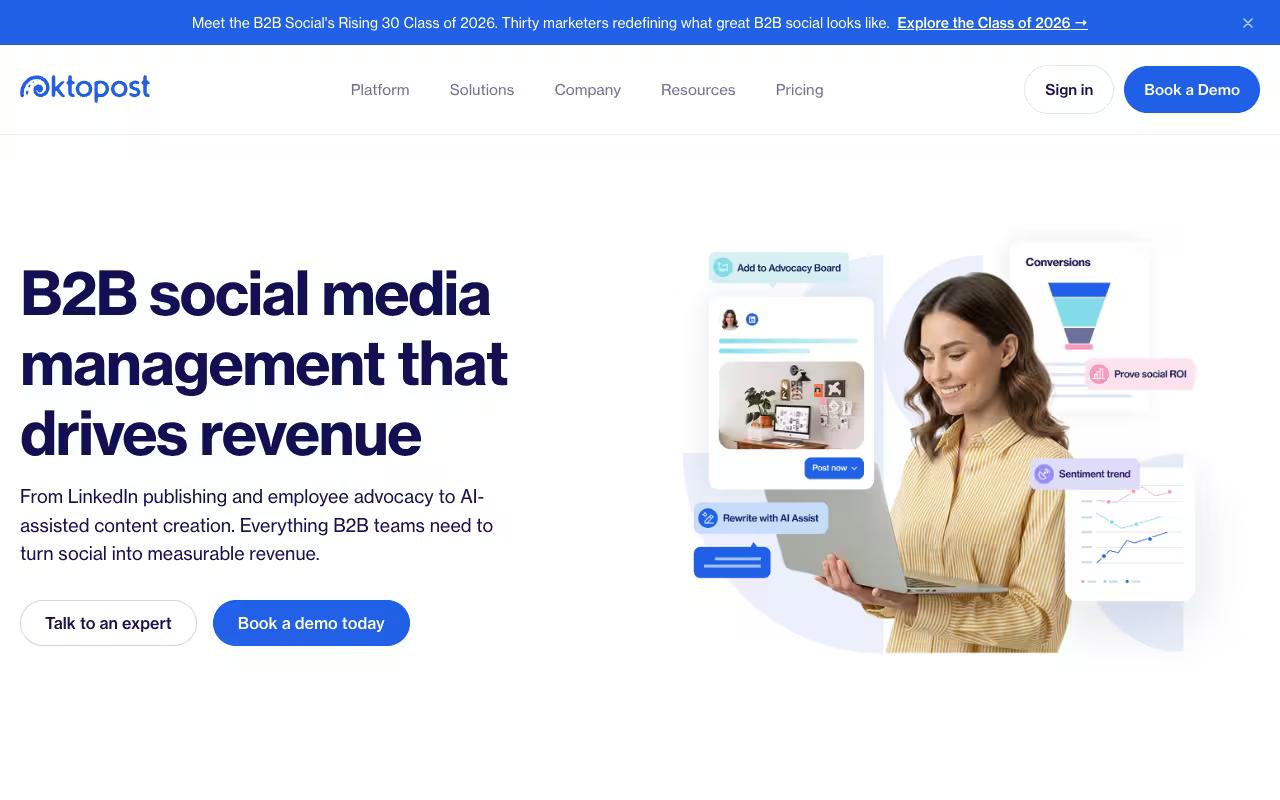
Oktopost is built exclusively for B2B marketing teams, connecting publishing, listening, employee advocacy, and analytics to pipeline and revenue. Campaign-based publishing with UTM tracking ties every post to leads and opportunities in your CRM, and the employee advocacy module comes with a leaderboard and a content library of pre-curated posts. If your buying trigger is "a competitor launched an advocacy program and the CEO wants one," this is squarely aimed at you.
A Reddit user in r/marketing described the advocacy app in practice: marketing populates a list of pre-curated posts, employees pick what to share with a click, and a leaderboard shows participation.
Pricing: Quote-based. The pricing FAQ discloses a Professional Package starting at $8,000/year and an Advanced Package starting at $12,000/year, with SSO, SCIM, and API access at the Advanced tier, per Oktopost's site.
On Capterra, Oktopost holds 4.5/5. Reviewers commonly praise comprehensive social media management tailored to b2b needs with reliable scheduling, advocacy tools, and customer support and note user interface usability issues and limited advanced customization or feature depth for some workflows. See the Capterra reviews page.
On G2, Oktopost holds 4.4/5 across 194 reviews. Reviewers commonly praise robust b2b-focused social media management and employee advocacy features with strong integrations and analytics and note learning curve and interface complexity along with occasional limitations in customization and reporting flexibility. See the G2 reviews and pros and cons pages.
Verdict: The dedicated B2B advocacy-and-attribution play, well suited to enterprise marketing teams with the budget to match its annual contracts.
6. Zoho Social
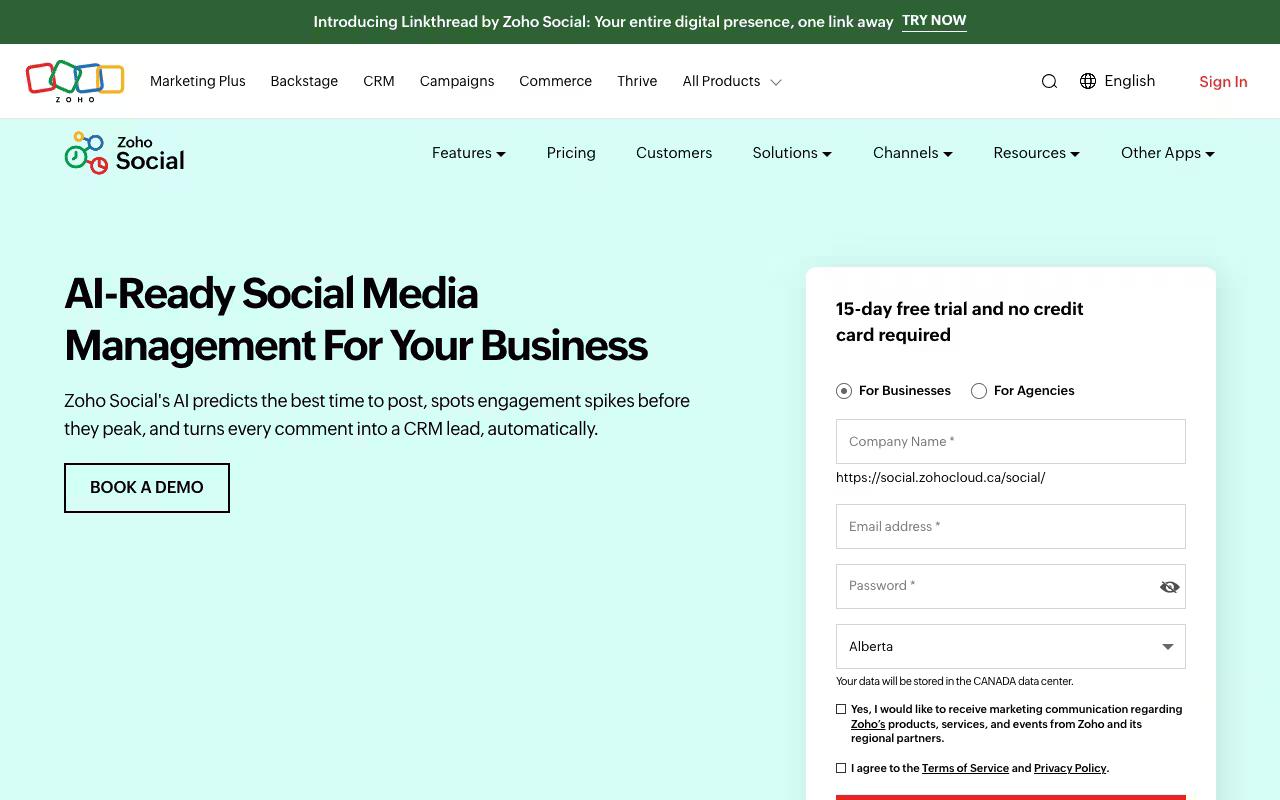
Zoho Social handles scheduling, monitoring, and analytics in one dashboard, with a listening tab, a unified inbox, SmartQ optimal-time predictions, and Zia, its AI assistant. It scales from a single personal profile up through agency plans, and it plugs neatly into the wider Zoho ecosystem including Zoho CRM. For a small team or agency already using Zoho tools, the integration is the draw.
Pros:
- Easy, intuitive scheduling of posts across multiple social platforms from one dashboard (Trustpilot)
- Saves significant time by posting to multiple channels at once instead of individually (Trustpilot)
- Affordable/inexpensive pricing compared to alternatives like Hootsuite and Sprout Social (Reddit, Trustpilot)
- Good post customization options, e.g. reel covers, multiple media formats (Trustpilot)
- Comprehensive feature set for businesses/agencies managing online presence (Trustpilot)
Cons:
- Considered basic/limited for advanced social media marketing compared to Hootsuite or Sprout Social (Reddit)
- File upload quality for videos could be improved (Trustpilot)
- General Zoho account/support issues reported (confusing support pages, hard to cancel subscriptions) - not Social-specific but relevant to the Zoho ecosystem (Trustpilot)
On Reddit, a user in r/Zoho called it "very basic and limited if you want to take full advantage of social media marketing" and "not on the same level of Hootsuite or Sprout Social," while Zoho's own account noted its premium edition ships inside Marketing Plus. TrustPilot reviewers (rating the overall zoho.com domain) frequently praise the Social product for smooth, time-saving multi-platform scheduling.
Pricing: Free tier at $0, Standard at $15/mo, Professional at $40/mo, Premium at $65/mo, plus Agency from $320/mo, per Zoho's pricing page. Annual billing saves roughly a third.
On Capterra, Zoho Social holds 4.7/5. Reviewers commonly praise ease of use, scheduling, and affordable social media management and note limited analytics, missing features, and occasional usability constraints. See the Capterra reviews page.
On G2, Zoho Social holds 4.6/5 across 2,944 reviews . Reviewers commonly praise ease of use, scheduling, and centralized multi-platform social media management and note limited advanced analytics, feature gaps, and missing platform integrations. See the G2 reviews and pros and cons pages.
Verdict: The best-value option for small teams and agencies, especially anyone already inside the Zoho stack. Just know it's lighter on advanced marketing muscle.
7. CoSchedule
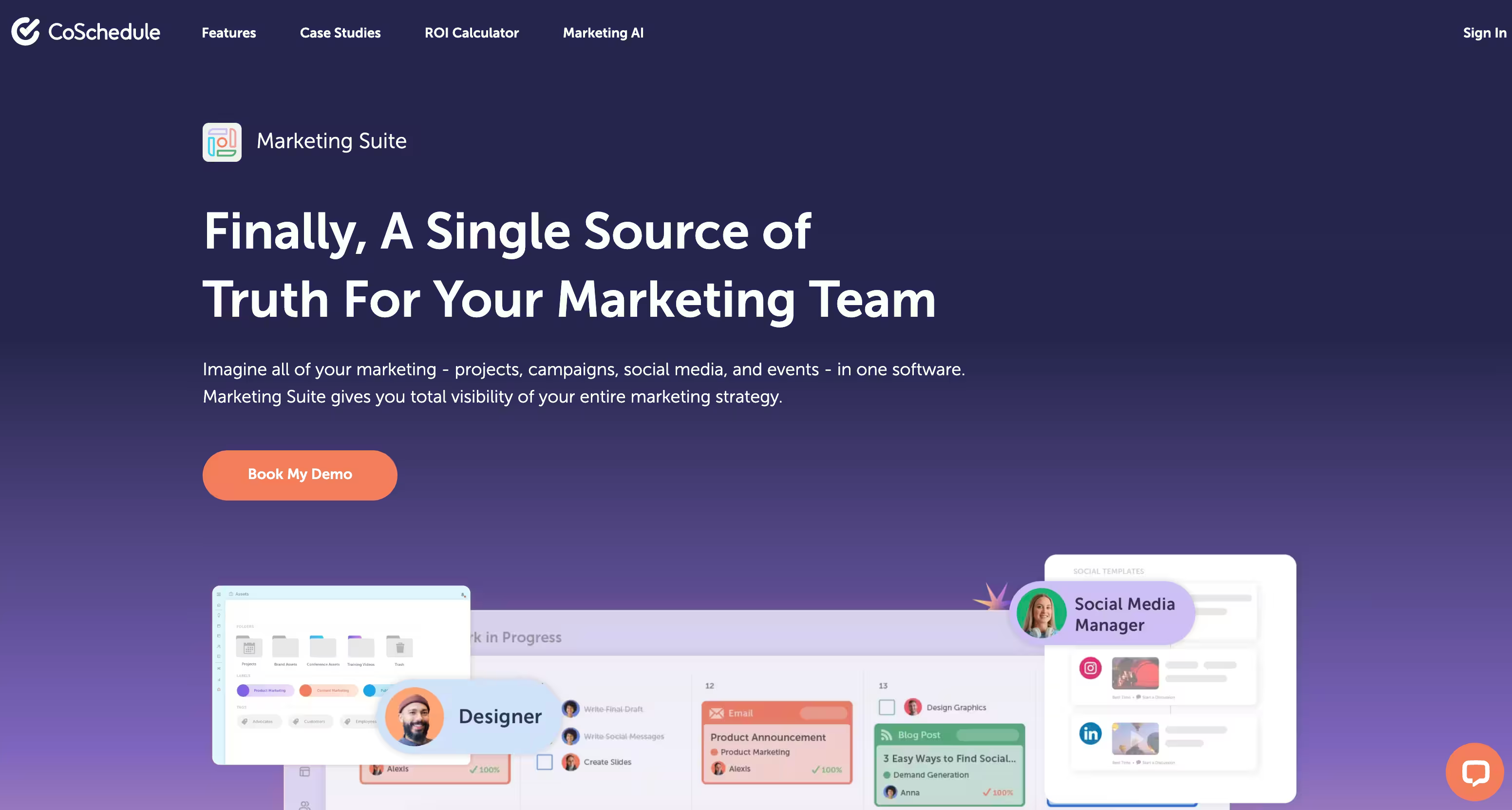
CoSchedule is a marketing calendar and work management platform sold as tiered products (Social Calendar, Agency Calendar, Content Calendar, Marketing Suite), so teams can organize social posts, blog content, and projects in one calendar. ReQueue for recycling top posts, a best-time scheduler, and campaign grouping are the anchors. It reaches for marketers who want social and broader project work in a single view.
Pros:
- Handles multiple use cases well (social media management, content management, marketing calendar, project management, reporting)
- Solid for cross-platform scheduling and approval workflows
- Good integrations across social platforms
- Scales from small teams to larger departments (20-100 people)
Cons:
- Can feel heavy/clunky compared to newer, more AI-focused tools, especially for short-form content
- Some reviewers report pricing creeping up while features are reduced over time
- Billing complaints, including difficulty removing a card or canceling
- Complaints about personal data handling and unwanted marketing emails
A Reddit commenter in r/socialmedia called it "solid for multi-platform, but feels a bit heavy." TrustPilot shows 3/5 from 5 reviews, mixed to negative, with one 5-star reviewer praising its range across social, content, calendar, project management, and reporting.
Pricing: Free Calendar at $0, Social Calendar at $19/user/mo (billed annually), Agency Calendar at $59/user/mo (billed annually), with Content Calendar and Marketing Suite at custom pricing, per CoSchedule's pricing page.
On Capterra, CoSchedule holds 4.4/5 . Reviewers commonly praise centralized marketing calendar and streamlined social media scheduling and note pricing structure and learning curve for advanced features. See the Capterra reviews page.
Verdict: Worth a look if you want social and project management in one calendar, but expect a heavier feel than a pure scheduler.
8. SocialPilot
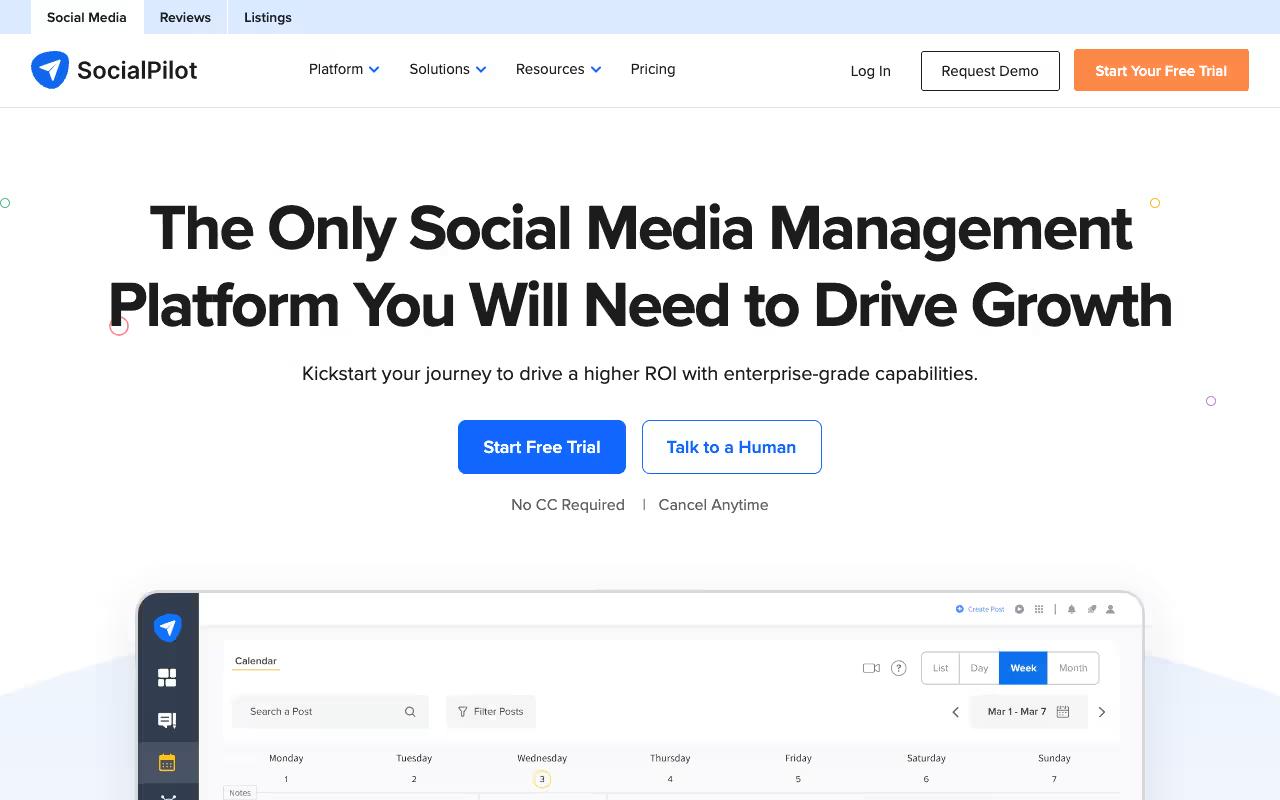
SocialPilot is an all-in-one management platform for agencies and brands scaling social, with bulk CSV scheduling up to 500 posts, a content library, client and manager approvals, white-label reports, and an AI Pilot for captions and brand voice. It's priced and packaged for small-to-midsize agencies who need a lot of accounts without enterprise pricing, which is exactly why Loomly refugees keep landing here.
Reddit sentiment is mixed. One r/SocialMediaMarketing commenter called it budget-friendly and good for straightforward scheduling but warned about "questionable business ethics," while another said it's a solid, long-established tool supporting most major networks. A separate r/socialmedia user reported a sharp drop in video views. On TrustPilot, a nonprofit user praised support responding "in 24 hours or less," though another review was titled "Refuse to give a Partial Refund."
Pricing: Essentials $30/mo, Standard $50/mo, Premium $100/mo, Ultimate $200/mo, and Enterprise custom, per SocialPilot's plans page. Annual billing saves about 15%.
On Capterra, SocialPilot holds 4.4/5. Reviewers commonly praise intuitive scheduling workflows and reliable multi-platform social media management and note occasional glitches and constraints in advanced analytics and reporting flexibility. See the Capterra reviews page.
On G2, SocialPilot holds 4.5/5 across 846 reviews. Reviewers commonly praise easy-to-use interface and centralized social media scheduling and management and note limited customization and depth of reporting and analytics compared to more advanced tools. See the G2 reviews and pros and cons pages.
Verdict: Strong value for agencies managing many accounts on a budget, provided you're comfortable with its billing reputation.
9. Sendible
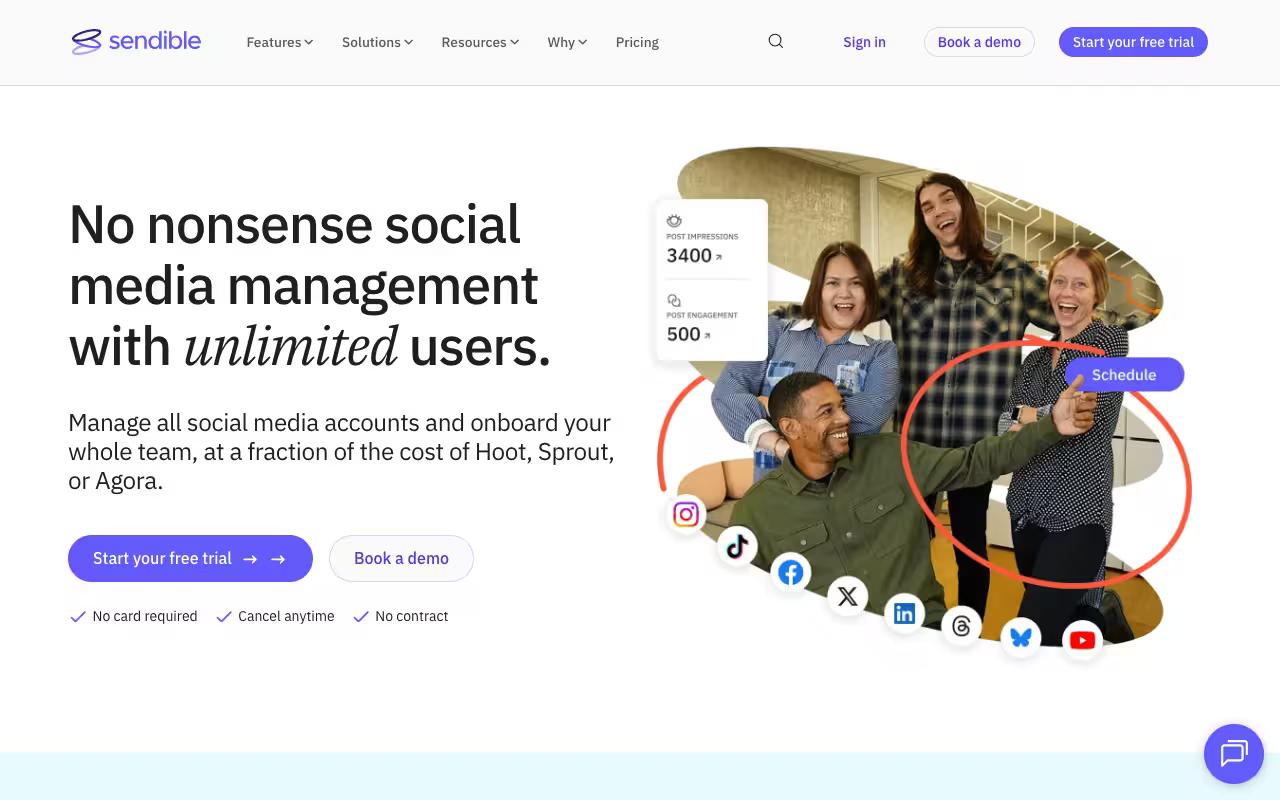
Sendible is an all-in-one platform for managing many accounts at scale, relied on by over 30,000 agencies, marketers, and brand managers according to its homepage. Bulk import, smart queues for evergreen content, a priority inbox, a Canva integration, and workspace-based organization make it a fit for agencies handling multiple clients or locations. All plans include unlimited users, which is unusual and useful for growing teams.
Pros:
- Easy to use, even for a one-person marketing team or small agency
- Efficiently manages multiple clients, locations, and platforms in one place
- Content calendar and 'best time to post' auto-scheduling are well liked
- Built-in Canva integration for quick graphic edits before posting
- Seen as good value compared to pricier competitors like Hootsuite
- Customer support/Customer Success Managers frequently praised as helpful
Cons:
- Occasional post-publishing reliability issues reported, especially on Instagram
- Billing/refund practices criticized (customers charged automatically with a strict no-refund policy)
- Difficulty downgrading subscriptions, with confusing steps and loss of functionality/users
- Post-sales support described as unhelpful by some despite generally positive support reviews elsewhere
- Advanced agency features like white-label reporting and approval workflows require significantly pricier plans
Reddit is where the caution shows up. A "Best Sendible alternative in 2025?" thread opens with "Too many post fails lately, especially on Instagram," and commenters recommend Planable, Later, or RecurPost rather than defending it. TrustPilot is more favorable at 4.2/5 from 23 reviews, praising ease of use for one-person teams and multi-location management, with Customer Success Managers frequently called helpful.
Pricing: Core $35/mo, Plus $99/mo, Premium $199/mo, Elite $299/mo, and Enterprise $750/mo, per Sendible's pricing page. Annual billing saves 15%, and there's a 14-day free trial.
On Capterra, Sendible holds 4.5/5. Reviewers commonly praise user-friendly scheduling and approvals workflows that save time for agencies and small businesses and note mobile app instability, limited functionality versus desktop, and higher pricing for smaller teams. See the Capterra reviews page.
On G2, Sendible holds 4.5/5 across 899 reviews. Reviewers commonly praise ease of use and time-saving post scheduling for managing multiple social media accounts and note glitches and limitations in certain integrations, especially instagram and linkedin, plus occasional publishing and connectivity issues. See the G2 reviews and pros and cons pages.
Verdict: A good multi-client agency tool with unlimited users, but stress-test Instagram publishing reliability before you commit.
10. Hootsuite
Hootsuite is an all-in-one management and social intelligence platform combining publishing, a unified inbox, deep social listening across 30-plus networks and 300-plus review sites, analytics, and competitive analysis. It's aimed at large brands and their social and comms teams. The listening and competitive-intelligence depth is where it earns its keep.
Pros:
- Unified inbox consolidates comments/messages across platforms, saving significant time (LinkedIn reviewer)
- Bulk composer speeds up scheduling a month of content in under an hour (LinkedIn reviewer)
- OwlyWriter AI helps draft usable captions (LinkedIn reviewer)
- Best Time to Publish feature reportedly improves engagement (LinkedIn reviewer)
- Handles multiple accounts well for larger budgets/agencies (Reddit)
Cons:
- Expensive/pricey compared to alternatives, especially for small agencies and startups (Reddit)
- Poor customer support with long response times and reliance on AI chatbot (Trustpilot)
- Billing problems: charges continuing after cancellation, refund/receipt difficulties (Trustpilot)
- Reliability issues and bugs, e.g. video upload and posting errors (Trustpilot)
- UI feels dated in places (LinkedIn)
- Ethical concerns over reported work with U.S. ICE prompted some customers to cancel (Trustpilot)
The reviews split hard by source. A LinkedIn strategist testing it called the Unified Inbox the real time-saver, said the bulk composer scheduled a month of content in 45 minutes, and reported the Best Time to Publish feature lifted engagement 12%, with the caveat that the UI "still feels a bit 2018 in places." On Reddit, commenters agree it works for larger budgets but is pricey for small agencies and startups. TrustPilot is brutal at 1.3/5 from 554 reviews, dominated by billing complaints (charges after cancellation, refund difficulty), poor support, and reliability bugs.
Pricing: Standard $99/user/mo, Professional $199/user/mo, Advanced $399/user/mo, and Enterprise custom, per Hootsuite's plans page (billed annually). All paid plans include a 14-day trial.
On Capterra, Hootsuite holds 4.4/5 . Reviewers commonly praise centralized scheduling and management of multiple social media accounts and note pricing concerns and limitations in advanced features and integrations. See the Capterra reviews page.
On G2, Hootsuite holds 4.3/5 across 7,355 reviews . Reviewers commonly praise comprehensive social media management capabilities and robust analytics and note learning curve and occasional usability and performance issues. See the G2 reviews and pros and cons pages.
Verdict: Justifiable for large brands that need serious social listening and competitive intelligence, but the price and billing reputation make it a hard sell for small teams.
11. Later
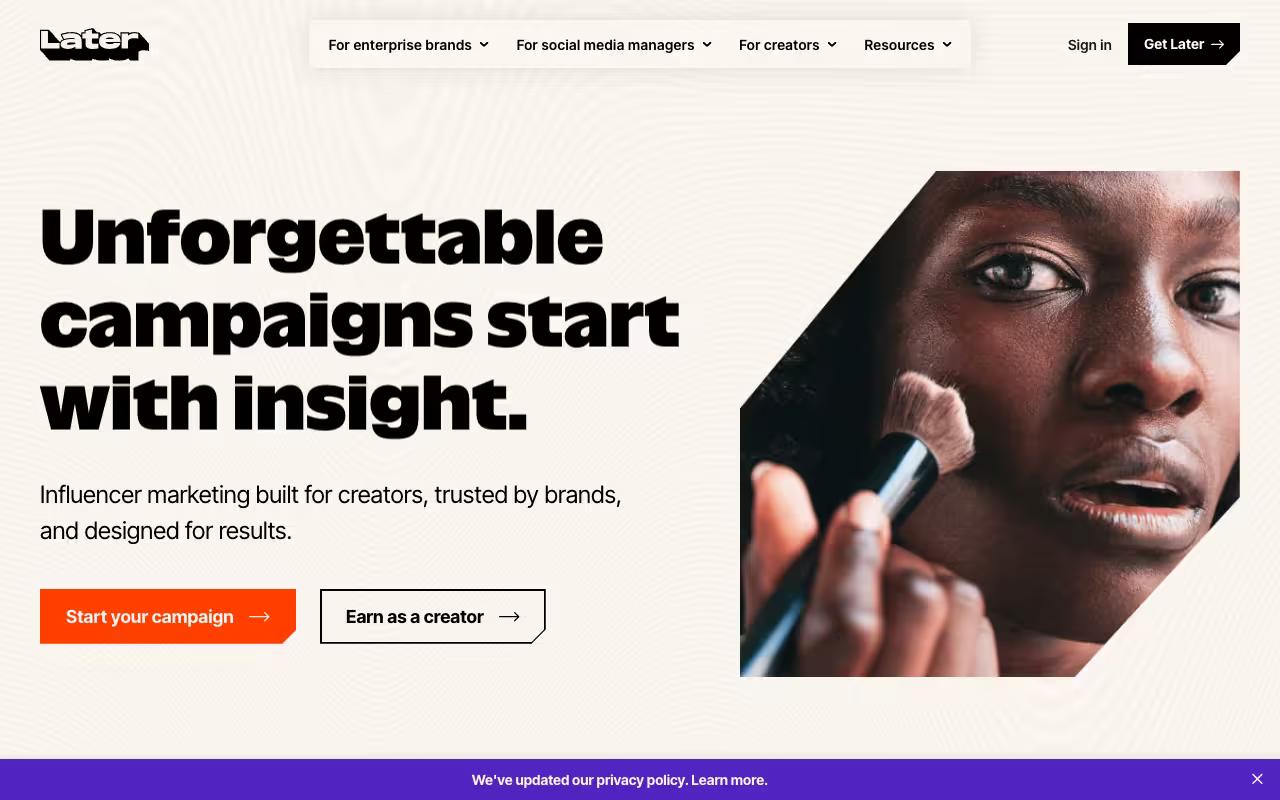
Later pairs social media management with influencer marketing tools, offering a drag-and-drop visual scheduler, a Linkin.bio page, analytics, and creator-matching software powered by its EdgeAI. It's built for brands and creators running influencer campaigns alongside their own social, plus full-service programs where Later's team manages creator campaigns for you. The visual, Instagram-first workflow is its heritage.
Pros:
- Easy to use and visually organizes content scheduling (praised by some Trustpilot reviewers)
- Reliable channel connections and reporting for some long-term users
- Some in-house/agency users report years of trouble-free use with helpful customer support
- Useful for standard Instagram workflows: posts, reels, first-comment hooks, thumbnails
Cons:
- Widespread complaints of large annual renewal charges with no warning and refusal to give refunds, even for canceled/unused accounts
- Cancellation process seen as difficult (e.g., desktop-only in some cases)
- Instagram account connection can be unreliable and require many attempts
- Video uploads reported as very slow
- Platform/interface described as outdated and lacking modern features (Reels, UGC campaigns)
- Instagram thumbnail feature and scheduling described as buggy/clunky by some Reddit users
- Some users report decreased engagement when posting via Later vs. native scheduling
Pricing: Starter $18.75/mo, Growth $37.50/mo, and Scale $82.50/mo, all billed yearly, per Later's pricing page. There's a 14-day trial and no permanent free tier.
On Capterra, Later holds 4.4/5. Reviewers commonly praise straightforward visual content calendar, bulk uploads, and helpful hashtag and media management features and note limited platform coverage, missing advanced workflows and collaboration features, and inconsistent customer support quality. See the Capterra reviews page.
On G2, Later holds 4.5/5 across 10 reviews. Reviewers commonly praise intuitive interface and easy-to-use scheduling that saves time across multiple social platforms and note scheduling limitations, account connectivity issues, and instagram-specific publishing and analytics constraints. See the G2 reviews and pros and cons pages.
Verdict: A fit for creators and brands running Instagram-heavy influencer campaigns, but set a calendar reminder for the annual renewal given the billing complaints.
12. Buffer
Buffer is a social media workspace for publishing, creating, engaging, and analyzing across a wide set of channels including Bluesky, Threads, and Mastodon. It's built for creators, small businesses, and agencies who want straightforward scheduling with an AI assistant, a link-in-bio Start page, and approval workflows. Per-channel pricing and a genuinely usable free plan make it easy to start small.
Pros:
- Easy to use and intuitive interface
- Saves significant time on scheduling social posts
- Good value/pricing compared to alternatives like Hootsuite
- Responsive customer support noted by some users
- Supports newer platforms like Bluesky and Facebook groups
Cons:
- Account connection issues and frequent need to reconnect/refresh social accounts
- Scheduled posts sometimes fail to publish reliably
- Some features (like image adjustment or comment replies) are limited or clunky
- Can feel expensive at higher tiers/more accounts relative to competitors
- Poor customer service experiences reported by some users
Reddit sentiment is generally positive: a long-time pro said Buffer is better supported and easier to use than Hootsuite, whose interface "looks like it hasn't changed since the early 00s," and another praised the price and the ability to connect Bluesky and Facebook groups. TrustPilot is more mixed at 3.4/5 from 109 reviews, with fans calling it easy and time-saving while critics cite connection problems and post failures ("Too Unreliable to Trust").
Pricing: Free at $0 (up to 3 channels), Essentials at $5/channel/mo (billed yearly), and Team at $10/channel/mo (billed yearly), per Buffer's pricing page. Per-channel rates drop at higher channel counts.
On Capterra, Buffer holds 4.5/5. Reviewers commonly praise simple, user-friendly social media scheduling and publishing and note constraints around in-depth reporting features and platform-specific functionality. See the Capterra reviews page.
On G2, Buffer holds 4.3/5 across 1,039 reviews. Reviewers commonly praise ease of use and intuitive social media scheduling interface and note limited advanced analytics and customization options compared to some competitors. See the G2 reviews and pros and cons pages.
Verdict: The easiest, most affordable entry point for creators and small teams, with the caveat that account connections can need babysitting.
FAQ
What Is the Best Agropulse Alternative for B2B LinkedIn Marketing?
For B2B teams focused on LinkedIn thought leadership and employee advocacy, Ordinal and Oktopost are the two most targeted options. Ordinal leans into LinkedIn-specific features (personal and company tagging, realistic previews, auto-engagement, and a Notion-style editor) with plans from $95/mo, while Oktopost centers on advocacy leaderboards and CRM pipeline attribution starting at $8,000/year. Ordinal fits teams that want to enable a handful of execs affordably, while Oktopost fits enterprises that need advocacy tied to revenue reporting.
Which Social Media Tools Offer a Free Plan?
Among the tools here, Zoho Social, CoSchedule, and Buffer all offer a free-forever tier. Zoho Social's Free plan covers 1 brand and 6 channels for 1 user, CoSchedule's Free Calendar covers 1 user and 1 social profile with up to 15 scheduled messages, and Buffer's Free plan connects up to 3 channels with 10 scheduled posts per channel. Loomly, Later, Sendible, and others offer trials rather than permanent free plans.
Why Do Some Tools Have High G2 Scores but Low Trustpilot Ratings?
Several tools on this list show a wide gap: Hootsuite is G2 4.3/5 from 7,751 reviews but TrustPilot 1.3/5 from 554 reviews, and Later is G2 5/5 from just 10 reviews but TrustPilot 1.4/5 from 345 reviews. TrustPilot reviews for these tools skew heavily toward billing and refund complaints, which tend to attract frustrated customers, while G2 draws a broader mix of everyday users. Read both, and weigh the review count: a rating from thousands of reviews carries more signal than one from ten.
Related Posts
Looking to learn more? The below posts may be helpful for you to learn more about social media and content marketing.